
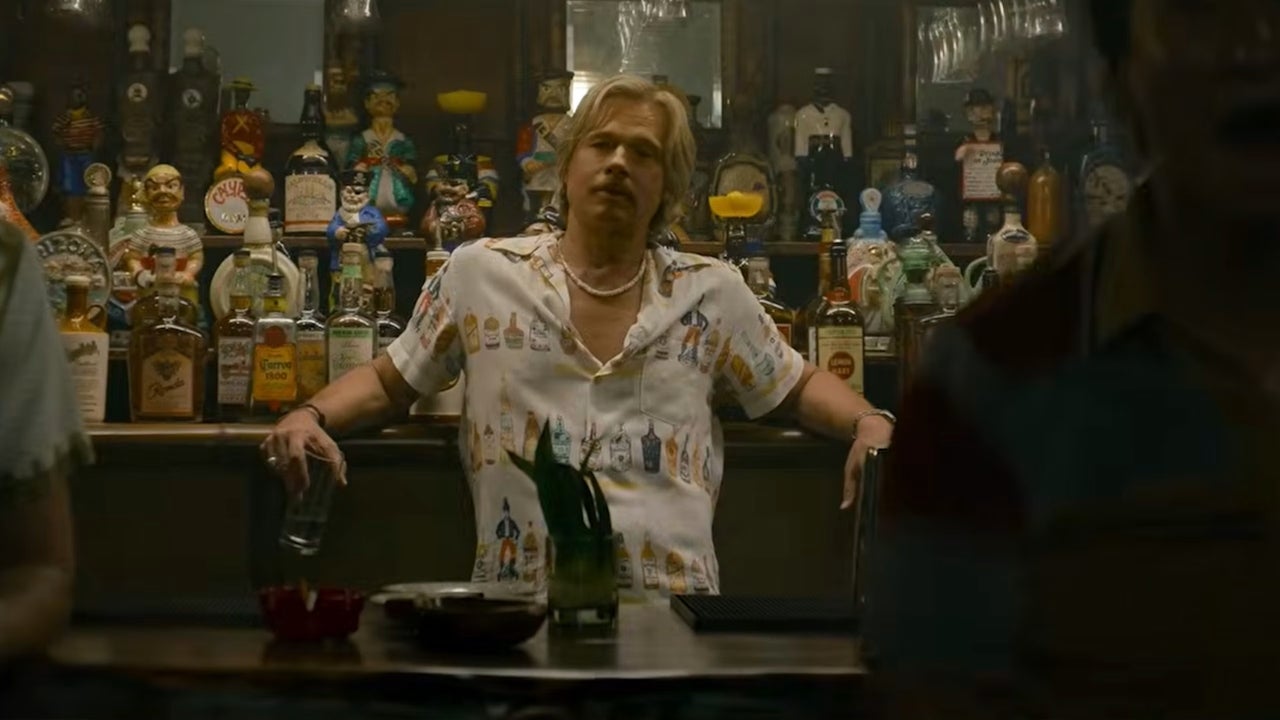
Quentin Tarantino built a long, successful career out of listening to himself talk. He writes reams and reams of dialogue, story progression be damned, which was novel in the 1990s. His early films films like “Reservoir Dogs” and “Pulp Fiction” removed the artifice from the classic and/or cult classic crime films that inspired him, like Ringo Lam’s “City on Fire” and Fernando Di Leo’s “The Italian Connection,” but preserved the style and swagger. Instead of bounding from plot point to plot point, Tarantino let his scenes linger, until there was nothing left for his stylish career criminals to do but prattle about every stray thought that filled their heads, whether it was about Quarter Pounders or Madonna’s “Like a Virgin.”As a director, Tarantino loves those empty spaces. He proved he can shoot all-timer action sequences in “Kill Bill” and “Death Proof,” but that didn’t stop him from letting his characters shoot their mouths off for pages anyway. By the time he got to “Once Upon a Time in Hollywood,” it seemed like he finally dropped all the pretense and made his ultimate hangout movie. An actor and a stuntman, drifting from one industry anecdote to another, until they finally murdered the Manson Family as an afterthought. Nevermind what it meant. It was just something Tarantino wanted to do, a fantasy to live out surreptitiously, much like his script for “True Romance,” where a kung fu film fan proves to be such a virile and macho ladies man that even Elvis Presley’s ghost looks up to him. The sequel to “Once Upon a Time in Hollywood” has all of Tarantino’s voluminous speeches and narrative sidetracks, but this time it’s directed by David Fincher, whose films are stylish but infinitely more focused. It’s refreshing to see what someone else can do with Tarantino’s screenplays again. Fincher films dialogue as a means of narrative propulsion, so “The Further Mis-Adventures of Cliff Booth” has a breakneck pace even though, for most of the movie, not much actually happens. “Cliff Booth” stars Brad Pitt, reprising his role as a charismatic, laid back stuntman who also loves killing. He killed his wife with a harpoon gun and got away with it, which “Once Upon a Time in Hollywood” left slightly ambiguous but Tarantino confirmed in the novelization. Some people had a hard time believing that Booth was a wife-murderer, because he seems so nice, but that’s officially who he is. He’s effortlessly charming and then kills a person and feels nothing, and for some reason that’s not supposed to detract from his likability. It’s a, let’s say, “interesting” stance to take in an industry where alleged abusers are given countless opportunities to redeem their careers while victims are forced into the background. A lot of people loved Cliff Booth in his first feature film appearance. Some of us didn’t, but it’s easier to root for him in his “Further Mis-Adventures,” where he’s a self-appointed avenging angel of Hollywood’s favorite, arguably less morally compromised celebs. Set in the summer of 1977, the film finds Booth zooming across Los Angeles from one gig to another, slinging margaritas at Tiki Bars, running a film projector at The New Beverly (which Tarantino now owns), and barrel-rolling at demolition derbies. But his most interesting side hustle is solving illegal problems for his old Hollywood buddies, like retrieving a stolen Oscar and stopping professional hitmen from doing their business the wrong way. Fincher and Tarantino’s film has a lot of casual dialogue, with Booth sharing stories about Ralph Meeker’s secret thespian weaponry, and talent agent Karen Crosby (Elizabeth Debicki) waxing reductive about film criticism, arguing that movies aren’t art, they’re hamburgers: enjoyable but meaningless. It’s a dare, a speech like that. Film critics are invited to take the bait and go whole hog to analyze the deeper meaning of “The Further Mis-Adventures of Cliff Booth” or embrace Crosby’s perspective and accept the film as an enjoyable trifle. Of course, there’s also a third option: acknowledging that whether it’s art or artless, Fincher and Tarantino’s latest is just okay. It’s a tasty hamburger, but, to use an analogy Angeleno legend Cliff Booth would understand, it’s no Apple Pan. “The Further Mis-Adventures,” like many Tarantino joints, wears its influences on its sleeve. There’s a lot of Robert Altman’s neo-noir “The Long Goodbye” in here, and even more of Brian Trenchard-Smith’s “Stunt Rock,” a film where another rakish stuntman uses all his tricks to woo the woman he loves. Booth doesn’t get dragged into Hollywood’s dark underbelly, he already lives there, but he thinks it’s a groovy place to hang your hat and he doesn’t consider an international murder plot any reason to stop wooing Karen Crosby. At a Shakey’s Pizza, no less. It’s amusing to watch Booth strut through film sets and country clubs, proving he’s the most interesting man in every room. But it’s also undeniably preening and self-satisfied, more enamored with the antihero’s vibes than anything resembling a story or a point. “Cliff Booth” invites us to hang out in Hollywood in the 1970s, which we are happy to do, but eventually the movie needs to get back around to its own day job — being an actual movie, with a narrative and everything — and that part amounts to very little. It was a mistake to get too invested. Cliff’s the kind of guy you want at your party but not the guy you want to emulate, unless you fantasize about drifting through life collecting urban legends, while earning nothing of consequence for yourself except a shiny reputation that belies the darkness in your soul. Of course, Fincher and Tarantino’s film is a fantasy. You can tell because Elizabeth Debicki Crosby finds street parking half a block away from a movie premiere at the Westwood Village Theater, which is easily the least plausible thing Tarantino ever put in a screenplay, up to and including strip club vampires. It’s a hypermasculine pipe dream where the protagonist is good at everything and sexually irresistible. That part gets old quickly. But it’s also a wistful daydream about living in an interesting era and visiting iconic locales, and on that level “The Further Mis-Adventures” is genuinely transportive. David Fincher films Tarantino’s world with vibrant verve, reminding us all that beneath his oeuvre’s characteristic grit and grime, he’s always been a playful storyteller, forever searching for new ways to surprise us. He rescues this clinically chillax story from its own dangerously low blood pressure, and his cast is in on the action. Pitt is in full smarm mode, which he’s good at, but which isn’t nearly as complex as Tarantino’s script likes to think. Debicki is electric but she’s saddled with a character whose whole purpose is to be superficially independent, but only so it’s more of a victory when she falls for Booth’s craggy beach bum flirtations. Scott Caan rounds out the main cast as a TV star whose fictional filmography is more interesting than the film we’re actually watching, but more than anyone he stands out in a role that could send his career into the stratosphere if he plays his cards right. “The Further Mis-Adventures of Cliff Booth” is accurately titled. It’s mostly just more Cliff Booth stuff, and if you love Cliff Booth, you’ll probably embrace this excuse to bask in his casually homicidal teddy bear aura. If you aren’t in love with Tarantino’s late-era vibe-coded storytelling, replete with terminal self-insert smugness, you could still get swept up in Fincher’s bracing, handsome filmmaking. Either way, by the time the credits roll, it’s clear this story didn’t mean anything to Cliff Booth, and by extension much of anything at all. That’s when you might find yourself wishing films were art again, instead of heart-clogging, sloppy chili cheese monstrosities, nestled between a couple soggy, messy buns. “The Further Adventures of Cliff Booth” premieres in Imax theaters on Nov. 25, before a Netflix streaming release on Dec. 23.
‘The Further Mis-Adventures of Cliff Booth’ Review: Tarantino and Fincher Make an OK Movie
Full Article
Original Source
Read the full article at Thewrap →KhanList aggregates and links to publicly available news content. We do not host full articles from third-party sources. Always verify important information with original sources.