
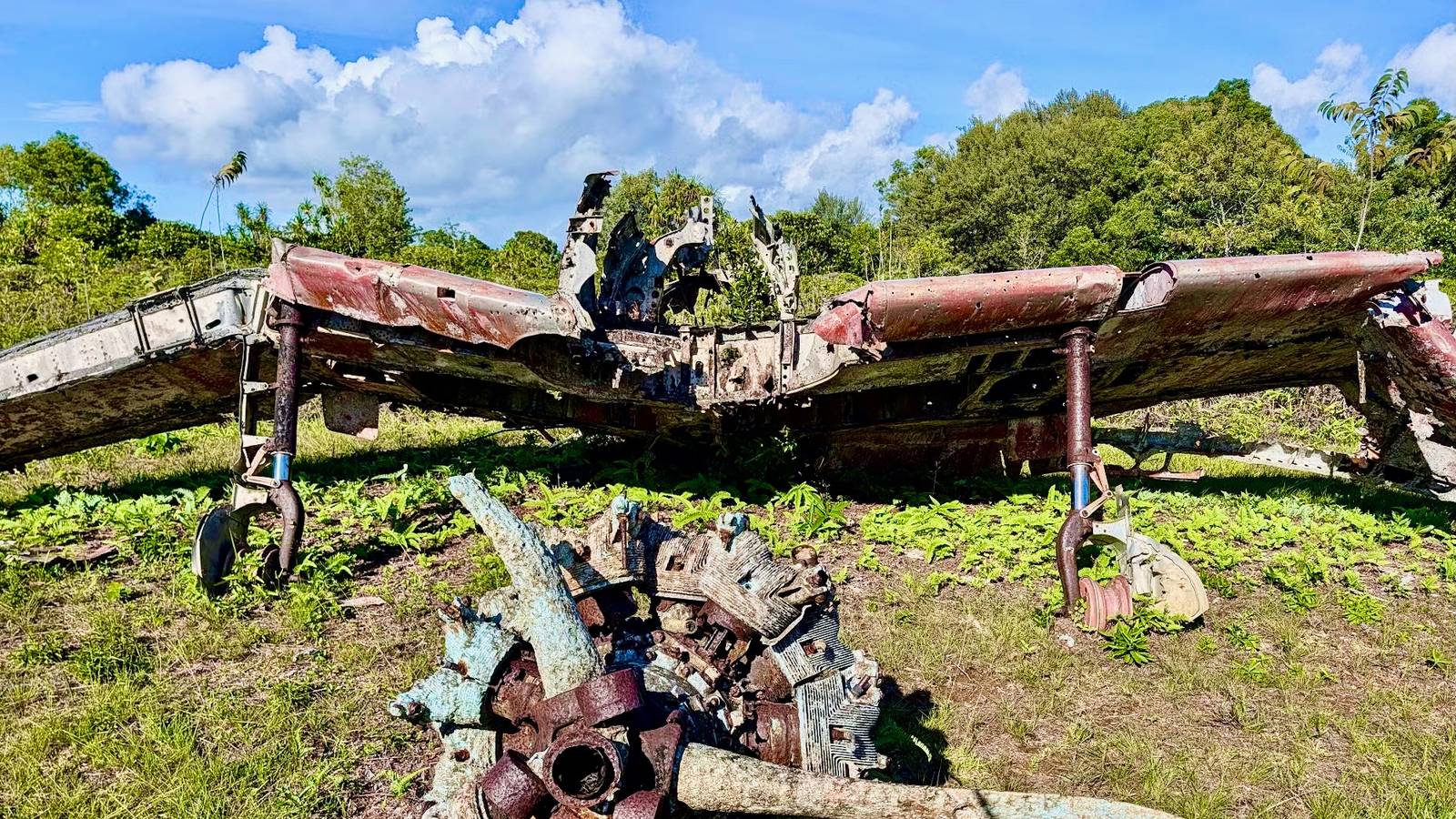
Published Nov 26, 2026, 12:00 AM EST Aaron is an aviation enthusiast and world traveler with a deep interest in aerospace history and technology. He has traveled around the world numerous times, often incorporating visits to aviation museums and historic aircraft collections into his journeys. A native of New Zealand, he is an expert in aviation and maintains a broad interest in a variety of other subjects. It is well known that many World War II fighter wrecks lie across the islands of the Pacific. Many of these are lost, forgotten, or abandoned, left to rot in jungles. Others lie in shallow waters, becoming refuges for marine life and attractions for today's divers. In October and November, I visited the island nations of Palau and the Federated States of Micronesia FSM (Yap Island), where the remains of WWII are everywhere. Only a very limited number of rather niche divers seem to be the only true tourists Yap attracts today. While various Japanese bunkers, radio buildings, light-rail trains, and guns are found across Palau, most of the fighting is on the smaller island of Peleliu. Unfortunately, I didn't visit Peleliu, although I did visit Yap. Peleliu was the site of one of the deadliest Marine operations. Conversely, invasion plans for Yap were scrapped, and the island was bombarded and bypassed. Today, visitors can see Japanese WWII aircraft lying, reclaimed by the jungle where they were destroyed. Yap Island In World War II Credit: Aaron Spray The island of Yap was controlled by Spain until the Spanish-American War of 1898, when it lost Cuba, Puerto Rico, the Philippines, and Guam to the United States. Spain was left with a large expanse of small Micronesian islands that the United States did not take over but could not defend. It promptly sold the islands to the emerging German Empire. Credit: Aaron Spray As World War I broke out, Japan quickly seized most of the German Pacific islands, although Australia took Nauru and New Guinea and New Zealand took German Samoa. The former German islands were then run by Japan under the League of Nations South Seas Mandate. It appears from Japanese colonization of the islands that Japan planned to integrate these islands, including Yap, into Japan proper, although this never happened. Credit: Aaron Spray When the Pacific War broke out, Japan had managed Yap for around 35 years and was busy populating the island. During the war, it fortified the islands to create a defensive ring to defend the Japanese home islands. The US Navy launched its famous island-hopping campaign to bring its bombers within range of the home islands. For a brief period of time in 1944, Yap found itself at the center of the Pacific War. Japanese Defenses On Yap Island Credit: Aaron Spray The Japanese military buildup on Yap began relatively late, and it was not heavily fortified before the Pacific War. The island lacked a good natural harbor and had few natural defensive strong points. The most significant Japanese installation was the airfield at Lamer, located adjacent to the modern Yap International Airport. The runway was built using reef material, although locals told me that the Japanese also used thousands of their famous money stones (Rai). By April 1944, the main strip was completed while some of the supporting infrastructure was unfinished. The site's main purpose was to establish an air transit and staging point for Japanese aircraft moving across the region. The combined Japanese Army and Navy garrison on the island totaled around 4,000 to 5,000 men. The US had intended to invade the island, but instead opted for bombing, neutralizing, and bypassing it. By May and June, Japan was deploying aircraft to the island. American reconnaissance reported 24 Japanese fighters, six dive bombers, two medium bombers, and six night fighters. The aircraft soon became a target for American long-range B-24 bombers. By September, Americans were encountering little or no aerial resistance from the island. The Japanese Airfield Today Credit: Aaron Spray After the war, the bombed-out Japanese airfield appears to have been abandoned. The forests regrew and reclaimed the airfield, while locals treated the runway as a roadway and built their homes along it. Today, some Japanese wrecks are located next to homes. Visitors can go and explore the old airbase and find the wrecks, as I did. There are World War II marker signs at most of the notable wrecks, but some are not marked. The signs are often not maintained and can be lost over time. Almost all the land on Yap is privately owned, and visitors are expected to ask landowners for permission before seeing the wrecks, even if they are marked and signed. In all, I found the wrecks of around eight Japanese aircraft, including a Mitsubishi G4M 'Betty' bomber. Bizarrely, the Betty bomber now lies next to a Boeing 727 that crashed next to it decades later. The runway is in poor shape, and it is extensively potholed and overgrown. It is lined with abandoned cars rotting in the jungle. Yap may be famous for its stone money, but having explored the island, it is hard not to also associate it with endless abandoned, decaying cars. Aircraft wrecks can generally be found between 150 and 300 feet (45 to 91 meters) from the runway. The Japanese Wrecks Visible Credit: Google Maps l Aaron Spray The Mitsubishi G4M bomber is one of the most notable wrecks. It was a medium bomber/torpedo bomber, with Japan building 2,435 examples of the type. It had a crew of seven. Another notable wreck is a Japanese Nakajima B5N Torpedo Bomber. These were three-man carrier-based torpedo bombers, of which Japan built 1,149 units. A number of Mitsubishi A6M Zero fighters can also be found. I found two small tails of wrecked aircraft that I assumed were Zeros, but they were unmarked, and I couldn't tell for sure. The Google Maps screenshot above marks the locations on the old airfield where I found Japanese wrecks. There are likely many more to be found, but this is private land, and the jungle is extremely thick, making movement and visibility very difficult. Japanese aircraft on Yap (per 1944 US reconnaissance) Quantity Fighters 24 Dive bombers 6 Medium bombers 2 Night fighters 6 Japanese aircraft I found 8 All around the airfield, large bomb craters from US bomb strikes are visible. I am used to finding these bomb craters in Vietnam. Many are visible at Vietnam's historic site of My Son, but they always seem to be difficult to make out in photos, especially when they are surrounded by thick jungles. One of the aircraft wrecks I found was next to a bomb crater, and I had to climb in and out of the crater to get around what was left of the aircraft. Other Military Ruins On The Island Credit: Aaron Spray Across the island, I saw many other remains of WWII. These include a well-marked Japanese Type 88 75mm anti-air gun preserved next to some Zero fighters. On the main hill overlooking the main settlement of Colonia, I found four more Japanese guns with the barrels destroyed. These were marked, but they are overgrown, and the signs have largely disappeared. Lost on the island is a Japanese lighthouse that became target practice for American pilots. A bomb disposal unit that happened to be on the island showed me pictures of it; I looked for it but failed to find it. But perhaps the most notable other wrecks are the remains of US Vought F4U Corsair fighter planes and B-24 bombers. These are typically less well-preserved, with sometimes just the engine or propellers remaining. I saw some houses with propellers on display, presumably from US or Japanese bombers. Two propellers are on display at Pacific Missionary Aviation's (PMA) hangar at the main airport. I asked the pilot about them; he said one was a US B-24 propeller, and the other was a B-29. US aircraft wrecks tend to have memorial plaques for the pilots, although they are not maintained and are decaying. Memorial plaques are absent from Japanese wrecks. Mostly Abandoned But Also Remembered Credit: Aaron Spray The WWII wrecks are a mixture of abandoned, forgotten, marked, and commemorated. Particular attention has been given to locating and commemorating American aircraft. One plaque I found tells the tale of Lt. Zack F. Lillard and the remains of his F6F-5 Hellcat that he operated from the USS Enterprise CV-6. It reads, "Following the war, Zack's body and the wreckage were not found, and he was declared missing. The partial wreckage of his plane was located in 2008." It's clear an effort was made in the 2000s to locate and mark the wrecks, but many of these signs have been left abandoned. It should be noted that there are practically no tourists on Yap. Foreigners on Yap are almost exclusively on business, government, military, or diving. The divers I saw didn't seem interested in exploring the island. I was the only backpacker on the island, and expats there told me they rarely or never see such tourists visiting Yap. When I was on Yap, I met and had drinks with a bomb disposal group made up mostly of contracted retired US military personnel. Their task was to find and gather unexploded WWII ordnance and blow it up. They informed me that they found and removed live rounds from aircraft pictured in this article, although I am not sure exactly which ones. That long-abandoned ammo was detonated while I was exploring the island looking for WWII wrecks.
The Forgotten Pacific Airfield Where WWII Fighter Jets Are Being Reclaimed By The Jungle
Full Article
Original Source
Read the full article at Simpleflying →KhanList aggregates and links to publicly available news content. We do not host full articles from third-party sources. Always verify important information with original sources.