
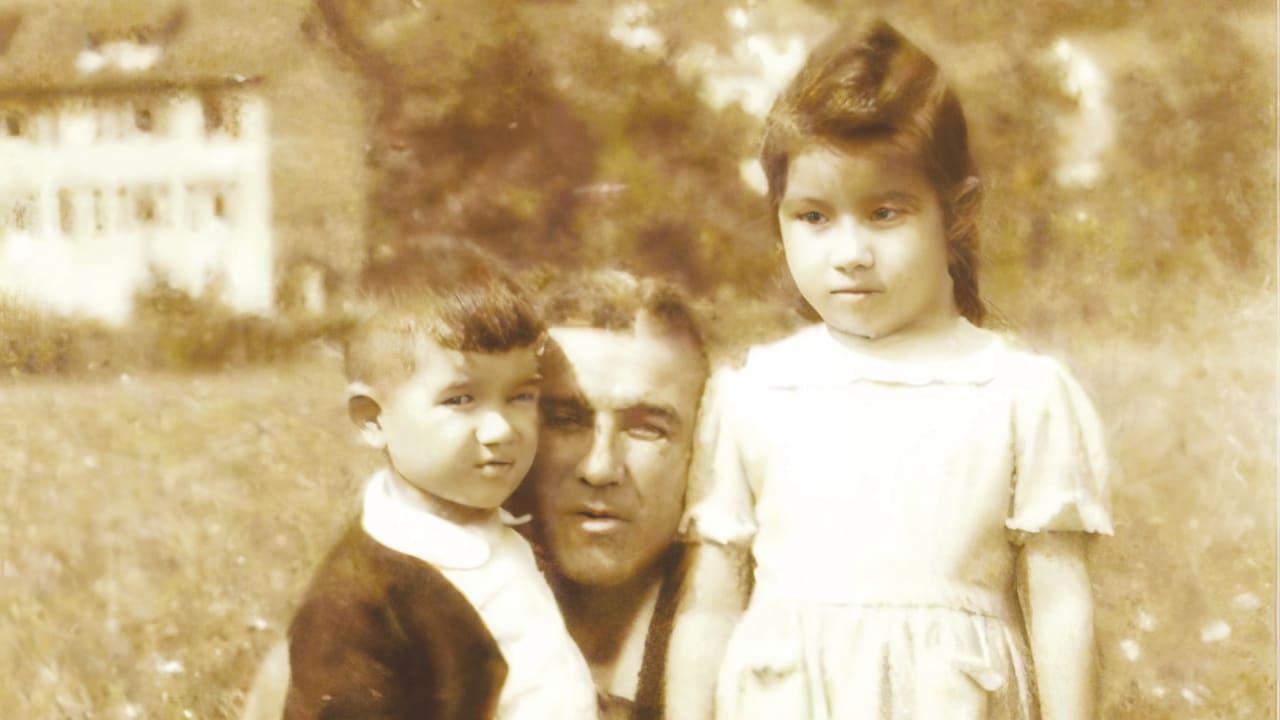
OCTOBER 18, 2026 02:56Renate Quastler kept a tantalizing and expensive secret. She never told her family about the illustrated diary begun as a young girl in wartime Japan. Yet she never threw it away, either.Renate was born in Stuttgart in 1933, the same year that Hitler came to power.Six years later, her Jewish father, Ernst Quastler, her Christian mother, Else, and six-year-old Renate escaped Germany for Japan, where Ernst had been offered work by German industrialist Willy Rudolf Foerster, and where Renate kept her diary at the peak of the war.More than eight decades later, after Renate’s death, that hidden diary would unexpectedly open a new chapter in the remarkable story of Foerster, and reopen questions about the German industrialist in wartime Tokyo whose rise and fall, and his role in helping Jewish refugees, are still being pieced together.Handwritten in German, Renate filled more than 120 pages with drawings and watercolors, photographs, pressed flowers and plants, and the everyday observations of a Holocaust refugee child with no awareness of her Jewish identity.Renate Quastler’s illustrated wartime diary as it appeared in the eBay listing. (credit: Courtesy Julie Quastler / eBay)Renate records the destruction of her family’s Tokyo home in the air raids of April 1945, both pleasant vacations and emergency evacuation in the mountain resort town of Karuizawa, postwar trips to barter for food, and then the bewildering new world of the American Occupation – Coca-Cola, nylon stockings, and jitterbugging.Among the surviving memorabilia are even her commuter train passes, with the Quastler name printed in Japanese. And among the names in Renate’s diary is one that would reopen a nearly forgotten history: the wife of Renate’s father’s employer, Hideko Foerster.Hideko came from a long lineage of doctors, and while the opposite in temperament to her headstrong husband, she was quietly self-assured with resources of inner strength to see her through a long life of unfathomable wealth and the complete dissolution of that fortune.Her husband, Willy Rudolf Foerster, was a German anti-Nazi industrialist who built one of the country’s most successful foreign-owned manufacturing businesses, based in Tokyo.Documents and photographs discovered by his biographer, Dr. Clemens Jochem, show that his factories employed more than a thousand people, including foreign workers from Korea and Southeast Asia and, astonishingly, a small number of Jewish refugees fleeing Germany and Nazi-controlled Europe – including Renate’s family.Quastler was entrusted with a key position: he became Foerster’s Betriebsleiter (general manager).Working closely with Tokyo’s Jewish Refugee Committee, Foerster helped Jewish families get employment, entry permissions, and other formalities they needed to reach Japan; in documented cases, he also paid their travel costs.Jewish refugees were not hidden away at the margins of his enterprise. Some were placed in important managerial positions.The Foerster family in the 1960s, shortly before Willy Rudolf Foerster’s death in 1966 at age 60. (credit: Courtesy Foerster family)A trail of documentsThe documented trail Foerster left behind is enormous and keeps on growing. Jochem spent more than a decade investigating Foerster’s story, working through thousands of pages of records discovered in archives in Japan, Germany, the United States, and Israel.One document in particular caught his attention: a 1959 letter from Foerster to Fritz Bauer, the attorney-general in Frankfurt who played a crucial role in bringing Adolf Eichmann to justice, a key Nazi architect of the Final Solution.Foerster provided Bauer with information about the wartime persecution of prisoners placed aboard German blockade-running ships in Japan. He also drew Bauer’s attention to what he believed was false testimony by former German diplomats that had obstructed efforts to clear his own name of Nazi associations.In the letter, Foerster pointedly described how he had employed Jewish refugees fleeing Nazi persecution, making it unmistakable where he had stood during those years.“I really was astonished,” Jochem recalled, “because if Foerster’s story was true, he seemed to be some sort of second Oskar Schindler.”What began as curiosity became years of meticulous archival investigation.Foerster with the Quastler family at Imre Quastler’s Lutheran baptism, in Omori, Tokyo, Feb. 11, 1941. (credit: Courtesy Quastler family)In 2017, Jochem published his findings in The Foerster Case: The German-Japanese Machine Factory in Tokyo and the Jewish Relief Committee (Der Fall Foerster: Die deutsch-japanische Maschinenfabrik in Tokio und das Judische Hilfskomitee).Jochem’s research also reconstructed the campaign that destroyed Foerster’s reputation and fortune. At the center of it was Adolf Hitler-appointed Josef Meisinger.Infamously called the “Butcher of Warsaw,” Meisinger was sent to Tokyo in 1941 as a Gestapo and Security Service liaison attached to the German Embassy.Foerster, who kept his distance from official Nazi circles in general, and Meisinger in particular, vehemently opposed National Socialism and, according to Jochem’s research, continued employing Jewish refugees.That willingness to oppose authority was how Foerster’s daughter, Erica, now 85, remembered her father.“My mother, Erica, always described him as someone who followed his own head,” Jesse Foerster told the Magazine. “If he felt something was wrong, he acted accordingly. She believed he knew that he was putting himself in opposition to the Nazi regime and that this could become dangerous for him. And even when his own situation became increasingly difficult, he continued.”In May 1943, acting at Meisinger’s instigation, the Japanese arrested Foerster on accusations of spying for the Soviet Union. He was imprisoned and tortured for more than a year and forced during his captivity to surrender his business for a fraction of its value.Released in June 1944, he was placed under house arrest. Hideko and several of Foerster’s employees were also arrested and detained.The defeat of Nazi Germany and the subsequent Allied occupation of Japan under US general Douglas MacArthur did not restore Foerster’s standing, his property, and the recognition that he had actually opposed Nazism.Instead, Allied occupation authorities classified Foerster as a Nazi, confiscated what remained of his extensive assets in Japan, and forcibly repatriated Willy, Hideko, and their two young children, Erica and Willy Jr., to Germany in 1947 – even though an internal US Counter Intelligence Corps investigation had reached a very different conclusion: “It is definitely established that he [Foerster] was anti-Nazi in fact and in action.”Willy Foerster’s acts of courageYet even as Foerster was being stripped of what the Japanese had left him, his land, his farms, his family’s home and his factory, and forcibly deported as an ‘objectionable German’, testimony was accumulating that verified both his story and his acts of courage.Jewish refugees and others who had known Foerster in Japan gave evidence on his behalf. Among them was Karl Rosenberg, a leader of Tokyo’s Jewish Refugee Committee.Rosenberg helped Jewish refugees find employment in Japan and referred suitably qualified applicants to Foerster’s F. & K. Engineering factory.One of Foerster’s Jewish employees was engineer Hugo Stern, who had made his way from Vienna through Shanghai to Tokyo. But his children, Ruth and Robert, were trapped in Nazi-controlled Vienna.Stern’s wife had died in Shanghai, and almost his entire family was murdered in concentration camps.“As far as I know,” Jochem told the Magazine, “he and his two children were the only survivors.”In a surprising development this past August, alongside the separate discovery of Renate’s diary, Jochem uncovered Japanese Foreign Ministry records that document, month by month, Foerster’s efforts to rescue Stern’s young children, Ruth and Robert, and bring them safely to Japan to reunite with their father.The Home Ministry approved the children’s entry on August 6; six days later, foreign minister Yosuke Matsuoka instructed the Japanese consul general in Vienna to issue their visas. Ruth and Robert subsequently reunited with Foerster’s employee, their father, in Japan.It is not difficult to understand why, after the war, Stern was prepared to speak on Foerster’s behalf. Yet testimony from Stern, Rosenberg, and others did not restore Foerster’s name.Paltry reparationsIn 1963, Willy and Hideko Foerster were awarded 7,390 Deutsche Marks in damages ($1,853) – a worthless sum compared with the fortune confiscated in Japan, estimated at $88 million in wartime currency, or approximately $1.6 billion today. The family never recovered those assets.Foerster nevertheless tried to begin again. In the early 1960s, he established Stahlbau Foerster in Bensheim, Germany, a similar engineering and industrial concern modeled after the one that had been so successful in Japan.The new enterprise, however, never approached the scale of the business he had lost. On February 19, 1966, at the age of 60, Willy Rudolf Foerster died of a stroke.“The judgment was not regarded by my grandfather as the final chapter in his effort to obtain justice, but as a first step,” Jesse shared.For Jesse, recognition of his grandfather for Jewish lives is important, but, in his words: “I don’t regard it as something my family is owed. Against the enormity of what Jewish families lost in the Holocaust, I’m reluctant to make my own family’s losses the center of the story.”The surprise of Renate’s diary The discovery of Renate Quastler’s diary was, in Jesse’s words, a “big, big surprise.”Here was the childhood diary of a girl whose family his grandfather had helped bring to Japan, resurfacing more than 80 years later with references to his grandmother Hideko and evidence of a relationship between the two families that even their descendants are only now beginning to understand.“I can’t wait to learn more,” Jesse said. “I’m nosy about that.”Julie Quastler initially searched for family records regarding her Austrian ancestry and possible citizenship.That search eventually led her to type the Quastler name into eBay, where she was astonished to find the $9,500 archive built around an illustrated diary belonging to her late aunt Renate – a diary Julie had never known existed.Among the names in the seller’s description was the name Foerster. She barely knew who Foerster was.But clearly the seller knew his Holocaust history and that he had stumbled upon an era in Japanese World War II history with evidence that Jews and even a non-Jewish German in Tokyo’s foreign community had actively played a role in saving the lives of Jews trapped in Europe.One of the Jewish refugees was Julie’s grandfather, Ernst Quastler, standing next to his boss, Willy Rudolf Foerster, in a photograph at a company event.“My heart was racing. I was absolutely stunned to discover my aunt’s illustrated diary on eBay – a diary I had never known existed,” she said.Willy and Ernst’s grandfathers had worked closely together in wartime Tokyo. The diary and photographic evidence provided by the Quastlers show a relationship that extended well beyond the factory.The very first image of her father, Imre, in the Quastler’s family photo album from Japan, shows his Lutheran baptism. Willy stands formally dressed with the family, and on the baptismal certificate his name appears as “Paten” – a German word that can mean godparent, godfather, or sponsor.Was the baptism simply a reflection of Else’s Christian background, or did it also offer the family a way of obscuring Imre’s Jewish ancestry at a dangerous time? Imre himself didn’t know he had a Jewish father until his teen years.The Quastlers stayed in Japan until 1951, and the Foersters were deported to Germany four years earlier. The families lost touch for the next 70 years. And now, the bridge comes through Renate’s diary, with vivid details of their bygone friendship.She records the family spending eight days with Hideko Foerster at her home in Karuizawa in August 1947, during the same period when Willy was being forcibly repatriated to Germany as an alleged Nazi.In 2019, Renate and Imre jointly signed a notarized declaration supporting Jochem’s research that showed Willy to have played a courageous and self-endangering role in helping their family escape Nazi persecution and reach Japan.Imre gave the document to Jochem, who personally submitted it to Yad Vashem as part of the effort to have Foerster recognized as Righteous Among the Nations.The $88 million questionJochem submitted extensive paperwork to Yad Vashem after completing the research. Why then, despite the evidence assembled about his actions, has he not been recognized by Yad Vashem?Dr. Joel Zisenwine, director of Yad Vashem’s Righteous Among the Nations Department, told the Magazine that a submission regarding Willy Rudolf Foerster had indeed been made, but that “the primary sources available are not sufficient to support recognition.”Zisenwine emphasized that “the title requires active involvement in saving Jews from death or deportation, risk to the rescuer’s life, liberty, or position, no expectation of compensation or reward, and testimony or documentation establishing the nature of the rescue.”Zisenwine left the door open. “If new testimony or evidence regarding this case becomes available, it can be submitted to the Righteous Among the Nations department for review,” he said. When a survivor’s personal account is unavailable, he added, supporting evidence may sometimes be found in archival primary sources.The evidentiary picture today, however, is not the one Yad Vashem had beforehand. Jochem clarified that the notarized declaration he submitted in 2019 came jointly from Imre and Renate. And the silence surrounding Foerster was not as complete as it once appeared.“There is one strand where it went differently,” Jochem told me. “The circle around Stern did engage, quite intensively and over years, with the German authorities to document the injustice that had happened in Japan.”Now newly uncovered Japanese Foreign Ministry records add contemporaneous evidence of Foerster’s sustained efforts to bring Stern’s children out of Nazi-controlled Vienna and into Japan.For Julie, the return of her aunt Renate’s diary has already changed the meaning of her family history.She shared that what began as a records search connected with Austrian citizenship became “this rare opportunity to better understand Renate – whom I adored my whole life – while gaining insight into an extraordinary historical experience my family rarely discussed.“I’m slowly discovering my own relationship to Jewish identity and history that was never part of my family’s conversations,” Julie added. “And if recovering Renate’s diary plays any part in Willy Foerster being honored as Righteous Among the Nations, I can’t imagine a more meaningful outcome.”Jesse would agree.“At one point, when I was preparing to bring more of my grandfather’s story into the public eye, COVID arrived, and the world suddenly had very different worries,” he told me.“Later, when I felt that society might finally have entered a somewhat calmer period again and that there could perhaps be more space and attention for Willy’s story, October 7 happened – and with it another enormous tragedy.”He found himself asking a question that kept his family’s historical grievance in proportion to suffering in the present: “How loudly would I have to shout in order to draw attention to something that happened so long ago, when you are looking into the eyes of people who are suffering right now?”“I still feel that way,” Jesse continued. “What has changed is not my sense of proportion, but the fact that the story has suddenly begun to move again from the outside – especially through the rediscovery of Renate’s diary and the Stern documentation, and everything that has followed from it. And, of course, we are very happy about that.“The historical classification of my grandfather’s story has become more important again, and perhaps the time is simply right.”This most unexpected chapter in Willy’s story is unfolding generations later. The painstaking work of tracing the Jewish forebears whom he helped escape Nazi persecution and murder is allowing descendants who were not themselves raised as Jews to claim their place in their families’ Holocaust history.And in recovering that nearly lost part of their inheritance, they are recovering Willy Rudolf Foerster’s story as well.■The writer is the author of The Wagamama Bride: A Jewish Family Saga Made in Japan.Dr. Clemens Jochem’s groundbreaking research into the Willy Rudolf Foerster story can be found here: www.tabletmag.com/sections/news/articles/japans-oskar-schindler Follow us on Google
The forgotten German who saved Jews in Japan - and the diary that resurfaced 80 years later
Full Article
Original Source
Read the full article at Jpost →KhanList aggregates and links to publicly available news content. We do not host full articles from third-party sources. Always verify important information with original sources.