
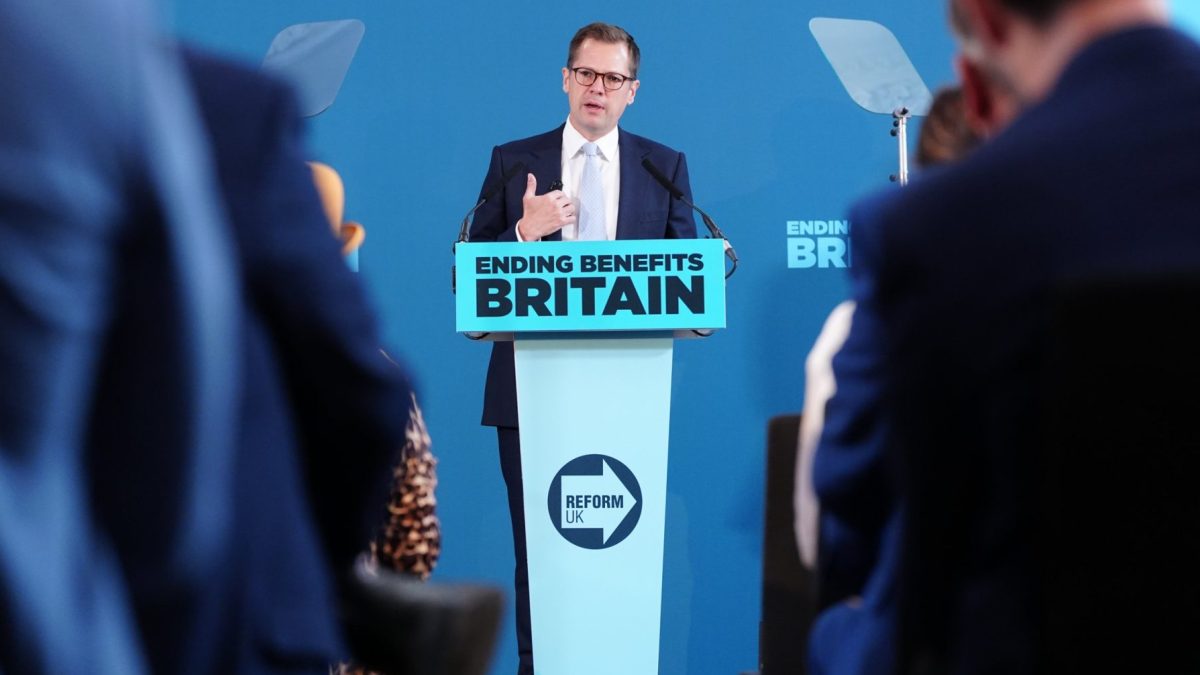
Reform UK has vowed to save £50bn from the welfare budget by slashing personal independence payments, banning foreign nationals from receiving benefits and forcing long-term claimants to do community work. Unveiling the policies at a press conference, the party’s Treasury spokesman, Robert Jenrick, said the “broken” welfare system was a “moral and an economic catastrophe” and Reform would stop some claimants “taking everyone else for mugs”. While the numbers and measures in Reform’s plan are eye-catching, there are reasons to suspect that delivering the policies will be complicated and Jenrick’s savings figures may be overambitious. Shorts What are the details of Reform’s plan? Reform’s policy has three main pillars. The first relates to how the welfare system treats foreign nationals. Under the plan, foreign nationals would be excluded from most benefits. The ban would include EU nationals with settled status in the UK, though there would be a few exemptions, such as armed forces veterans. Jenrick said such a ban would save £21bn by 2029. Secondly, Reform would shake up disability benefits through a new system of “Return to Work Cover”. For the first two years of an employee being signed off sick, their employer would have to pay for them based on existing welfare rates. Jenrick said businesses would take out specialist insurance to cover this risk, offset by a cut to their national insurance contributions. Those unable to return to work would go through a disability needs assessment, with a reduced caseload of eligible claimants receiving cash and in-kind support to help with living costs, Reform says. Jenrick said only the most vulnerable would get PIP, which would be reformed into a “PIP health security allowance”. Lastly, people on universal credit for more than 12 months who are fit to work would be assigned to a welfare-to-work scheme, and required to provide 20 hours a week of community work arranged by their council. If claimants were to refuse, they would “get nothing”, and if councils refused to run the schemes, they would “face cuts to their funding”, Jenrick added. While that is the plan, it would face numerous hurdles, starting with the EU. Renegotiating with the EU Reform’s ban on foreign nationals receiving benefits would cover EU nationals who arrived in the UK before 2021 and have settled status. This would require a renegotiation of the Brexit withdrawal agreement. However, it is not clear that Brussels would want to rewrite the agreement, and the bloc would likely respond with countermeasures such as stripping British expats of benefits. Brussels could even launch retaliatory trade measures against the UK. Reform has allocated £500m of contingency funding to cover the potential cost of British citizens returning to the UK to claim benefits if their entitlement to welfare in the EU is withdrawn. But the cash would only cover around 10 per cent – about 130,000 – of the 1.3 million British citizens living in the EU returning home to claim benefits. It is also worth remembering that if Reform got into government, they would be embarking on the renegotiation at the same times as implementing other policies which would be almost certain to strain relations with Europe. For example, Reform wants to use the Royal Navy to forcibly return migrants to French ports – something which France has said would violate its sovereignty and breach international law. Asked by The i Paper whether Europe would really want to cut a deal with the UK against that backdrop, Jenrick said: “I think we can negotiate with the EU a hell of a lot better than Keir Starmer or Andy Burnham will do. I trust Nigel Farage to cut a good deal with the EU because he’s a strong leader who knows what he wants.” Making employers pay for sick workers Jenrick said Return to Work Cover would be modelled on the system used in the Netherlands. However, making employers liable for sick employees for two years could have unintended consequences. Jenrick said his policy would give the “employers who know their workers best an incentive to help them back into work rather than pass the bill to the taxpayer”. He also said there would not be “any additional financial burden on businesses”, promising a “commensurate cut” of 0.2 per cent to employer national insurance contributions. However, it is not clear whether this would be enough to offset the extra costs which employers would be incurring – something Jenrick himself admitted. “If it turns out the costs are higher than that, then we’ll consider that obviously,” he said. Shifting the responsibility to employers could also create a perverse incentive for employers to not hire people with disabilities or previous experiences of ill-health. Jenrick said he was alive to this risk and that the insurance which employers would take out would be structured not to create this incentive. “You can put in place robust non-discrimination procedures that mean those who are providing the insurance cover do not discriminate between sectors where there are higher levels of sickness, or between individuals,” he added. But while Jenrick said employers must not discriminate, Reform is at the same time pledging a bonfire of equalities legislation, including the Equality Act and the Human Rights Act, and UK withdrawal from the European Convention on Human Rights. Pushed by The i Paper on whether people would be able to challenge discrimination without these legal protections, Jenrick said: “Just because we see that Tony Blair’s legislation and the Equalities Act has been a failure… does not mean for one minute that we would do anything to reverse the good steps our country has made over the course of my lifetime on disability discrimination, race discrimination, equal pay for women, support for women on maternity to get back into the workplace.” Voter backlash The Institute for Fiscal Studies (IFS) said much of Reform’s plans remainws vague. “Most of the planned savings here would come from a new disability needs assessment which is intended to be substantially tougher,” said Tom Waters, an associate director at the IFS. “But there is relatively little detail on what the new assessment would actually entail or on how they would avoid the experience of previous attempts to toughen up the system, which saw savings falling significantly short of government’s expectations.” Finally, there are the political implications of the measures. Many of Reform’s top target seats have large PIP caseloads. The welfare plans could therefore open up a vulnerable new flank for Burnham’s resurgent Labour Party.
The flaws in Reform’s plan to scrap PIP and slash £50bn from benefits bill
Full Article
Original Source
Read the full article at Inews →KhanList aggregates and links to publicly available news content. We do not host full articles from third-party sources. Always verify important information with original sources.