
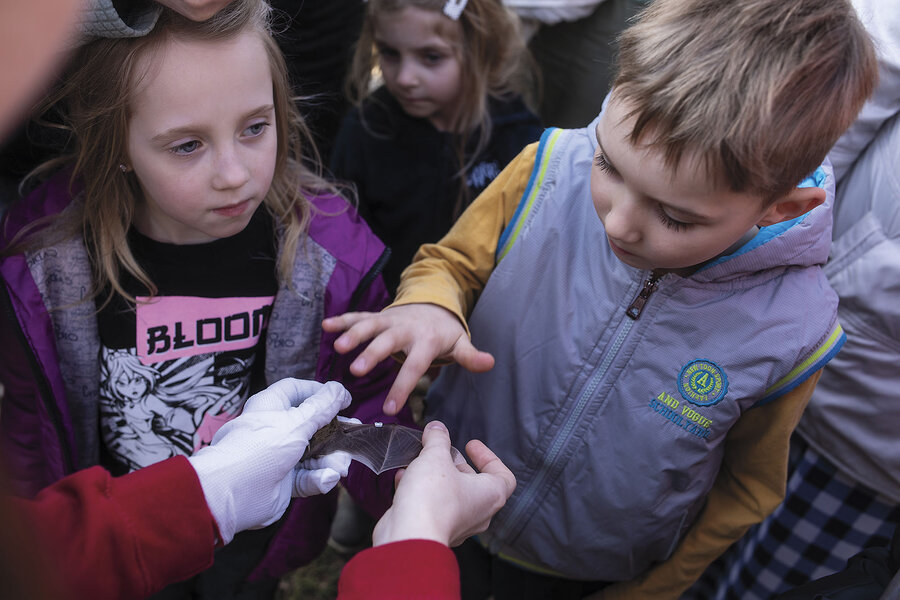
On a spring evening just before dusk, roughly 1,000 curious residents crowd into a tree-studded park in Poltava in central Ukraine. As part of a demonstration by the Ukrainian Bat Rehabilitation Center, research assistant Ruslan Stohnii gently stretches out the wing of a common noctule bat (Nyctalus noctula). He wants to show that for all the fearsome lore about bats, the animals have delicate features and aren’t typically harmful to humans.The crowd then presses in to watch Mr. Stohnii release fluttering bats, one by one, into a deepening navy-blue sky. When it’s the crowd’s turn, he reaches into cotton bags in which the waiting bats have been kept and places the animals gingerly into a few gloved, outstretched hands.“I could have never imagined that I would touch a bat like this,” one woman exclaims, her young daughter bursting with excitement as her mother holds a bat heavenward. The bat looks sleepy, perhaps a bit stunned at its sudden portal to freedom. After a few haphazard flops, it flits away into the tangle of tree branches clawing at the sky. Why We Wrote This The Ukrainian Bat Rehabilitation Center has been hosting annual nationwide bat releases for years. Thanks to social media, popularity has skyrocketed against the backdrop of a brutal war with Russia. This is not just bats taking flight, but hope itself.The UBRC staff members are there to demonstrate bats’ feeding patterns and sleeping habits; their critical role in the ecosystem as devourers of pests; and their sensitivity to noise and pesticides. The UBRC has been hosting these nationwide annual releases for years, but thanks to social media, popularity has skyrocketed against the backdrop of a brutal war with Russia, now running longer than did World War I. FANGS FOR THE MEMORIES: Ruslan Stohnii, a research assistant with the UBRC, checks the teeth of a common noctule bat that was displaced by construction activity amid the backdrop of a ruinous war Founded in 1999, the UBRC is the only center of its scale and specialization in Europe. It brings together biologists, veterinarians, and volunteers across the nation to care for bats found in critical condition, including many displaced by the conflict. Before Russia’s full-scale invasion in 2022, the UBRC cared for an average of 3,000 bats per year. As of December that year, it had rehabilitated more than 32,000 bats.Though artillery fire, land mines, drones, and missile strikes limit its fieldwork, the 30-member team perseveres to collect insight and data on the nation’s bat populations. All 28 confirmed bat species in Ukraine are protected by law.The UBRC’s work never ends, Mr. Stohnii says. Bats at the center need daily hand-feeding of mealworms and cockroaches.“When I first started working here, I dreamed about bats – that there were hundreds that I needed to feed,” Mr. Stohnii says.Tetiana Burianova contributed reporting for this article. PEST CONTROL: Bats at the UBRC hungrily eat mealworms. A bat can consume up to one-third of its body weight daily – about 10 grams (0.4 ounces), or 4,000 mosquitoes, for example. THE BAT CAVE: Mr. Stohnii carries a cage full of bats in the UBRC’s underground lab in Kharkiv, in eastern Ukraine, to prepare them for feeding. FLIGHT CHECK: Mr. Stohnii measures a bat’s wing size before the bat release in Poltava. A teenage volunteer, Marharyta Ohiienko, cared for the bat throughout the winter. CREATURE FEATURE: Residents of Poltava attend the bat release. Roughly 1,000 people turned out, nearly double the numbers from previous years. WINGSPAN: Mr. Stohnii stretches out a bat’s wings to teach curious Poltava residents basic facts about bats.
The flap of wings, the flutter of hope: Bats take flight in Ukraine
Full Article
Original Source
Read the full article at Csmonitor →KhanList aggregates and links to publicly available news content. We do not host full articles from third-party sources. Always verify important information with original sources.