
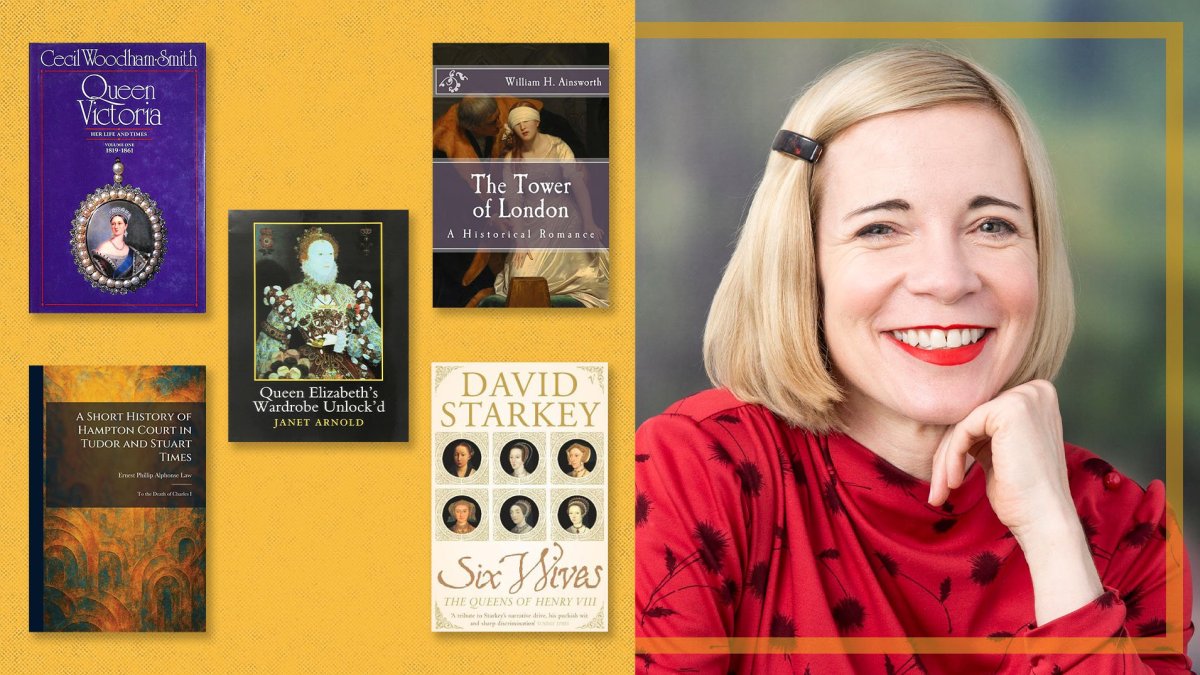
Palace intrigue, royal scandals, power struggles and plots – few people know the drama of British royal history better than Lucy Worsley. The bestselling historian spent more than 20 years as chief curator of Historic Royal Palaces, immersing herself in the lives of the monarchs who once walked their corridors. Now, in her latest book, Queens and Kings, she draws on those experiences to tell a wonderfully personal history of the British monarchy, spanning thousands of years. But which are the royal books she reads herself? Here are her five favourites… A Short History of Hampton Court by Ernest Law “Victorian historian Ernest Law spent half his life researching Hampton Court, the palace Cardinal Wolsey built, even living in a house in its park. His chatty guide was written for the tourists who poured in after Queen Victoria opened the doors in 1838. Law wanted them to see the place not just as a building, but as a stage-set for history’s great events, such as Wolsey’s fall. “He also, frankly, wanted them to shiver. According to Law’s colourful stories, Catherine Howard haunts the solemn cloisters while another Tudor ghost works ‘an unseen spinning-wheel’. Having worked at Hampton Court myself, I can’t hold Law’s love of drama against him. Storytelling is part of the fabric of the place.” Tradd Street Press The Tower of London by William H Ainsworth “Victor Hugo reinvented Notre-Dame in a novel of 1831; a few years later, William Harrison Ainsworth tried the same trick with the Tower of London. In a way, the Tower has never quite recovered. Ainsworth retells the story of Lady Jane Grey, proclaimed queen in 1553 on the death of Edward VI, and promises a peek into parts of the fortress closed to the public. “Ainsworth simply makes up many of these hidden features for this novel, imagining ‘subterranean galleries’ of moaning prisoners and a torture chamber whose implements have been ‘recently employed’. “Mary I, in his anti-Catholic imagination, personally oversees the suffering of blameless Protestants. Much of Ainsworth’s black legend of the Tower is nonsense. But it is also unforgettable.” Wildside Press Queen Victoria by Cecil Woodham-Smith “Cecil Woodham-Smith specialised in writing about intense, self-dramatising women like Florence Nightingale, before building up to her great work on Queen Victoria. She died before finishing the biography, but her one completed volume takes you deep into the warped world of Kensington Palace in the 1820s and 1830s, when the little princess was hidden away in rooms Victoria later remembered as ‘dreadfully dull, dark and gloomy’. “I’ve worked in those rooms, and I’d argue that they weren’t the real problem. Quoting great chunks of sources from the Royal Archives, Woodham-Smith tells how John Conroy, Victoria’s mother’s adviser, set out to ‘break her will’ and build a pliable queen. “Satisfyingly, Victoria simply bided her time, and threw him out the moment she could.” Hamish Hamilton Queen Elizabeth’s Wardrobe Unlock’d by Janet Arnold Elizabeth I is history’s dressiest queen, the woman who used white face paint and fantastically rich clothes to build the image of the Virgin Queen. Almost none of her clothes survive, which is why Janet Arnold matters so much. “Her transcription of the royal wardrobe accounts conjures up Elizabeth’s marvellous, vanished gowns. A Swiss visitor once saw her in white satin embroidered with gold, with ‘a whole bird of paradise for panache’ on her head. “One fragment of one of the queen’s dresses survives in the costume stores at Hampton Court. For everything else, we have Arnold.” Routledge Six Wives by David Starkey “David Starkey follows Henry VIII and his queens from Greenwich to Westminster to Hampton Court, scrupulously quoting the 16th-century sources and knocking down Victorian myths as he goes. His Catherine of Aragon, for example, isn’t a passive victim but a fighter, using the law and her stubbornness against her husband. “Starkey is also sharp on the unfair judgements made against Catherine Howard, a young woman cynically used by men. “You can feel Starkey’s influence well beyond the academy. When the queens of the musical Six sing their own version of Tudor history, they present a revisionist version that owes much to Starkey.” Vintage ‘Queens and Kings: An Unusually Personal History’ by Lucy Worsley is out now (Hodder & Stoughton, £25)
The five best books about the monarchy, according to Lucy Worsley
Full Article
Original Source
Read the full article at Inews →KhanList aggregates and links to publicly available news content. We do not host full articles from third-party sources. Always verify important information with original sources.