
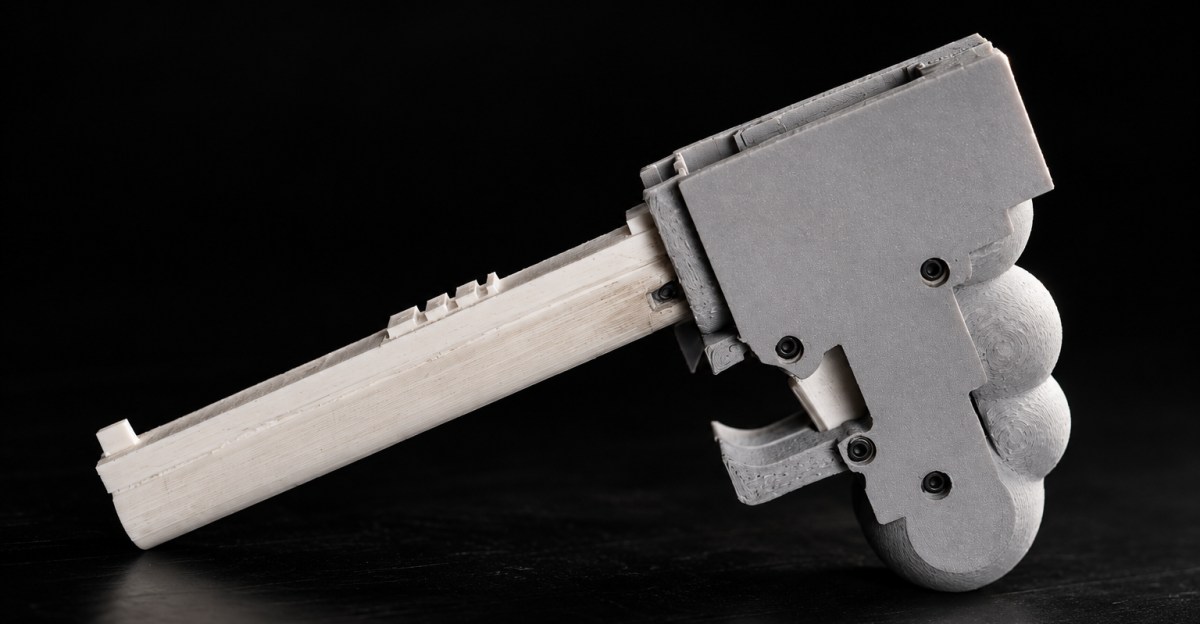
Since gun-rights activist and alt-right-friendly agitator Cody Wilson made the first 3D-printed firearm 13 years ago, he’s helped usher in a chaotic era of untraceable ghost guns. Now he’s claiming another first: “the first AI-made gun.” It’s called the WASP.I stood about 20 feet away as Wilson and his sidekick clamped the WASP to a DIY test mount outside Defense Distributed headquarters in Austin, Texas. The 3D-printed .22 caliber handgun is, in reality, little more than a pistol barrel attached to a spring-loaded plastic box. Its rudimentary design bears a resemblance to Wilson’s single-shot 3D-printed “Liberator,” albeit with some quintessentially AI-generated oddities, like a wacky, bubbly grip that doesn’t quite fit a human hand. It was aimed toward a shallow green slope in the backyard of a semi-residential neighborhood. A long black string ran from its trigger to Wilson, who sat crouched about 10 feet back behind a police riot shield.“Three. Two. One.” I braced for a thunderous crack, but instead heard only a loud click. The world’s first AI-generated gun had misfired.“This didn’t happen last time,” Wilson, annoyed, reassured me as he carried out some quick troubleshooting. The gun’s striker had hit the cartridge, he said, but failed to set off the primer. I quietly took another step back. After some more fiddling, Wilson declared the WASP ready for a second chance. This time, pulling the string produced a sharp bang, about as loud as a firecracker. Downrange, a cardboard target had a hole ripped through its top left corner. His colleague had suggested using a life-size cutout of Joe Biden, but Wilson shot that down as “too on the nose.”The safety test completed, Wilson then unclamped the WASP, slipped on a protective glove, took aim at the cardboard target, and squeezed the trigger himself. Another bang. This time, a miss, slightly high. The AI gun, today at least, was two for three in terms of shots successfully fired.With the smell of gunpowder still lingering, I asked Wilson the obvious question: Why make this functionally suspect firearm in the first place? We’re in Texas, where buying a conventional gun is often easier than getting a driver’s license. He paused, taking issue with the premise.“I would argue that what we’ve made is not an AI-generated gun, but an AI that can generate guns.”His supposed AI gunsmith is a custom model he calls GatGPT. But instead of generating pasta recipes or travel plans, this unfiltered model answers questions about firearms. It’s trained on DEFCAD’s expansive library of gun files and can help enthusiasts pick out the exact parts they need for a build. Launched in 2012, DEFCAD (another Wilson-led project) is the world’s largest online repository of digital gun and component files. Gun safety advocates and lawmakers have argued sites like DEFCAD aid the proliferation of “ghost guns,” firearms made partly or entirely of components without a serial number. Wilson, meanwhile, has called access to firearms “a fundamental human right.”“I would argue that what we’ve made is not an AI-generated gun, but an AI that can generate guns.”Under US federal law, licensed gun makers are required to include serial numbers on the frames or receivers of guns they sell. Wilson and others in what’s referred to as the 3D2A movement say gun files aren’t actually guns, they are computer code, a form of protected speech. That core argument, whether or not gun codes are protected speech, has been argued in court cases for over a decade, with many often citing or involving Wilson. It’s possible the issue will wind up before the Supreme Court.Now, Wilson claims, AI can also come up with its own unique designs. The results have a bizarre, surrealist quality emblematic of early generative art to the tune of Will Smith slurping spaghetti.The WASP’s entire development, Wilson claims, from its name to safety tweaks (an early grip design could have cost someone a finger), resulted from a natural-language dialogue between the model and its human user. In other words, it’s essentially a vibe-coded gun. Though mostly a proof of concept, the WASP nonetheless fires real, lethal rounds and doesn’t have a serial number. Wilson believes AI-generated guns like this will only improve as GatGPT ingests more data, and as users engage with it.But the WASP also poses another pressing public safety issue. Producing 3D-printed guns has gotten easier over the years, but it still fundamentally requires some technical know-how. Now, however, a novice armed with GatGPT could plausibly make a gun with only a handful of prompts. That’s exactly the kind of barrier-lowering that critics of 3D-printed guns, like Everytown, have spent years warning about.“[Wilson] admits the goal here,” Everytown senior vice president for law and policy Justin Wagner told The Verge. “He wants to lower the barrier to entry so anyone, regardless of their background check status or legal eligibility [can] own a gun. He wants anyone to be able to design and manufacture weapons, and that’s dangerous.”Everytown has played a prominent role in advocating for a pair of recently passed laws in New York and California that will require 3D printer manufacturers to install firearm-blocking software that can detect guns or gun parts and stop them before they are ever printed. (Experts have questioned how and if these methods would actually work.)Wilson didn’t specifically cite evading detection as a reason for building an AI gun maker, but the development comes on the heels of his recent efforts to complicate firearm-blocking technology that New York and California will require in future 3D printers. In August, Wilson began rolling out a tool called Hochulization (a jab at New York Gov. Kathy Hochul) that he says subtly alters a file’s underlying hash, which functions as a kind of digital fingerprint. By late September, Wilson claimed to The Verge that users had already “Hochulized” files more than 26,000 times, with some users applying the treatment more than once. It’s one of the many ways Wilson has planted a flag in the evolving battle over how to regulate 3D-printed guns.“He wants anyone to be able to design and manufacture weapons, and that’s dangerous.”The core idea behind that “self-defense measure,” as Wilson calls it, is to stymie a purely hash-based gun detection system by rendering it unable to keep up with constantly changing hashes. A new AI-generated gun design also wouldn’t immediately be recognized in a gun detection database, since it didn’t exist yet. More sophisticated gun detection software goes beyond simple hashes and uses AI to try to predict whether a file is likely a gun or gun component before it prints. It’s unclear whether this type of software, which is still being developed, would reliably detect a sufficiently strange-looking AI-generated gun design.“Individuals who intentionally aim to thwart safety regulations put themselves and New York communities at risk, which is why Gov. Hochul remains committed to combating emerging threats and the production of ghost guns and illegally manufactured guns, and strengthening regulations that keep New Yorkers safe,” Hochul spokesperson Jess D’Amelia told The Verge.Defense Distributed’s AI didn’t just log on one day and suddenly decide to build a gun. It started with a specific request from a human to riff off an existing design. An employee asked the model to build a new gun based on a design called “Ergo Harlot,” itself a variation of the more popular “Harlot” model. Like the WASP, the Harlot is a compact single-shot handgun that fires a .22 caliber round. The AI prompter, according to chat logs viewed by The Verge, framed the assignment as a “challenge” and told the AI model its entry “must be completely and fully functional and have a unique design.”Chat logs show the AI model responding with a plan for a new design called the WASP and submitting it for approval. The AI didn’t explain its name choice, though Wilson suggested it bears some physical resemblance to the insect. When I asked whether it’s possibly an abbreviation for “white Anglo-Saxon protestant,” he said it isn’t.The AI model listed six key changes it made to the inspiration design, including a slightly longer barrel than the Harlot’s and a grip made of three grooved, circular lobes. Once a Defense Distributed employee approved the model’s plan, the logs show it checking and testing each component, much like how an AI coding agent such as Anthropic’s Claude Code works through a checklist when vibe-coding an app. The team then printed the WASP in its office on a Bambu Lab printer using standard plastic filaments, along with a handful of common metal parts for the firing pin and barrel. Wilson said the print took about six hours.So is the WASP actually a good gun? Ashley Hlebinsky, a firearms historian and founder of consulting firm The Gun Code, told The Verge that it’s hard to judge without handling it, but several design choices stand out as odd. Most notably, the AI appears to have started making a trigger guard (the loop that normally protects a shooter’s finger) but doesn’t finish it, leaving the trigger exposed, for no apparent reason. The gun also seems to borrow from what are called modern “beavertail” grip designs. But bizarrely, the AI appears to have inverted its grip.“It reminds me of times when I’ve prompted AI to draw a picture of a gun and it gets most of the way there but then has some weird parts missing,” Hlebinsky said. “It has an obvious futuristic, sci-fi appearance that reminds me of Marvin the Martian’s ray gun.”Jonathan Ferguson, keeper of firearms and artillery at the Royal Armories Museum in Leeds, England, was more critical when asked if the WASP seemed functional.“Functional? From a legal perspective, if it successfully fires a shot without a breech explosion, it’s a viable firearm, but so are two lengths of steel pipe with a firing pin and cap attached to the rear of one,” Ferguson told The Verge. “From a technical perspective, I would not call this a ‘sound’ or ‘good’ firearm. It does not appear to be comfortable to hold or easy to aim and, based on the test firing, seems to be only marginally functional.” If anything, Ferguson noted, he expected generative AI in 2026 to do a better job at designing a reliable firearm. “There are vestigial sights that can’t work, an open trigger guard, [and a] weirdly shaped grip.”“This certainly is a development, [but] I don’t think it’s necessarily that novel. It’s another way to 3D print a gun,” Wagner said. “A victim of a mass shooting who was shot by a ghost gun told me when you get shot, it doesn’t matter if it’s a ghost gun, a 3D-printed gun, or a gun that got bought over the counter. They’re all just as lethal,” he added.“From a technical perspective, I would not call this a ‘sound’ or ‘good’ firearm.”Wilson is confident his AI’s design will improve, both in terms of functionality and aesthetic uniqueness, as the DEFCAD database grows. More gun files will help, but he expects the biggest gains will come from users chatting with the model and pushing it to refine its choices. (GatGPT is currently in limited early access.) Eventually, he predicts, constant back-and-forth between users and AI could dramatically speed up the pace at which new 3D-printed gun designs appear.“This is all just spontaneous parallel thinking,” Wilson said. “I think you’ll see those cycles faster now because of AI.”“It’s like you’re speedrunning the available possibilities, the materials, the platforms, the concepts,” he added.A skeptic would say the WASP’s origins as essentially a remix of a previous designs makes its claims to true originality shaky. Like many half-baked AI movie scripts or janky generative art, the WASP conjures up the familiar feeling of AI slop, made manifest in the real world. Even Wilson admits it looks a bit like a “Fortnite gun.”Still, Wilson maintains the WASP is fundamentally an AI creation and one that he’s ultimately not responsible for, even though his team’s prompts led to its creation. That position aligns with a broader argument Wilson’s made for the better part of a decade in legal skirmishes with the State Department and local lawmakers: that gun files are protected speech. In fact, Wilson said he doesn’t necessarily consider the WASP a gun at all until it’s printed and fired.“This thing lives first as a digital organism,” he said.Follow topics and authors from this story to see more like this in your personalized homepage feed and to receive email updates.Mack DeGeurin
The first vibe-coded gun is here
Full Article
Original Source
Read the full article at Theverge →KhanList aggregates and links to publicly available news content. We do not host full articles from third-party sources. Always verify important information with original sources.