
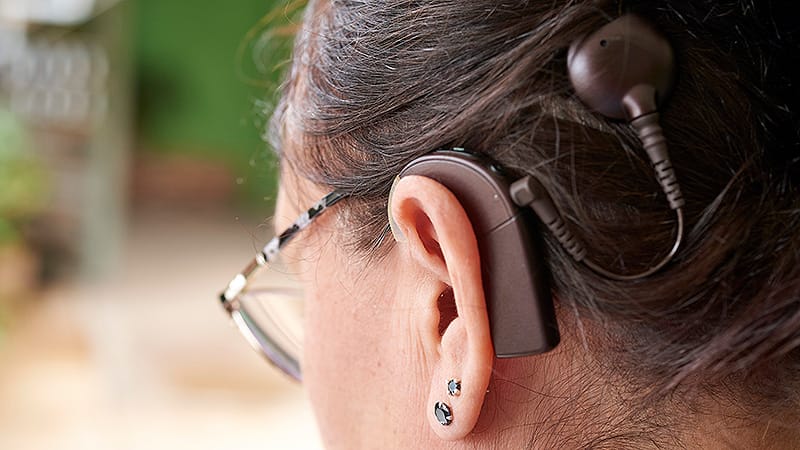
A new chapter is unfolding for one of the most widely used neural prostheses.The first commercially available fully internal cochlear implant marks a transition from traditional behind-the-ear (BTE) devices — which transfer sound from an external microphone and processor to an internal receiver — to full implants with the processor, microphone, and battery all under the skin. It’s a major advance for patients who are deaf — and for the wider neurotechnology space.Cochlear implants have long been considered “the first true neural implant,” said Michael Cohen, MD, pediatric otolaryngologist at Mass Eye and Ear and associate professor at Harvard Medical School in Boston. “Lessons learned from biocompatibility, signal processing, implant/neuron interface have all progressed markedly in the decades since the start of cochlear implantation. These lessons can likely be applied to any neural implant.”Austrian company MED-EL launched the TICI UNICO across European markets in late September. A similar device from US-based Envoy Medical — which uses a sensor designed to work with the ear’s natural structures rather than a microphone — is moving through the FDA’s premarket approval process, and a third from Cochlear in Australia is being tested in clinical trials, recently reaching 1 million hours of testing in 100 patients.The devices help avoid the problem among young children of damaging or losing their BTE processor or putting it in their mouths. They may also be useful for people with sensory sensitivities or who spend time near bodies of water.“When I was younger, I remember wishing I could have the whole thing under the skin,” said Alex Johnson, a longtime cochlear implant user in Seattle. “While my inner child feels excited and happy, my current self has several reservations.”Engineering the ImplantThe TICI (totally implantable cochlear implant) has been 50 years in the making, said Jennifer Robinson, MED-EL’s corporate director of product management hearing solutions. She cited two “key” challenges in building the device: “developing an implanted microphone that can pick up sound through the skin” and “creating a rechargeable implanted battery.”“The real accomplishment is integrating all the necessary components into a tiny package,” said Michael Daniele, PhD, professor of biomedical engineering at North Carolina State University in Raleigh.Technologies that transfer power through tissue have long been available, Daniele said. Batteries have been getting smaller and lasting longer across industries. And researchers have been experimenting with placing microphones under the skin, including at the Massachusetts Institute of Technology and Mass Eye and Ear.“The microphone is especially interesting because detecting and processing sound through the skin introduces some unique engineering challenges,” Daniele said. “You can imagine putting your cell phone microphone or speaker under your hand or finger and how well it works.”Robinson said that the fully charged battery can last for about 40 hours and can be recharged by placing a wireless charging device (the company’s GoPod) over the skin to magnetically align with the battery underneath. The battery’s expected lifespan is roughly 15 years — if it fails, users can continue to use the system with a conventional BTE device.The Bigger PictureCochlear implants have played a pivotal role for the wider neurotechnology field throughout history. Research connects them to the development of auditory brain-computer interfaces, deep brain stimulation, spinal cord stimulators, and visual restorative medicine.“Cochlear implants are by far and away the most developed — and longest around — for neurosensory implants,” said Zachary Schwam, MD, neurotologist at Mount Sinai West and the Ear Institute at Mount Sinai in New York City.Advances in programming, miniaturization, and battery power paved the way for these latest fully internal devices — and could potentially lead to other neural implants, such as retinal implants.“In theory, any sensory implant is possible,” Cohen said.Still, implants placed directly into neural tissue pose different challenges. “We already have systems, such as deep brain stimulators, that use implanted electrodes connected to electronics housed elsewhere,” Daniele said. “Moving toward smaller, more distributed electronics that can operate directly at the neural interface introduces additional challenges related to power, heat, packaging, tissue response...but all solutions that may be on the horizon.”Why Patients’ Reactions Are MixedMany will be drawn to a hidden processor due to stigma around medical devices, said Schwam, whose department performs 200 cochlear implant surgeries a year.But reactions among deaf people online are mixed.“Calling it ‘totally invisible’ and focusing so much on the fact that you can’t see it really bothers me because it feels like erasure,” Johnson said. “It feels like this caters to just not making able-bodied people uncomfortable with unfamiliar external medical equipment peripherals.”Removing visible signs could introduce new challenges with “proving” one’s deafness. “In 2026, we are still struggling with having to educate others on how to communicate with us effectively,” Johnson said. “I am not sure how hiding our devices helps in that endeavor.”For those who already have BTE devices, experts recommended against replacing them with an internal processor. “There is real risk with revision surgery,” Cohen said. “Whether there is a great enough advantage to warrant replacement” remains unknown. Insurance also may not cover reimplantation if the current processor still works, Schwam said.Widespread adoption will depend on how the technology performs and how sound quality compares to current processors — but that next chapter is still being written.Cohen reported being a board member of Ironsides Medical and principal investigator for Skylark Bio’s SONIX trial. Schwam reported making educational videos for Grace Medical. Daniele reported having no relevant disclosures.
The ‘First True Neural Implant’ Is Taking a Big Step Forward
Full Article
Original Source
Read the full article at Medscape →KhanList aggregates and links to publicly available news content. We do not host full articles from third-party sources. Always verify important information with original sources.