
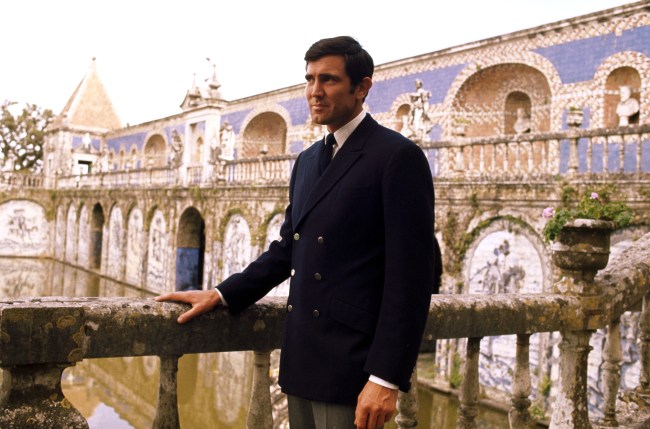
When long-time producers Barbara Broccoli and Michael Wilson stepped away from the James Bond franchise last year and Daniel Craig made it clear that he was finished playing agent 007, new producers Amy Pascal and David Heyman were faced with an unenviable task: finding a new actor to step into one of the most iconic roles in all of cinema. In the last few weeks, it’s been reported that Pascal, Heyman, and new Bond director Denis Villeneuve have zeroed in on a few final contenders including Jack Lowden, Callum Turner, and Josh O’Connor. Whoever the filmmakers choose, it’s likely to be controversial; Bond fans are very loyal to their particular favorites, and have been ever since Sean Connery was first replaced in the role back in 1969. The general consensus seems to be that Connery was the best Bond (though Craig runs a close second in most polls), but often one’s preference depends on which Bond was one’s first; as someone who grew up with Roger Moore, he’s always been my favorite, and I argued for his supremacy in an earlier IndieWire piece. The casting of a new James Bond has always set off a media furor, even in the days long before social media and Letterboxd. When Connery decided he had had enough as 007 after shooting the fifth James Bond movie, “You Only Live Twice,” the press followed producers Albert “Cubby” Broccoli and Harry Saltzman’s talent search with bated breath. Once the role was cast, they scrutinized the choice with an intensity that no actor could have survived — certainly not a male model whose only screen credit was a series of chocolate commercials. After Connery quit, Broccoli, Saltzman, and director Peter Hunt spent over a year interviewing, auditioning, and screen testing hundreds of actors — including a young Shakespearean thespian named Timothy Dalton, who would go on to play Bond nearly 20 years later — to play Bond in “On Her Majesty’s Secret Service.” Anthony Rogers (“Camelot”), John Richardson (“Black Sunday”), and stage actor Roy Marsden were considered before the filmmakers landed on George Lazenby, whose previous acting experience was limited to those chocolate commercials. Lazenby lied at his initial meeting and said he had been acting in movies Germany and Hong Kong, figuring the producers wouldn’t be able to check, but came clean to Hunt the next day. Hunt and the producers were concerned about Lazenby’s chops but loved his look, so they took a chance on the newcomer and put him through hours of voice coaching (to lose his Australian accent) and stunt training before deciding to pull the trigger a few weeks before production was scheduled to begin. The question then became how to frame Lazenby’s onscreen introduction to make the transition as seamless as possible for audiences. One of screenwriter Richard Maibaum’s drafts began with Bond surviving an explosion that required him to undergo reconstructive surgery, but this was scrapped in favor of a more conventional prologue involving Bond encountering love interest Diana Rigg and fighting foes on the beach and in the water. When Rigg leaves Bond behind instead of making love to him as was customary for Bond’s leading ladies, Lazenby looks in the camera and says, “This never happened to the other fellow.” It’s a very funny and very efficient way of acknowledging the change in personnel and then moving on, and the opening credit sequence further eases the transition by utilizing clips from earlier Bond movies. It also helps that the creative team on the movie consisted of Bond veterans including Maibaum, production designer Syd Cain, composer John Barry, and Hunt, who made his directorial debut with “On Her Majesty’s Secret Service” but had been an editor and second unit director on earlier Bond films. As a result, “On Her Majesty’s Secret Service” still looks and sounds so much like a Bond film that the introduction of Lazenby is less jarring than it might have been, though what’s interesting about the movie is how much better it is in just about every way than the previous Connery pictures. One can argue about the relative merits of Connery vs. Lazenby, but there’s no debating the visual elegance of “On Her Majesty’s Secret Service,” which eschews the somewhat bland high-key lighting of the earlier Bond films in favor of something more atmospheric and glamorous. Audiences at the time might not have appreciated Hunt and cinematographer Michael Reed’s efforts, being distracted by debates over Lazenby, but contemporary directors like Steven Soderbergh and Christopher Nolan have referenced “On Her Majesty’s Secret Service” as an influence and made a case for it as the best of all James Bond movies. On his website, Soderbergh wrote that “On Her Majesty’s Secret Service” was cinematically “the best Bond film and the only one worth watching repeatedly for reasons other than pure entertainment (certainly it’s the only Bond film I look at and think: I’m stealing that shit).” ‘On Her Majesty’s Secret Service’Courtesy Everett Collection Aside from containing several of the series’ best set pieces (including some awe-inspiring ski chases that inspired Nolan when he made “Inception”), “On Her Majesty’s Service” is also the most emotionally resonant Bond film to be made before the Daniel Craig era, with a genuinely moving love story between Lazenby and Rigg. Although composer John Barry scored a lot of 007 movies, his talents were never put to better use than in this film, which fully took advantage of Barry’s skill for sweeping, romantic themes that would later win him an Oscar for “Out of Africa.” Lazenby gets some of the credit here too; he may lack Connery’s icy charm, but he’s a more human Bond. Displaying a slightly goofier sense of humor than Connery, he’s a transitional figure between the original 007 and the more overtly comic one Roger Moore would introduce in “Live and Let Die” four years later. According to Lazenby, he could have expressed even more emotion had Peter Hunt allowed it; when the actor played one particularly devastating scene with tears in his eyes, Hunt ordered a second take, arguing that Bond shouldn’t cry. As good as he is in the part, Lazenby’s experience shooting “On Her Majesty’s Secret Service” doesn’t seem to have been pleasurable, though whether or not the blame rests on his shoulders depends on who’s telling the story. According to Lazenby, Hunt went cold toward him early in shooting over a misunderstanding and was too preoccupied with the technical side of things to give him much attention; Cubby Broccoli, on the other hand, said Lazenby was spoiled and entitled and alienated many of his colleagues. ‘On Her Majesty’s Secret Service’Courtesy Everett Collection Although Broccoli was ultimately happy with Lazenby’s performance, by the time the movie opened, there were a lot of lingering hard feelings — a situation that wasn’t helped by the fairly lukewarm reviews Lazenby received, or by one of his representatives making a statement that Lazenby would not be returning to the role of James Bond. This was the first Broccoli or Harry Saltzman heard of any plans for Lazenby to abandon the part, and they quickly announced that Lazenby had been fired to make it seem as though his departure was their decision, not his. Although Lazenby later stressed that he wasn’t the one who made the announcement he was quitting, he also clearly didn’t have any great desire to stay on as Bond. His contract was for seven years and had multiple clauses that he felt would restrict his career and lifestyle, and he still hadn’t signed it when “On Her Majesty’s Secret Service” wrapped. Lazenby figured he could make more money doing one film in Italy than he could in five years on his Bond contract; he also, in one of the great errors in judgment in movie history, assumed that the James Bond franchise was dying in the era of “Easy Rider” and wouldn’t last much longer anyway. In fact, “On Her Majesty’s Secret Service” was a sizable hit, grossing $82 million on a production budget of $8 million. It wasn’t as popular as the last Connery film, however, and the mixed reviews gave it the aura of a failure. Broccoli and Saltzman began another worldwide search for a new Bond, considering American stars like Clint Eastwood, Burt Reynolds, and Adam West before convincing Connery to return. The result, “Diamonds Are Forever,” was a monster hit, and Lazenby went on to scattered work around Europe, acknowledging years later that his decision to quit Bond was a major mistake. Lazenby didn’t completely leave 007 behind, however. After “On Her Majesty’s Secret Service,” he played a James Bond-esque character in the “Alfred Hitchcock Presents” episode “Diamonds Aren’t Forever” and, in 1983, Lazenby appeared in the TV movie “Return of the Man from U.N.C.L.E.” as a spy with the initials J.B. (who drove an Aston Martin, no less). The actor made a handful of interesting films after he played Bond, most notably Brian Trenchard-Smith’s great action film “The Man from Hong Kong” and Peter Bogdanovich’s exquisite Paul Theroux adaptation “Saint Jack.” Lazenby was never more memorable than he was as James Bond, however, and it’s a shame he didn’t play the character in more pictures and further develop his variations on the persona. It remains to be seen where Villeneuve’s selection will place in the pantheon of Bonds, but whoever is cast would best be advised to ignore the inevitable social media firestorm that’s coming their way. Lazenby’s saga proves that no matter how capable an actor is stepping into Bond’s shoes, it takes a while for history to render a fair assessment. 57 years after critics dismissed it, “On Her Majesty’s Secret Service” has stood the test of time — it’s Soderbergh and Nolan’s verdicts, not those of the contemporary press, that have proven correct.
The First Time Producers Had to Find a New James Bond, the Result Was the Best 007 Movie Ever
Full Article
Original Source
Read the full article at Indiewire →KhanList aggregates and links to publicly available news content. We do not host full articles from third-party sources. Always verify important information with original sources.