
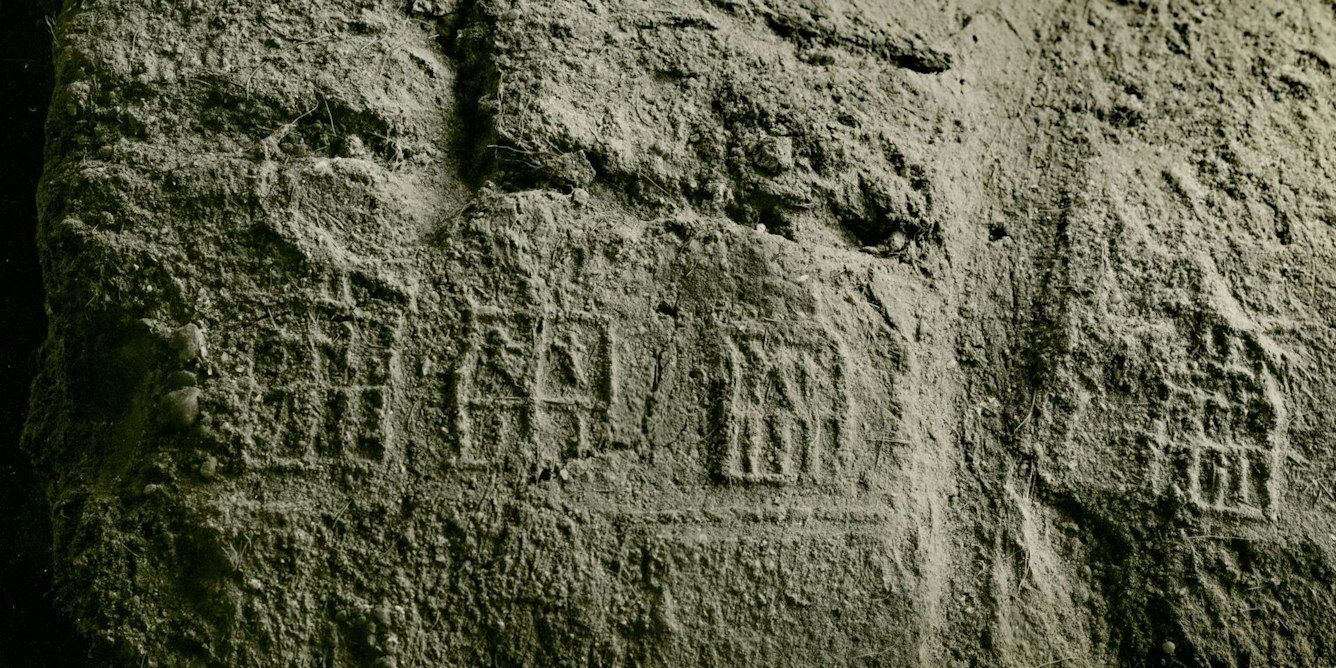
The black-and-white photograph of a long-lost artifact depicts four serekhs, symbols of Egyptian rulers, and two of them, a recent study suggests, are hers October 1, 2026 8:00 a.m. An archival photo is the only remaining evidence of the artifact that first pointed to the extent of Meretneith’s power. The Egypt Exploration Society More than five millennia ago, a queen named Meretneith ruled ancient Egypt. That’s according to a study recently published in Prague Egyptological Studies, for which researchers used digital tools to re-examine an old photograph of hieroglyphic inscription lost to time. They say the symbols suggest that Meretneith (also spelled Merneith or Meret-Neith) was not just an interim ruler or regent but possibly equal to an Egyptian king. “Egyptologists have long disputed whether Meretneith was an independent ruler of Egypt,” study coauthor Susan Kelly, an Egyptologist at Macquarie University in Australia, writes in the Conversation. “Resolving that dispute would require finding a text that identifies her as a ruler. Our new research … might do just that.” Meretneith lived during ancient Egypt’s first dynasty. She was likely related to its third pharaoh, King Djer, who ruled Egypt in the 2800s B.C.E. Historians have long known that Meretneith was an important royal: Her vast burial complex in Abydos’ royal cemetery contained the graves of 41 servants and courtiers as well as sealed jars full of wine. And an ancient list of rulers found in the tomb of King Den in Saqqara, another first dynasty pharaoh, identified Meretneith as “king’s mother.” From this, historians guessed she might have acted as regent during Den’s childhood. Quick fact: Royal, religious necropolis Abydos is the burial site of the earliest ancient Egyptian kings, those of the first and second dynasties and even earlier, and came to be associated with Osiris, god of the dead. A temple for Osiris was erected at the site, prompting pilgrimage and annual festivals celebrating resurrection. Only one known text might provide evidence of Meretneith’s sovereignty. It’s a hieroglyphic inscription written on an ancient stopper, a plug used to seal a jar. The English archaeologist Walter B. Emery found 13 of these mud stoppers in the 1940s, at the entrance to a tomb in Saqqara. Each stopper was inscribed with four special glyphs called serekhs, which represent Egyptian rulers. Emery said that the first and last serekhs represented Djer and that the middle two represented Meretneith—a controversial claim. The researchers first increased the contrast of the image. Susan Kelly and Crystal Miller, Prague Egyptological Studies, 2026 “Among the many arguments against Emery’s theory was that the poor quality of the original published photo made it impossible to confirm what the signs on the mud stopper depicted,” Kelly writes. The whereabouts of all 13 stoppers and the original glass plate of Emery’s black-and-white photograph are “unknown,” Kelly tells Live Science’s Owen Jarus. So she and study co-author Crystal Miller, a bioarchaeology researcher at the University of Bucharest, in Romania, worked with what they had: a digital scan of the archival photo. The researchers isolated the hieroglyphs, inverted the colors and converted the image to a scalable vector. Kelly writes in the Conversation, “We produced a crisp digital replica—much like a high-tech pencil rubbing over a coin.” They then isolated the serekhs from the background. Susan Kelly and Crystal Miller, Prague Egyptological Studies, 2026 Per the study, the symbols in the second and third serekhs are consistent with Meretneith’s patron deity and name. “There appears little argument left to dispute that the serekh—held only by rulers—belonged to Meretneith,” the researchers write. The characters identify Meretneith using the “primary mark of rulers in this period,” Kelly writes, which means “she really was a female king … a true equivalent to a male ruler.” Kelly tells Live Science that Meretneith likely co-ruled with Djer, who might have been her father, and later acted as regent for her son Den. The researchers suggest in the study that within this 30-year political career, Meretneith may have also ruled alone. “Meretneith may have had the advantage of stepping on and off the rulership platform as necessitated by the political environment,” the researchers write. “Unlike male rulers who succeeded, reigned, died and were buried by their successors.” The researchers’ digital “rubbings” of the serekhs, pictured atop Walter B. Emery's 1954 drawings Susan Kelly and Crystal Miller, Prague Egyptological Studies, 2026 Researchers generally accept that Meretneith had power, but not that she ruled alone or was equal to a king. Eva-Maria Engel, a historian at the Humboldt University of Berlin, tells Live Science that she doesn’t think Meretneith is represented by any of the serekhs on the stopper. Engel, who wasn’t involved in the study, maintains that although Meretneith was an influential woman, the enhancements to the photograph seem to show that “the seal only mentions the name of King Djer and that Meretneith is not mentioned at all.” Egyptologist Margaret Maitland, who curates the National Museums Scotland’s ancient Mediterranean collections, told Live Science’s Sascha Pare in 2023, “Wives and daughters were not typically considered in terms of royal successions.” But Jean-Pierre Patznick, an Egyptologist at Sorbonne University, in Paris, once called Meretneith the first female pharaoh, writing, “No other queen of the early dynastic period possessed so many royal privileges.” You Might Also Like Get the latest stories in your inbox every weekday. More about: Ancient Egypt Archaeology Artifacts Egypt New Research
The First Female Pharaoh? An Old Photo of Ancient Hieroglyphics Highlights the Status of One of Egypt’s Earliest Queens, Researchers Say
Full Article
Original Source
Read the full article at Smithsonianmag →KhanList aggregates and links to publicly available news content. We do not host full articles from third-party sources. Always verify important information with original sources.