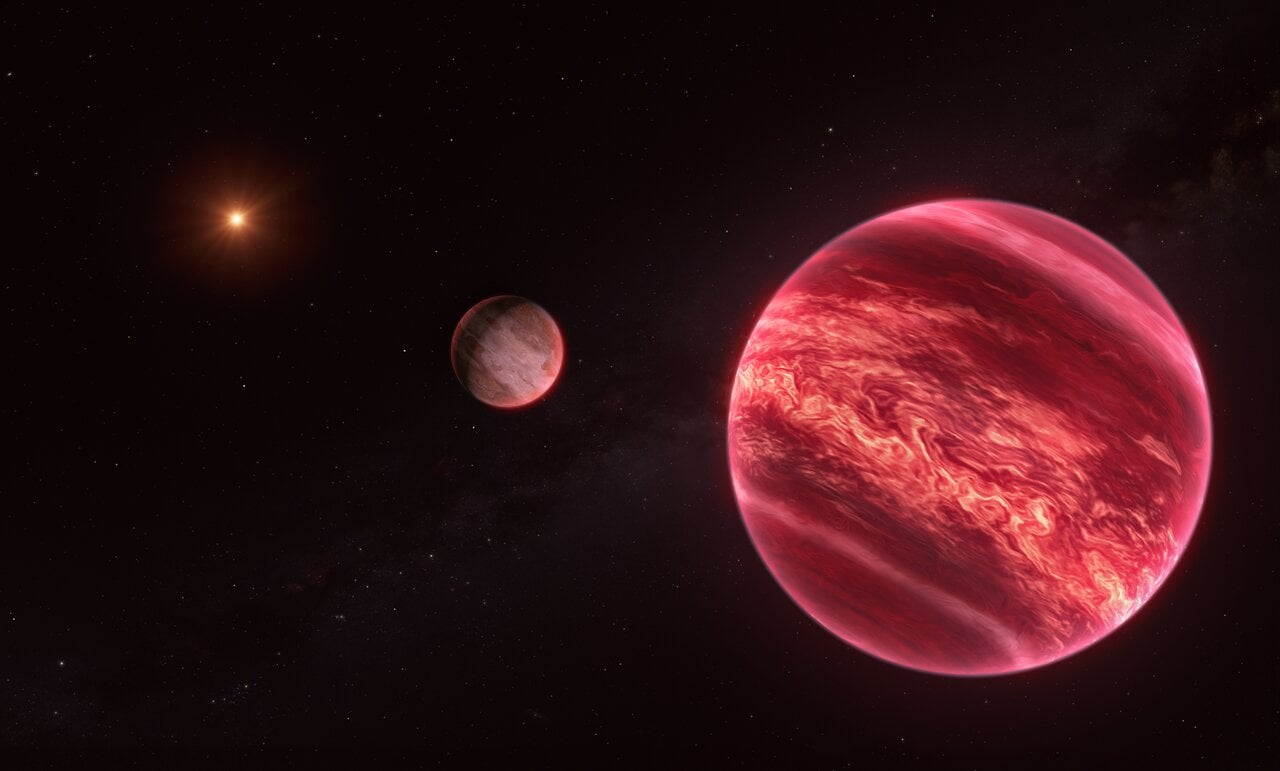
Stars, planets, and moons are easy to define in the broad. Stars shine, planets orbit stars, and moons orbit planets. It seems simple enough, but as we've come to understand more about both our solar system and others, our simple definitions become less clear. The most famous example is the debate over whether Pluto is a planet. It does orbit the Sun, but so does the asteroid Ceres. Currently the official International Astronomical Union (IAU) decision is that Pluto is not a planet because it hasn't "cleared its orbital neighborhood." It's a decision that remains contentious in the astronomical community. It also raises other questions. Pluto has a large companion, Charon. If Pluto is not a planet, then is Charon a moon? Pluto is considered a dwarf planet, but Charon could also be considered a dwarf planet. Does that make them a double dwarf planet? Our Moon is larger than Pluto, so should it be considered a dwarf planet? These debates center on smaller bodies, but a newly studied star system challenges our definitions on the large end of the spectrum. The star is CD-35 2722, an M-type red dwarf about 70 light-years away. Spectral observations of the star find that the star has a periodic wobble thanks to a companion object, CD-35 2722b. Based on the estimated mass of the star and the amount of wobble, the companion has a mass somewhere between 29 and 38 Jupiters. This makes CD-35 2722b a brown dwarf. Its mass is less than the 90 Jupiters needed to fuse hydrogen like a star, but any body with more mass than about 15 Jupiters is large enough to fuse deuterium, so they aren't truly in hydrostatic equilibrium like traditional planets. Brown dwarfs straddle the gap between planet and star. CD-35 2722b is large enough to be imaged directly by ESO's Very Large Telescope. Recently, spectral observations of the brown dwarf found that it too has a regular wobble. The best mass estimate puts it around the same mass as Jupiter. It is the first "exo-satellite" to be confirmed, but it's a Jupiter-sized object orbiting a brown dwarf, which in turn orbits a star. Brown dwarfs are funny things. The largest of them can have surface temperatures of 2000K and would appear like small stars. The smallest of them would look like large planets. CD-35 2722b is a mid-sized brown dwarf, so it's unclear how it appears. And given the size of brown dwarfs, it is likely that many are orbited by bodies the size of planets. Some of these exo-satellites could even be within the habitable zone of a star and possibly even have life. Would that make them moons? Planets? Should we consider them something entirely different? The only thing certain is that this exo-satellite is the first example of such a world, but it will not be the last. Reference: Hoy, K., Zurlo, A., Peña R, P.A. et al. Planetary-mass exosatellite detected around the substellar companion of a star. Nature 655, 865–869 (2026).
The First Confirmed Exo-satellite Challenges Our Definitions of Planets and Moons
Full Article
Original Source
Read the full article at Universetoday →KhanList aggregates and links to publicly available news content. We do not host full articles from third-party sources. Always verify important information with original sources.