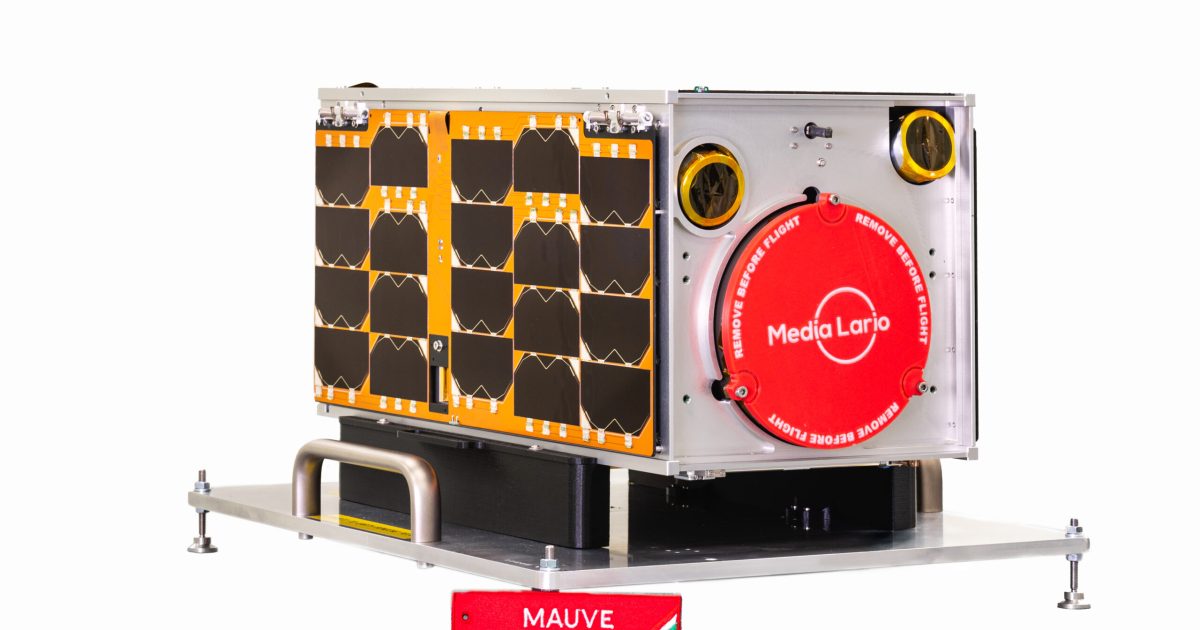
Mauve’s solar panels are folded flat and its telescope aperture sealed beneath a red "Remove Before Flight" cap. The CubeSat was photographed here during pre-launch testing, months before riding to orbit in November 2025 aboard a SpaceX Falcon 9 Transporter mission. Credit: C3S LLC/Blue Skies Space Let the science begin: The world’s first commercial space telescope is up and running. On July 6, Blue Skies Space delivered data from its Mauve satellite to the international roster of universities enrolled in the Mauve Science Program, shifting the mission into full scientific operations. It’s the next step for a mission that reached orbit in November 2025 and captured its first spectrum barely three months later. After a period of tuning and calibration, the space telescope is fully operational and delivering data to its customers. Blue Skies is close to publishing a peer-reviewed paper on that commissioning process, according to CEO Marcell Tessenyi. That’s just the first report out the door, though – research papers and fresh discoveries are expected to follow in the months ahead. “We are delighted to deliver the first datasets to members of the Mauve Science Program,” said Benjamin Wilcock, senior science program manager at Blue Skies Space, in a press release. “Over the coming weeks, we will ramp up data acquisition as we execute the first year of the observational program.” From launch to operations Mauve is a CubeSat about the size of a suitcase, carrying a 5-inch (13 centimeters) Cassegrain telescope. Built by the London-based company Blue Skies Space, it’s designed to track how a star’s brightness shifts over time — data astronomers can use to study stellar flares, binary systems, exoplanets and more. Mauve rode to orbit on Nov. 28, 2025, as one of more than 100 rideshare payloads aboard a SpaceX Falcon 9 Transporter mission. By Feb. 9, the satellite had achieved its first light: a five-second look at Alkaid, the hot, blue-white star at the tip of the Big Dipper’s handle, chosen because its well-known spectral features make an easy yardstick for a new instrument. The months since were spent further calibrating the instrument. That work involved watching a set group of stars with fixed brightness, allowing the team to isolate quirks in the instrument itself so they won’t mistake noise for stellar behavior in future observations. There was also the more basic problem of pointing. To figure out exactly where the telescope was aimed relative to what it was reporting, the team first turned to Jupiter to calibrate the instrument. Once commissioning and calibration were complete, the data began to flow. “You know, our satellite is in orbit, it’s in good health. We’re really, really happy with how the whole process has went,” Tessenyi tells Astronomy. “And we’re really happy to see all the instrumentation work on board and to see that we’re able to get the data down and we’re about to start getting some papers out and show the results to the world.” Small telescope, big science Mauve’s 5-inch (13 cm) telescope, a modified off-the-shelf commercial Cassegrain design, is a fraction of the size of the Hubble Space Telescope’s 2.4-meter mirror, let alone the 6.5-meter mirror on the James Webb Space Telescope or the 8.4-meter at the ground-based Vera Rubin Observatory. But Mauve wasn’t designed to compete with these large telescopes. Rather, it fills its own niche. Ground-based telescopes can’t see the ultraviolet light Mauve specializes in — Earth’s atmosphere blocks most of it before it reaches the ground. “By observing stars in ultraviolet light, wavelengths that can’t be studied from Earth, we’ll gain a much deeper understanding of how stars behave and how their flares may impact the environment of orbiting exoplanets,” Blue Skies Space Chief Scientist Giovanna Tinetti said in a press release when Mauve launched last year. “Traditional ground-based telescopes just can’t capture this information, so a satellite like Mauve is crucial for furthering our knowledge.” The big space telescopes have their limits, too. Hubble can see some ultraviolet light, but its schedule is stretched thin, leaving little room for the kind of repeat, months-long monitoring that Mauve can provide. JWST, meanwhile, is tuned mainly to infrared wavelengths, not UV. Mauve fills a specialized gap: parking on the same bright stars for months at a time, tracking how their ultraviolet brightness rises and falls, without competing for time. That specialization is the whole premise behind the Mauve Science Program, in which researchers buy into a satellite built around exactly the kind of observations their science needs. How the Mauve Science Program works Any university can join for roughly the cost of funding a Ph.D. student for a year according to Tessenyi, a price point “that hopefully is reasonable for most institutions to be able to take part,” he says. Eleven institutions have signed on so far, including Boston University, Columbia University, Rice University, Vanderbilt University, Kyoto University, Chalmers University of Technology, and more. Tessenyi likens the subscription model to the Sloan Digital Sky Survey’s: “In a sense, we’re a bit like SDSS but in space.” It’s one of several approaches to the same problem, he says — some efforts lean on philanthropic funding, others on university collaborations, and some institutions build their own instruments outright. “But I think we’re just part of the wider ecosystem where there is clearly pressure on more data being provided to the scientific community and I think people are experimenting [with] different ways of doing that.” Because no single government funds the satellite, he notes, there’s also relatively equitable access for those inside the Mauve Science Program. “One interesting element of this we’ve noticed by talking to the scientists who joined is that because we’re a private company and we’re not funded by a particular government, there is no geopolitics at play,” Tessenyi says. Anyone who joins the science program participates equally in determining how Mauve’s observation time is spent. “And as a consequence, it’s a very flat structure.” That structure resonates with researchers. Dr. Emma Whelan, an astronomer at Maynooth University, is one of Mauve’s science program members. In an interview with Blue Skies Space, she contrasted Mauve’s approach with how she’s spent most of her career getting telescope time: submitting proposals during fixed cycles, competing for time, then working within “observations [that] are usually defined well in advance, leaving little flexibility to respond to unexpected discoveries or intriguing developments in the data.” If something interesting turns up midcampaign, she said, researchers often have to submit an entirely new proposal and wait for the next cycle. Mauve, she said, “offers a fundamentally different approach,” letting her “adjust observing strategies as new results emerge, and pursue exciting discoveries in real time.” She expects the shift to spread beyond Mauve: “I believe that models like this are likely to become increasingly important in the future of astronomy.” Members of the science program shape the observing plan together before each observing year begins. The Mauve Science Collaboration’s paper outlining that plan was peer-reviewed and published in RAS Techniques and Instruments. It included four broad research themes: Stellar flares, star-planet interactions, hot stars, and unusual binary systems, split into 10 projects for year one. Whelan’s own project falls under the star-planet theme. She’s watching Herbig Ae/Be stars — young stars more than twice the mass of the Sun — for the brightening and dimming episodes astronomers call “bursters” and “dippers,” in order to trace how planets forming within the disk affect the accretion of material onto the star. Year two’s lineup depends on which institutions re-up and what year one turns up. If demand keeps growing, Tessenyi says that’s a welcome problem: Enough interest could justify building another satellite. Setting time aside for education Tessenyi also confirms that Blue Skies Space is developing an education program that would set aside a portion of Mauve’s observing time for the public, allocated through a proposal process similar to the one professional astronomers use to compete for telescope time. Details are still being finalized, but he says an announcement is coming. What’s next for Blue Skies Space? Mauve’s commissioning paper is still working through peer review, and Tessenyi hints it’s just the first of several updates in the pipeline. Blue Skies Space is developing Twinkle, a larger flagship satellite; a lunar radio astronomy CubeSat project funded in part by the Italian Space Agency; and a next-generation UV satellite informed by Mauve’s early performance. “The most important thing for us now is to see the data going to the members who joined and see what kind of publications come out of this,” Tessenyi says. Brooks Mendenhall is a staff writer for Astronomy and is based in Chattanooga, Tennessee.
The first commercial space telescope delivers
Full Article
Original Source
Read the full article at Astronomy →KhanList aggregates and links to publicly available news content. We do not host full articles from third-party sources. Always verify important information with original sources.