
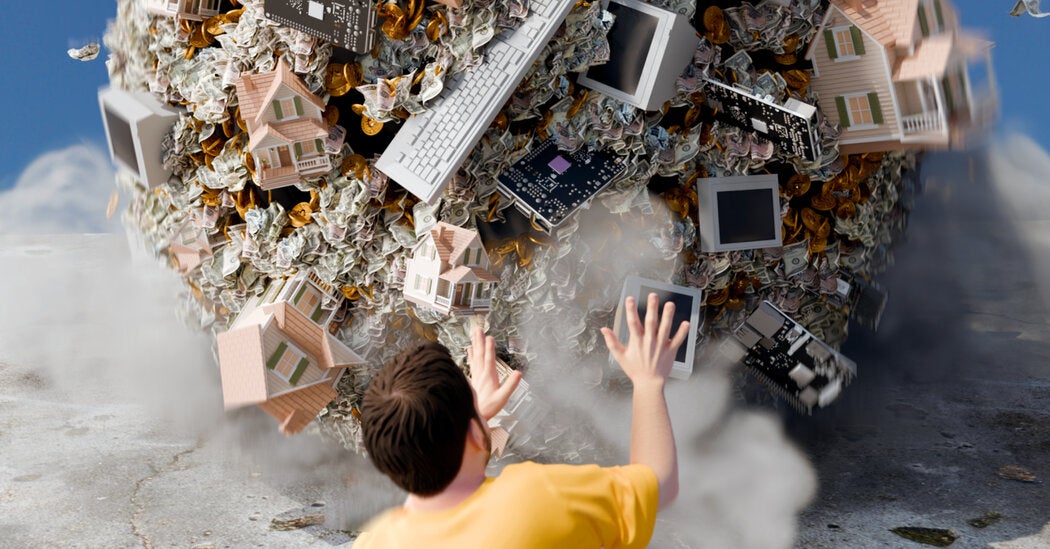
Credit...Danielle Del PlatoWe Cannot Keep Careening From Crisis to CrisisCredit...Danielle Del PlatoZachary D. CarterMr. Carter is the author of “The Price of Peace: Money, Democracy and the Life of John Maynard Keynes.”It wasn’t too long ago that Silicon Valley was celebrating the greatest invention in economic history. A dazzling new medium called cryptocurrency had arrived — at once an extraordinary investment, a government-proof digital money and perhaps a way to bring world peace. It would end global poverty and cure inflation. The possibilities were endless — until the public face of the crypto revolution landed in federal prison and the American president began winning his family millions through Trump-branded crypto schemes.Cryptocurrency still exists, though few take seriously the grandiose promises of yesteryear. As the public’s enthusiasm for digital currency faded, some of its most prominent boosters began showering praise on another shiny object: The artificial intelligence universe is just lousy with crypto players. A.I. “is our alchemy, our Philosopher’s Stone — we are literally making sand think,” trumpeted Marc Andreessen, whose firm has been one of the most influential crypto and A.I. players over the past decade.Of course, the extreme prognostications about artificial intelligence aren’t exactly like the woo-woo crypto hype of 2020. A.I. already has some genuinely useful applications in software development. It might even blow up the world! Maybe that’s why Silicon Valley’s hype machine has been so successful at turning the economy into a massive one-way bet on delivering a still undefined type of “superintelligence” to the globe. Last year, according to the St. Louis Fed, nearly 40 percent of American economic growth came from the A.I. build-out.These days, however, excitement is mutating into anxiety. A major A.I.-themed hedge fund collapsed over the summer. Days ago, shares of the A.I. chip giant Nvidia plummeted upon the abrupt resignation of its megawatt chief executive amid allegations of extramarital affairs with a Chinese spy and two women who reported to him. Whatever technological changes may lie in store, the bigger picture is starting to look a lot like a movie we’ve seen before — wild promises and warnings, unusual financing arrangements and the collapse of highflying adventurers. One of our newest industries is following a highly familiar script: The A.I. build-out has become so dependent on the riskiest lending practices of Wall Street that Silicon Valley itself might now be better understood as a wild, unregulated division of the banking sector.If you haven’t seen this movie, it usually ends in a mess: the 2008 financial crisis, or the collapse of railway mania in 1840s Britain that spurred an industrial depression, or the Panic of 1873 that caused a global catastrophe so bad they called it the Great Depression until that other one came along.When financial history repeats, fatalism can be hard to resist. It is genuinely disheartening to see people pitch and fall for farcical nonsense, time after time. But our present is not simply repeating the recent past — in important ways, the cycle is getting worse.Since the 1980s, the United States government has been subjecting more and more of the national economy to the risks of runaway finance. When any financial mania ends, the public shoulders the costs. Crushed stock markets erase savings and ravage job prospects. And when the government has to deploy taxpayer dollars to bail out, say, a major bank that got in over its skis, there’s less money around to fill the potholes, pay for the bus drivers or fund struggling schools. Almost everything working families rely on in daily life gets worse after a financial crisis, and the effects linger for decades in the form of lost earnings and family lives turned upside down by unemployment.It doesn’t have to be this way. Or at least, it doesn’t have to be this bad. About 90 years ago, the economist John Maynard Keynes observed that monetary markets are inherently preoccupied with stories about the future. We save money to spend it later; we spend now to build and attain the things our future selves will appreciate. Keynes realized that attempts to calculate the future value of an investment accurately would require a level of certainty about the future that human beings do not possess. Sometimes things just happen — strange wars, senile presidents — you never know. Financial judgments are thus inevitably susceptible to the “animal spirits” of human psychology, carrying “only a little more” scientific precision than predictions about “an expedition to the South Pole.”But Keynes insisted that while there may be no perfect economic system, there are degrees of dysfunction. The more a nation’s economy — be it based on manufacturing home appliances or on developing software — is absorbed by the vagaries of its financial functions, the more prone it will be to financial calamity.At a time when valuations for A.I. firms like Anthropic are rising into the trillions, the American government is pouring gas on the fire. President Trump has been heralding massive A.I. spending as the economic future, before championing the coming of a “Supreme Intelligence” (since modified to “Super Intelligence,” his preferred term of art). Mr. Trump loves a soaring stock market and understands that the stock market is currently running on A.I. spirits — more than a third of the entire value of all U.S. equities is now subsumed under A.I. stocks. By late summer, tech stocks accounted for more than half the value of the S&P 500.Not every stock market crash ends in a Great Depression, but the 1929 crash did. That experience persuaded the American government to implement a strict legal separation between financial activities and the rest of the economy — you couldn’t run a manufacturing operation that was also a bank. You couldn’t even run a bank that was also speculating in the stock market; these businesses had to be independently operated and regulated in order to isolate financial contagions, and to protect other economic sectors from the risks inherent to finance. And between the 1930s and the 1970s, this program basically worked. The catastrophic cycle of boom and bust that had plagued the American banking sector since the Civil War came to an end.In the 1980s, however, President Ronald Reagan ushered in a fundamental redesign of the American economy. There hadn’t been a serious bank crash for decades, and Reagan was convinced that post-Depression regulations and other government red tape were to blame for the rampant inflation and grim productivity that dogged the 1970s. The marching orders were clear: Decentralize government oversight, and unleash the power of American profit.These changes were not merely legal — they transformed the culture of the economy. For decades, bank executives had been the helpmates of heavy industry, living by the “3-6-3” mantra: borrow at 3 percent, lend at 6 percent, and hit the golf course by 3 p.m. Now they were to be masters of the universe, commanding the American economy from the skyscraper on down, disciplining bloated industry and complacent labor with the relentless drive for lower costs and higher profits. The earth-toned images of crime families and crooked cops that had dominated the late 1970s sharpened into the slicked-back icons of best sellers such as “The Bonfire of the Vanities” and “Liar’s Poker” and the director Oliver Stone’s “Wall Street.”By the end of the 1990s, it seemed like nobody could imagine an economy pushed onward by anything other than the wolves of Wall Street. When Bill Clinton reviewed his presidential achievements in his 2004 memoir, he didn’t even mention two major financial deregulation bills he had signed into law with overwhelming bipartisan support. Finance was fundamental; financialization was just how the world worked.The dismantling of Depression-era firewalls has predictably been accompanied by banking crises. As the 1980s turned to the 1990s, over a thousand ordinary savings and loans failed — roughly a third of the entire sector. Private equity firms had seized on new Reagan-era rules to turn these local lenders into dumping grounds for ultra-high-risk debt.A decade later, executives at previously staid banks like Wells Fargo, Citigroup and Bank of America were enjoying new abilities to cross state lines and storm into the insurance and securities businesses. Once regional operations exploded into multisector international behemoths whose byzantine exposures were all but impossible to track, let alone manage. Even General Motors, the nation’s largest auto company, began exploiting various legal avenues to transform itself into one of the nation’s largest mortgage lenders, a move facilitated by a 1997 Utah state law allowing the company to operate its own full-fledged bank. It was an open mockery of the wall between finance and commerce that had been built after the Depression. Federal regulators looked the other way — until the financial crisis. By 2010, the U.S. Treasury had devoted $17.2 billion to rescuing G.M.’s bank, and $49.5 billion to save General Motors. Congress authorized hundreds of billions of dollars to help save the rest of the nation’s financial system, with trillions more in emergency lending from the Federal Reserve.All of these debacles resulted in privileged insiders’ reaping enormous rewards while ordinary Americans were called in to clean up the mess. Banks dependent on public support paid out billions of dollars in bonuses to their top executives. The national unemployment rate hit 10 percent.Financialization changed American institutions and altered the national culture of work and reward. Today, roughly one in four young men in America trades stocks on a daily basis; a similar percentage of young men gamble on a daily basis. Most of them, according to a conservative think tank, “feel like failures.” The, ahem, traditional sports betting industry in the United States scored record revenues of nearly $17 billion last year — never mind the growth of the indistinguishable activity at new sites called prediction markets, which are moving $24 billion a month globally.Dudes have more time to trade these days: Between 1980 and 2000, the United States lost about two million manufacturing jobs. Mr. Clinton didn’t just deregulate finance; he attacked domestic industry by signing the North American Free Trade Agreement into law and welcoming China into the World Trade Organization. As a share of the U.S. economy, today’s financial sector is roughly triple the size of its post-World War II nadir — but even this figure is difficult to estimate, because so much financial activity has been subsumed into the tech world itself, with trillions of dollars in investment now hanging in the balance.Everywhere you look in 2026, multitrillion-dollar tech companies are storming into the financial world. Meta and Apple now move funds for digital shoppers around the world, while Amazon and Apple pitch credit cards. Nvidia, the country’s largest computer chip manufacturer, is also a major lender to the A.I. industry and its insatiable hunger for cash, approving $500 billion worth of partnerships with big banks and private equity firms. Nvidia doesn’t just make and sell the chips that power the A.I. revolution. It also invests in the data centers that power the technology, and is partnering with OpenAI and other A.I. developers to provide hundreds of billions of dollars in additional financing for still more A.I.-related projects.Nvidia is even in talks with insurance companies to insure these loans against default. This should sound familiar: In the early 2000s, big banks turned to the insurer A.I.G. to protect themselves against losses on risky mortgage bonds. But when home prices crashed, A.I.G. collapsed, risking the viability of Goldman Sachs, Citigroup, Wells Fargo and others. Insurance did not alleviate financial risk — it loaded an extra layer of financial risk atop the market, amplifying dangers rather than reducing them.Whether Nvidia can, in fact, secure an insurer remains to be seen. But the impulse is revealing. By operating as a lender, Nvidia is already injecting the instability of Wall Street directly into what has become the most economically critical manufacturing operation in the country — as a matter of standard corporate policy. How fitting that the executor of many of Nvidia’s aggressive financial moves, the chief financial officer, Colette Kress, has just been named its interim chief executive; the company’s financial maneuvers may be as critical to its future as its physical products.Nvidia isn’t propping up the sector alone. A multitrillion-dollar sub-industry of “private credit” — a term of art for loans made beyond the purview of traditional financial regulations — has ballooned at the nation’s largest banks and private equity firms. And this shadow market just happens to specialize in hard-to-value projects related to A.I. and data centers.The candle is burning from both ends. Wealthy individuals are increasingly relying on tech stocks as collateral for loans that are propping up our economy — loans to buy real estate, or cars, or even more tech stocks. A tech blowup could thus easily disrupt lending to other sectors of the economy: Mess with either the A.I. build-out or its increasingly fragile financial underpinnings, and both will be in trouble. They are already in many respects the same entity.In other countries, innovation isn’t so heavily focused on A.I. China is investing in A.I. too, but it is accompanying its computer push with $2.2 trillion a year in green tech investment that is about strengthening manufacturing prowess rather than pure processing power. China has been developing better solar panels, more powerful wind farms, more efficient batteries and a new generation of electric vehicles. These innovations have their own stories to tell about the future, but there is an important difference between promising to improve something that already exists — say, a car, an effort that adds jobs — and vowing to change the technological foundation of all work without a plan. In the United States, the bulk of A.I. spending goes into building data centers with temporary local benefits; once they’re built, the construction jobs are gone, while the tax incentives deployed to get them constructed drain resources from state and local governments.It is folly to hope the Trump administration will do anything to avert an A.I.-driven financial crisis. The administration is not only encouraging the tech industry’s leap into the turbulent waves of finance; it is helping car manufacturers get back into banking, too. In January, about 17 years after our government was forced to bail out G.M.’s bank, the Trump administration approved applications from Ford and G.M. to open new banks, headquartered in Salt Lake City.This is probably going to hurt all of us, and managing the fallout from a crash is as much art as science. How we ought to structure the economy going forward, however, has been clear since the Great Depression: Don’t let big business merge with big finance. Our government needs to hold big tech and big finance accountable for operating deeply uncertain businesses with vast public consequences. We need smaller, simpler tech companies that support American industry rather than dominating it.A.I. optimists tend to spend a lot of time talking about how the technology will cure cancer or end poverty — an acknowledgment that A.I. is a means to other advances that actually matter to people. If you follow the money, however, Silicon Valley is far more focused on generating more computing power, in the belief, held by some, that it will give A.I. superhuman abilities that will fix all of our problems. Not everyone agrees with that belief. Major A.I. executives can’t even agree on what A.I. is. (Most do seem to agree that they should not be liable for crimes committed with their new tools.)Better computers can help with all kinds of things, but you can’t cure cancer with data centers alone. As with the pandemic-era crypto boom, A.I. has let its stories about the future run so far ahead of economic reality, the ultimate project starts to look like sweeping economic change for the sake of sweeping economic change. There are better futures to bet on.Related ContentAdvertisementSKIP ADVERTISEMENT
The Financial Bubble Cycles Are Getting Worse
Full Article
Original Source
Read the full article at Nytimes →KhanList aggregates and links to publicly available news content. We do not host full articles from third-party sources. Always verify important information with original sources.