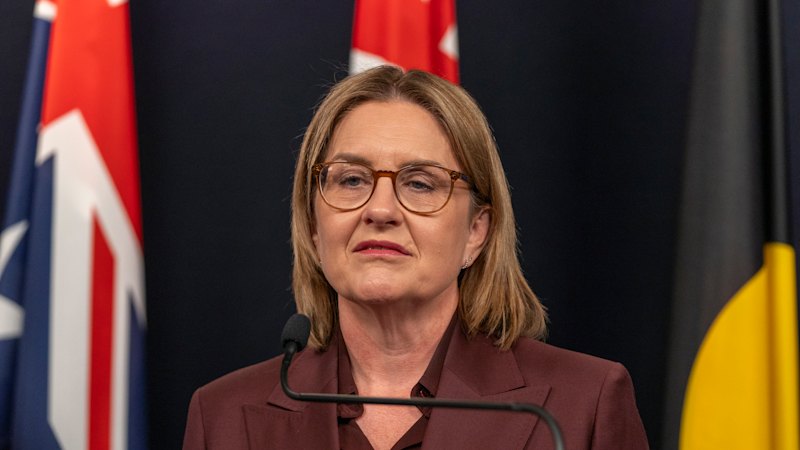
Two weeks ago in Bentleigh East, a part of Melbourne where neat, orderly rows of brick veneer houses speak to suburban comfort and simpler times, a car carrying Jacinta Allan pulled up outside an Indian community centre.The Datta Yoga Centre, or DYC, is a spiritual place where, guided by Hindu teachings, Indian-Australians gather to promote universal brotherhood, wellbeing and social cohesion. When Allan hopped out of the car, about 30 smiling community volunteers were waiting outside to welcome her arrival.Jacinta Allan announces her resignation on Tuesday.Jason SouthAs she moved across the footpath to greet them, a man from across the road screamed at her: “Jacinta, you are a traitor to Australia.”In that moment, Allan understood with renewed clarity why she is in politics and why, despite mounting speculation that colleagues were plotting to force her out of her job, she needed to lead the Victorian government into the November election.“That’s why I’m not for turning,” she told The Age last week, as word of a potential challenge started to spread. “I know who I am fighting for and I know who I am fighting against.“I am not interested in fighting my colleagues internally, I am interested in fighting the real enemy.”The episode strengthened Allan’s conviction that the coming election is unlike any this state has seen before. Although the headline contest is between Labor seeking an unprecedented fourth consecutive term, and the Coalition a long-awaited return to power, it is also a plebiscite on whether the rank populism of One Nation should have any influence on Victorian affairs.This is why, when Allan finally decided late on Monday night to stop fighting, it was such a wrench.With Monday falling at the start of a parliamentary sitting week, Allan spent the night in Melbourne instead of the semi-rural home on the outskirts of Bendigo she shares with her husband, Yorick, and two school-aged children, Peggy and Cormac.Her closest advisers remained close by. The colleagues she entrusted to gather numbers on her behalf for an expected caucus-room showdown, senior ministers Steve Dimopoulos and Sonya Kilkenny, updated her on the progress of their count.Their news wasn’t good.Members of her own Left faction were lining up behind Deputy Premier Ben Carroll. Leading women of Labor’s Left – ministers Gabrielle Williams and Ingrid Stitt – had sat in her office as part of a cross-factional delegation and told her she no longer had their support.Carroll had the numbers he needed to spill the party’s leadership. If she were to save her leadership, it would require forcing a ballot of all rank-and-file party members – a move provided for under party rules, but one that would plunge her government into limbo for six weeks.Allan believed she could still win the election. Even in the depths of this week’s leadership crisis, published opinion polls showed that support for Labor, while tepid, had not entirely collapsed. She believed that, as Victorians moved closer to an election and a real choice about who they wanted in charge, the contest would tighten.She also knew it was in nobody’s interest – her party, her government or ordinary Victorians disconnected from the goings-on of Spring Street – for her to drag things out that long.Whatever the eventual result, a protracted leadership contest just four months before the election would forever damage her relationship with the party she has represented in parliament for 27 years, and the relationships she had built with colleagues over countless hours spent in common purpose or disagreement.The party that most stood to benefit from such a spectacle was One Nation, a movement which weaponises grievance against politics-as-usual and the idea that both major parties are more focused on questions of power and position than the needs of average voters.As one of Allan’s confidantes remarked: “She could have opted to burn the joint down. She didn’t. That is her.”On Tuesday morning, shortly before the caucus meeting where Carroll was endorsed as Victoria’s next premier, Allan told her staff she had decided to resign. She then fronted a hastily arranged press conference where she related the enduring and at times conflicting advice she had been given by her parents.Her mum taught her to never give up. Her dad taught to always do the right thing. “Recently, I’ve reflected on how deeply, deeply these two lessons have shaped me, and the fact they don’t always point in the same direction.” This day, giving up was the right thing to do.“I am making this decision because it is the right thing by the Labor Party and by the Victorian people,” she said.“I was prepared to put my record and my plan to a ballot of members, as our rules allow. I believe I would have won. But doing so this close to an election takes up valuable resources, including the most precious one – time. More importantly, it puts the state in a position of uncertainty. That hurts the Victorian people, and I just don’t do that.”Allan did not take her place on Labor’s sprawling backbench when parliament resumed. When she returns to her electorate of Bendigo East, she will announce to her local constituents that she will not contest in November the seat she has held since the unexpected start of the Bracks and Brumby governments in 1999. It is a seat Allan now would have struggled to win.The most surprising moment of Allan’s resignation speech is what she had to say about Carroll.Allan has endured regular speculation about her leadership since the start of last year, when Labor’s primary support slumped to nadir of just 22 per cent – as measured by the Resolve Political Monitor published by this masthead – and anxious colleagues started to size up Carroll as a break-glass replacement.Her supporters believe she was the target of a relentless destabilisation campaign led by people in the Labor movement but outside the caucus. “It is fair to say there are a couple of people who brought the Rudd/Gillard disease to Victoria,” one observer noted.Ben Carroll had been Jacinta Allan’s deputy since she took over from Daniel Andrews after he resigned in September 2023.Marija ErcegovacThis is a reference to the role played by two of the party’s most experienced factional operatives, former federal MP Alan Griffin and former senator Stephen Conroy, in variously coaxing, encouraging and cajoling MPs within their respective Left and Right factions to make what they saw as an essential change for the good of the party.If Allan blames Carroll, a former adviser to Conroy, for any of this, she kept it well concealed on Tuesday. Instead, she offered her full endorsement – a sentiment almost never heard from premiers or prime ministers on the sharp end of a leadership spill.“Should Ben Carroll emerge as our next Labor leader and Labor premier, he will have my congratulations and unqualified support,” she said.Allan’s legacy is complex. She served in a Labor government that came to power with energy and purpose. As a senior minister, she oversaw some of its best achievements and worst excesses. As premier, she never escaped the shadow cast by her predecessor Daniel Andrews or fully accepted responsibility for the corruption of major infrastructure projects and the waste of public money which occurred under her watch.Like Julia Gillard, Allan has a warmth that voters rarely got to feel during her three years in the top job. Once the TV cameras were rolling, she never fully trusted herself to put down the A4 sheet of talking points provided by her office and just speak to people in her own way.In her leaving, Allan was all class.Start the day with a summary of the day’s most important and interesting stories, analysis and insights. Sign up for our Morning Edition newsletter.From our partners
The final hours: How Jacinta Allan realised it was time to stop fighting
Full Article
Original Source
Read the full article at Smh →KhanList aggregates and links to publicly available news content. We do not host full articles from third-party sources. Always verify important information with original sources.