
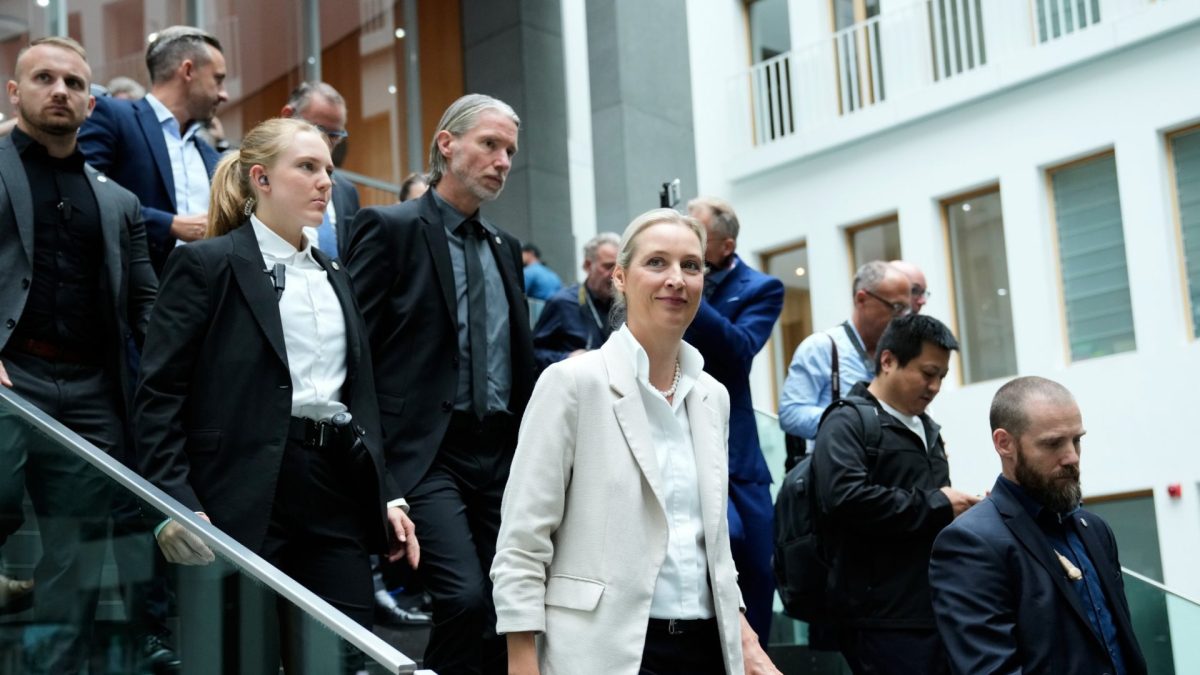
Germany’s extreme-right party, backed by Donald Trump, has won a “sensational” victory in the eastern state of Saxony-Anhalt. Preliminary results show that Alternative für Deutschland – Alternative for Germany or AfD – has taken 43.8 per cent of the vote but fallen short of an outright majority. This means it can’t govern alone and will now need to engage in negotiations with rivals to form a coalition. However, the result is significant. If it manages to form a government it will be the first time since the Second World War that a far-right party has controlled a German state. Shorts The leader of the AfD in Saxony-Anhalt, Ulrich Siegmund, said it was a “sensational” victory. “This isn’t just about Saxony-Anhalt,” he said after the result. “It’s a signal for the whole of Germany – a self-confident signal.” Resounding success – but not enough to rule alone The AfD’s vote share more than doubled since its last result in 2021, and is expected to give it powers over policing, local education and culture in Saxony-Anhalt. The closest rival was the centre-right Christian Democrats (CDU) of the Chancellor Friedrich Merz, which took 17.2 per cent of the vote, while the centre-left Social Democrats (SPD) polled 9.3 per cent, the Greens 8.9 per cent and the Left Party 8.6 per cent. While Saxony-Anhalt has a small population of 2.1 million, the AfD’s victory is part of a wider trend in Germany. The party came second in last year’s federal elections, winning a record 152 seats in the 630-seat parliament with more than a fifth of the vote. Grégoire Roos, director for Europe and Russia and Eurasia at Chatham House, previously described the AfD as moving from “peripheral protest to the country’s main structural political force, shaping the national agenda on migration, energy and the debt brake”. Mass deportations and a ban rainbow flags: What the AfD wants The AfD was founded in 2013, largely in response to European integration, but has become synonymous with hardline, anti-immigration ideas. The party has been classified by German authorities as “right-wing extremist”, something it rejects. The domestic intelligence agency said that the AfD does not view citizens of a “migration background from predominantly Muslim countries” as equal members of German society. Saxony-Anhalt was one of the AfD branches specifically classed as right-wing extremist by the domestic intelligence agency, with specific allegations raised about racism. “Numerous anti-Muslim, racist and antisemitic statements by officials and elected representatives of the state association demonstrate that the AfD in Saxony-Anhalt seeks precisely such an ethnoculturally homogeneous national population and calls for the exclusion of people on the basis of their origin or religion,” the agency said. Co-leader of AfD Alice Weidel leaves a press conference in Berlin, Germany, on Monday. Preliminary results show that the party has taken 43.8 per cent of the vote but fallen short of an outright majority (Photo: Ebrahim Noroozi/AP) AfD co-founder Alice Weidel has used the term “remigration” – which is generally understood to reference the mass deportation of those with a foreign background – and discussed “large-scale repatriations”. Lena Kotre, an AfD lawmaker in Brandenburg, pledged that if the party came to power in the state: “People will be deported until the runway glows hot.” Despite Saxony-Anhalt suffering from a long-term shortage of skilled workers and population shrinkage, the AfD wants to reduce immigration to the area and exclude children who do not have permanent residency in Germany from attending regular schools. It says it will focus on bringing Germans living overseas back to fill jobs shortages. Some AfD figures have been accused of minimising Nazi crimes or seeking to reduce efforts to commemorate the Holocaust, describing a “guilt cult” of excessive focus on Germany’s Nazi history. The AfD is also pro-Russian. It has repeatedly called for an end to German support for Ukraine and to resume purchasing Russian oil and gas. This was largely suspended after Russia launched its unprovoked invasion of Ukraine in 2022, which has killed tens of thousands of people. Its programme calls for greater Russian language teaching in schools and promotes “maintaining good relations with Russia, both economically and culturally”. AfD leaders have also called for an end to support for Ukrainian refugees, of which Saxony-Anhalt reportedly has around 31,000. Election poster of for the AfD in August Berlin. While Saxony-Anhalt has a small population of 2.1 million, the AfD’s victory is part of a wider trend in Germany` (Photo: Frank Hoensch/Getty) The AfD also wants to set up an auxiliary police force to enforce security, which it describes as a “voluntary citizen patrol as a third pillar of the local security architecture”, and ban rainbow flags – symbols of LGBT+ rights – in schools. It is not clear how many of its policies an AfD state government could implement, because many are decisions made at a federal government level or enshrined in international law. Friends in high places Despite concerns about its extremist ideology, the AfD has some high-profile fans. As the result of the Saxony-Anhalt election broke, US President Donald Trump posted a screenshot of the poll showing the AfD’s projected victory. This post was later shared by the Russian presidential envoy Kirill Dmitriev, who praised a “historic win for the pragmatic AfD”. AfD Saxony-Anhalt leader Siegmund also thanked tech billionaire and former Trump adviser Elon Musk for his backing. Musk has previously called the party “the best hope for Germany”. US Vice President JD Vance has also expressed support for the party, including meeting its leader. ‘Serious moment in Europe’ The Polish prime minister, Donald Tusk, who is centre-right, said: “In Poland, only idiots and traitors can rejoice at the triumph of the AfD”. But the AfD, and its ties to the Trump administration, pose a severe challenge to mainstream European parties. France’s Europe minister Benjamin Haddad said the win was “a serious moment in Europe”, warning that “nationalism and xenophobia will never be a solution”. Almost one in four voters in Europe now support far-right parties, research found in June, with the rate growing nearly fivefold since the mid-90s. Across Europe, politics has seen a swing towards populism, with Giorgia Meloni assuming power in Italy, Robert Fico’s pro-Putin party winning Slovakia’s election and The Netherlands’ far-right, anti-Islam Freedom Party counting a dramatic victory in 2023. The UK has seen the growth of Reform and Restore, which promote anti-migration policies. AfD supporters gather to hear AfD lead candidate Ulrich Siegmund speak at a campaign rally prior to the Saxony-Anhalt state elections in Naumburg, Germany (Photo: Sean Gallup/Getty) Dr Matthew Varco, of Germany’s Trier University, described the far right’s “increasing electoral force” as a “transnational European trend”, linking it to disillusionment with establishment parties, a push against immigration and the breakdown of alliances and norms in post-war party democracy in Europe. “How to respond to the resurgent right at a parliamentary level is now a burning question for Europeans of numerous political stripes,” he said. Not all far-right parties are thriving, however. The hard-right Hungarian leader Viktor Orbán was toppled this year after 16 years in power, key Meloni reforms to the judiciary were rejected recently in Italy and The Netherlands’ Freedom Party was beaten by the centre-right last year. But without a sea change in European politics, the AfD may continue their rise – and inspire similar movements across the Continent.
The far right just won a major victory. This is what it means for Europe
Full Article
Original Source
Read the full article at Inews →KhanList aggregates and links to publicly available news content. We do not host full articles from third-party sources. Always verify important information with original sources.