
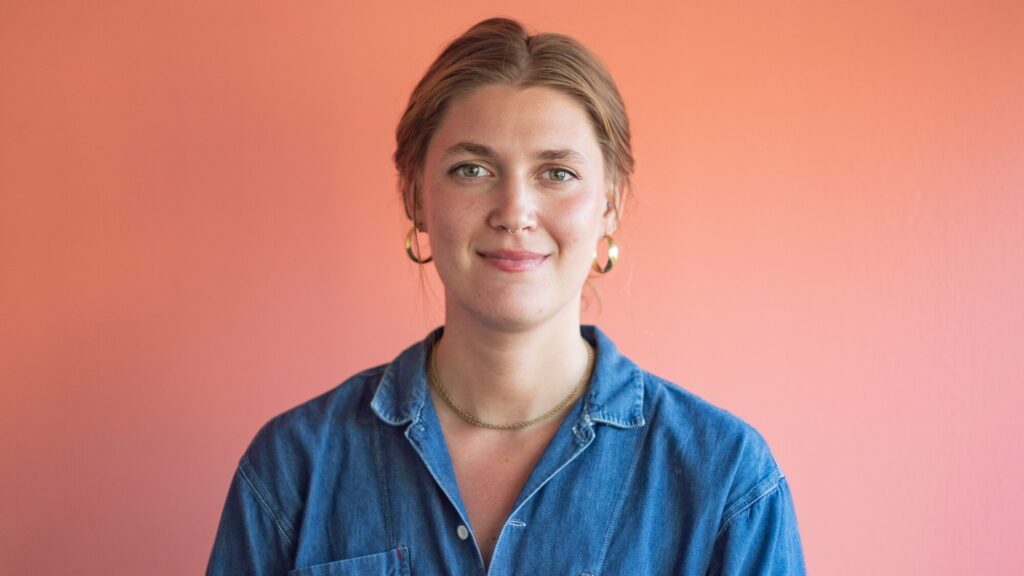
Betsy Pleasants was studying one historic disruption to abortion access when a more seismic one emerged. In spring 2022, as a graduate student at UC Berkeley School of Public Health, Pleasants was researching the effects of the Covid-19 pandemic on abortion services when a leaked draft opinion indicated that the U.S. Supreme Court would overturn Roe v. Wade. The court finalized its decision that June, ending the nearly 50-year-old constitutional right to abortion and ushering in an era of rapid change and increased state restrictions. Working with her thesis committee, Pleasants, who is interested in expanding access to abortion and other reproductive health care, adapted her dissertation to study conversations on the social network Reddit. Her new focus was tracking emerging barriers to abortion access in real time and examining the role of online resources in connecting people with evidence-based health information and services. “When it became clear that Roe v. Wade was going to be overturned, we all agreed that we had to shift the project,” said Pleasants, now a postdoctoral research associate at the Center for Women’s Health Research at the University of North Carolina. The Supreme Court decision “is something that required a response, and this project was positioned to offer timely insights into what this policy change means in people’s lives.” Pleasants and her colleagues plumbed thousands of posts from the Reddit forum r/abortion using natural language processing (NLP) — a type of computational analysis used to identify patterns in human language — alongside a qualitative close reading of a subset of posts. Through this dual approach, grounded in safeguards for user privacy, Pleasants is defining a framework for using artificial intelligence tools without losing sight of the context, complexity, and people behind the data. “We are in a complex policy moment for reproductive health,” said Pleasants, who was recently named a STAT Wunderkind. This type of research “is an act of documenting in an effort to work towards evidence-based policy change over time, and to advocate for the change that’s needed to promote access to reproductive health care.” Findings by Pleasants and her colleagues reaffirmed well-established barriers to access, including high costs and limited appointment availability, while also revealing lesser-known challenges, such as delays in receiving abortion medications by mail, low credibility of online ordering platforms, and concerns about the legal risks of seeking abortion or related medical care. “Embracing this opportunity and new methods was visionary,” said Ushma Upadhyay, professor in the Department of Obstetrics, Gynecology, & Reproductive Sciences at the University of California San Francisco, who mentored Pleasants during her doctoral research. “At the time, I didn’t know of any other studies using NLP to study online discourse on abortion. Most researchers will just take a random sample of a manageable number that they can analyze, and so this approach was really great because Betsy was able to get a more complete picture.” For scientists like Pleasants, the value of NLP goes beyond making large-scale research more efficient. It offers a broader view of how people communicate and behave at a scale that would otherwise be difficult to capture. “Computational research is like a stepping stool over a tall fence that lets you look at the other side and see everything that’s around you,” said Danny Valdez, associate professor of public health at the Indiana School of Public Health-Bloomington, who has employed NLP to study vaccine misinformation, addiction and recovery, and cancer care. “NLP, machine learning, and, increasingly, AI methods give you a 1,000-foot overview of how people communicate when they need help. You can learn a lot about the pulse of the nation, which helps us understand and inform where future policy could be headed.” A new model for studying online discourse Growing up in North Carolina, Pleasants got her first window into how people access health information, sparking an interest that would eventually shape her career. Even in Durham, a liberal core city of North Carolina’s Research Triangle, she recalled receiving abstinence-only sex education from a gym teacher. The contrast between the information she received at school and at home made her aware of how unevenly health knowledge and resources could be distributed. “I saw peers and other people in the community navigating not having good sex education, not having access to desired health services, and stigma,” said Pleasants. “All of these things really shaped the capacity they had to make decisions for themselves about their reproductive health.” Those early observations would become a throughline in Pleasants’ career, from earning her undergraduate degree at the University of North Carolina to completing her master’s and doctorate at UC Berkeley, and ultimately returning to UNC for her postdoctoral research. Pleasants entered college with an eye on becoming a physician, but was instead drawn to medical anthropology and broader discussions of how history, politics, and culture have shaped, and continue to shape, the U.S. health care system. “A big question that came up for me was: ‘Do I want to work within that system or do I want to critically engage with it?’” said Pleasants. “So, I ended up on this trajectory of research with an interest in asking questions of how we offer health services, particularly for women, and seeking to understand how we can make that better for all people as much as possible.” Analyzing r/abortion while at Berkeley allowed Pleasants to capture perspectives often overlooked by conventional research methods. The platform’s relative anonymity gave people space to speak candidly about personal experiences they might hesitate to share elsewhere. And because most community members had not interacted with the health care system, their experiences would often be missed by practice-based analysis. “Following the reversal of Roe v. Wade, a lot of people were turning to Reddit for support,” said Upadhyay. Pleasants and her collaborators used NLP to analyze more than 7,000 posts from the months before, during, and after the leak of the Supreme Court’s draft decision, identifying 55 distinct topics. Human oversight was integral throughout, both to validate the computational approach and to guide deeper qualitative analysis. The team closely examined posts within the identified topics to understand not only what people were discussing, but how they were navigating their experiences. The research revealed a wide range of barriers to abortion care, from state bans, high costs, and long travel distances to stigma and lack of social support. It also surfaced emerging challenges, including delays receiving abortion medications by mail, uncertainty about the legitimacy of online services, and concerns about potential legal risks. The qualitative analysis provided further insight into the impacts of these barriers, including anxiety and isolation and, in some cases, the need to self-manage abortions. The emphasis on human supervision also extended to protecting the privacy of Reddit users. As NLP and AI tools become more widely integrated into public health research, their use has fueled broader discussion, both within the research community and among the public, about the ethical use of online data. Pleasants said the stakes are particularly high in reproductive health research. “We are studying issues that are, at minimum, sensitive and stigmatized, and in some cases even pose risks for prosecution,” she said. “This becomes even more complex when you’re working with publicly available data where people may not be aware that their posts could be used for research.” To protect Reddit users, the team employed a “heavy disguise” process, replacing potentially identifiable posts with composite quotations that combined and rephrased similar experiences. The researchers then tested these composites using online searches and plagiarism-detection tools to help ensure they could not be traced back to their original sources. Together, these practices have established a model for studying sensitive online discourse at scale. “As this technology keeps getting faster and faster and faster, you do have very talented and forward-thinking researchers like Betsy, who are slowing things down and looking at how to make this as rigorous and concrete as possible through a very firm qualitative lens,” said Valdez, who was not involved in Pleasants’ research, though both have received funding from the Society of Family Planning. “We need work like Betsy’s that’s already acknowledged the difficulties of social media mining … and to show very high regard for the content that people are leaving on social media.” Today, Pleasants said her research, which has now expanded to include contraception and misinformation online, has taken on greater urgency as shifting policies increasingly constrain access to reproductive health care. She noted that researchers, advocates, and clinicians in the field have long worked amid scrutiny and uncertainty. “The importance of the research doesn’t lessen just because policies make the work harder. Rather, the opposite seems true right now,” she said.
The fall of Roe dramatically changed abortion access. This researcher used Reddit to capture how
Full Article
Original Source
Read the full article at Statnews →KhanList aggregates and links to publicly available news content. We do not host full articles from third-party sources. Always verify important information with original sources.