
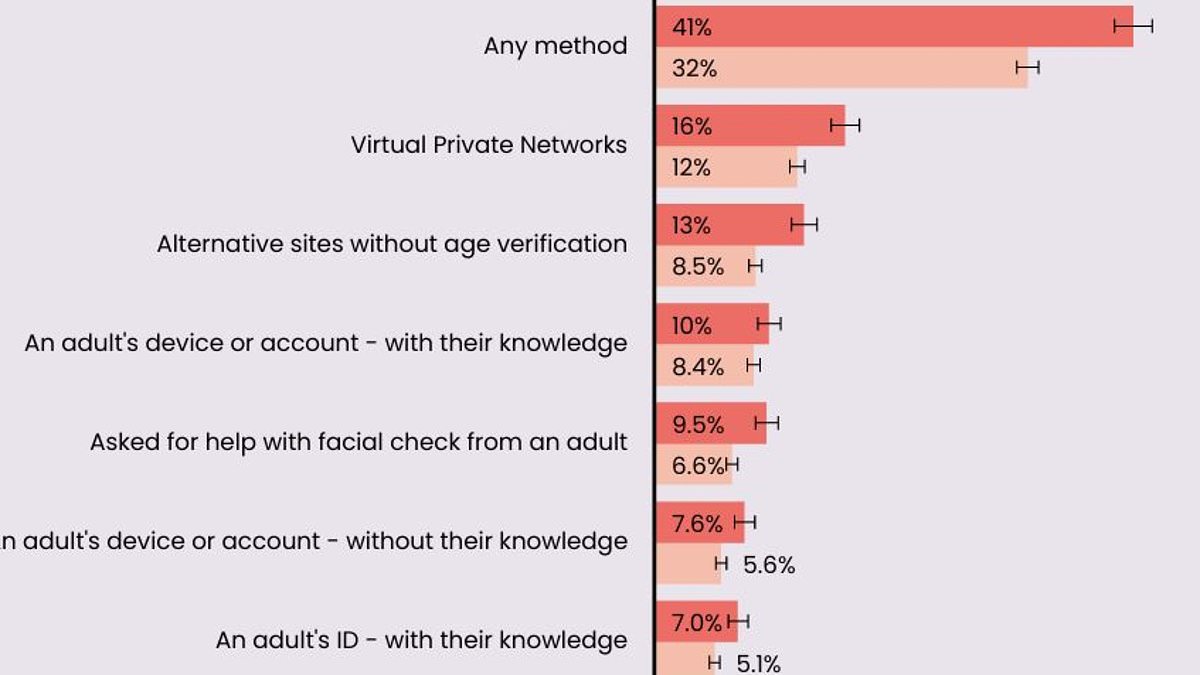
It's been more than a year since the Online Safety Act cracked down on children accessing harmful content online.But a new study shows that the government's efforts haven't kept determined teens from surfing the web.Research conducted by the Youth Endowment Fund discovered that a third of UK teens have bypassed online age checks.By far the most popular method, used by 12 per cent of all 13-to-17-year-olds, is Virtual Private Networks or VPNs.VPNs hide a user's actual location by rerouting their connection through a remote server, making it appear that they are visiting the site from a country without age checks.Jeremy Miles, CEO of the Youth Endowment Fund, says: 'Age restrictions could help reduce children’s exposure to harmful content, but many teenagers simply find ways around them.' A third of teens aged 13 to 17 are getting around age verification checks using VPNs or sneaking onto a parent's account The Youth Endowment Fund's new report is based on a survey of 9,988 children in England and Wales carried out between May and July 2026, almost a year after the Online Safety Act’s child safety duties came into force.In theory, this legislation required all websites hosting 'harmful' content to put robust age restrictions in place to prevent under-18s from gaining access.However, in reality, the bigger, more well-regulated sites put restrictions in place while smaller, less scrupulous operators simply ignored the rules.Recent research from the Lucy Faithfull Foundation found that nearly 45 per cent of UK over-18 porn users have visited sites without age verification checks since the rules came into effect.Now, the Youth Endowment Fund has shown that under-18s have been exploiting the same gaps in regulation.Of teens who use social media for more than five hours a day, 13 per cent said they access alternative sites without age verification.However, some teens have been more creative in their workarounds, even recruiting help from adults.Over eight per cent of all teenagers said they had used an adult's account or device without their consent to avoid an online age check. VPNs hide a user's actual location by rerouting their connection through a remote server, making it appear that they are visiting the site from a country without age checks (stock image) The most common reason for bypassing age restrictions was to access pornography, followed by age-restricted content showing fictional violence, including cartoons, TV shows, and movies The most common ways kids are bypassing age checks VPNs: 16%Alternative sites without age verification: 8.5%An adult's device or account - with their knowledge: 8.4%Asked for help with facial check from an adult: 6.6%An adult's device or account - without their knowledge: 5.6%An adult's ID - with their knowledge: 5.1%An adult's ID - without their knowledge: 3.9%Other ways of accessing age-restricted content: 3.7% Meanwhile, five per cent said they had asked to borrow an adult's ID to pass the check, and 3.9 per cent said they had taken an adult's ID without permission.Over six per cent of teenagers even said they had asked an adult for help passing automated facial recognition systems, designed to determine age based on a photo or video.For teens who spent more than five hours on social media per day, all of these rates were higher.Perhaps unsurprisingly, the most common reason for bypassing age restrictions was to access pornography.A quarter of all teens who admitted to finding a way around the restrictions said they did so to visit 'sites showing nudity or sexually explicit content'.That was followed by 'violent content involving fictional characters or cartoons', visited by 18 per cent of teens.This includes any age-restricted content that is fictional in nature and depicts violence, including cartoons, anime, TV shows or movies with real actors.Meanwhile, one in six teens who bypassed age restrictions did so to access online gambling or betting, while 12 per cent visited sites showing 'violent content involving real-world people'. Researchers found that children who spent more than five hours on social media per day were more likely to have bypassed age verification checks Despite supporting age restrictions on social media, almost half of teens still say they would go to 'any means' to retain access if a ban were introduced Boys were more likely to access every form of age-restricted content besides content related to self-harm or suicide, which was visited by 10 per cent of girls compared to 7.2 per cent of boys.Mr Miles says: 'Tech companies must do more to protect children from harmful and illegal content.'We have laws in place to hold them accountable, and those laws must make a difference in what children see online.'Despite going to such lengths to avoid these restrictions, 88 per cent of teenagers still say there should be a minimum age to access social media, although only a third thought it should be 16 or older.Almost half of teenagers thought spending less time on social media would improve their family relationships and mental health.However, that does not mean teenagers would accept a ban themselves, with almost half saying they would find a way to bypass the restrictions if they were imposed on their age group.Elijah, Youth Endowment Fund Youth Advisory Board member, says: 'The reality for a lot of young people is if you take away their social media access, then you're taking away their sense of community and connection to others.'I think what's really important is to make sure that young people don't fill this lonely gap with more harmful content.' What is the Online Safety Act?The Online Safety Act 2023 (the Act) is a new set of laws that protects children and adults online. It puts a range of new duties on social media companies and search services, making them more responsible for their users’ safety on their platforms. The Act will give providers new duties to implement systems and processes to reduce risks their services are used for illegal activity, and to take down illegal content when it does appear.The strongest protections in the Act have been designed for children. Platforms will be required to prevent children from accessing harmful and age-inappropriate content and provide parents and children with clear and accessible ways to report problems online when they do arise.The Act will also protect adult users, ensuring that major platforms will need to be more transparent about which kinds of potentially harmful content they allow, and give people more control over the types of content they want to see.Source: UK government
The fake IDs of the 21st century: A third of teens have bypassed online age checks using VPNs or by sneaking on a parent's account, study finds
Full Article
Original Source
Read the full article at Dailymail →KhanList aggregates and links to publicly available news content. We do not host full articles from third-party sources. Always verify important information with original sources.