
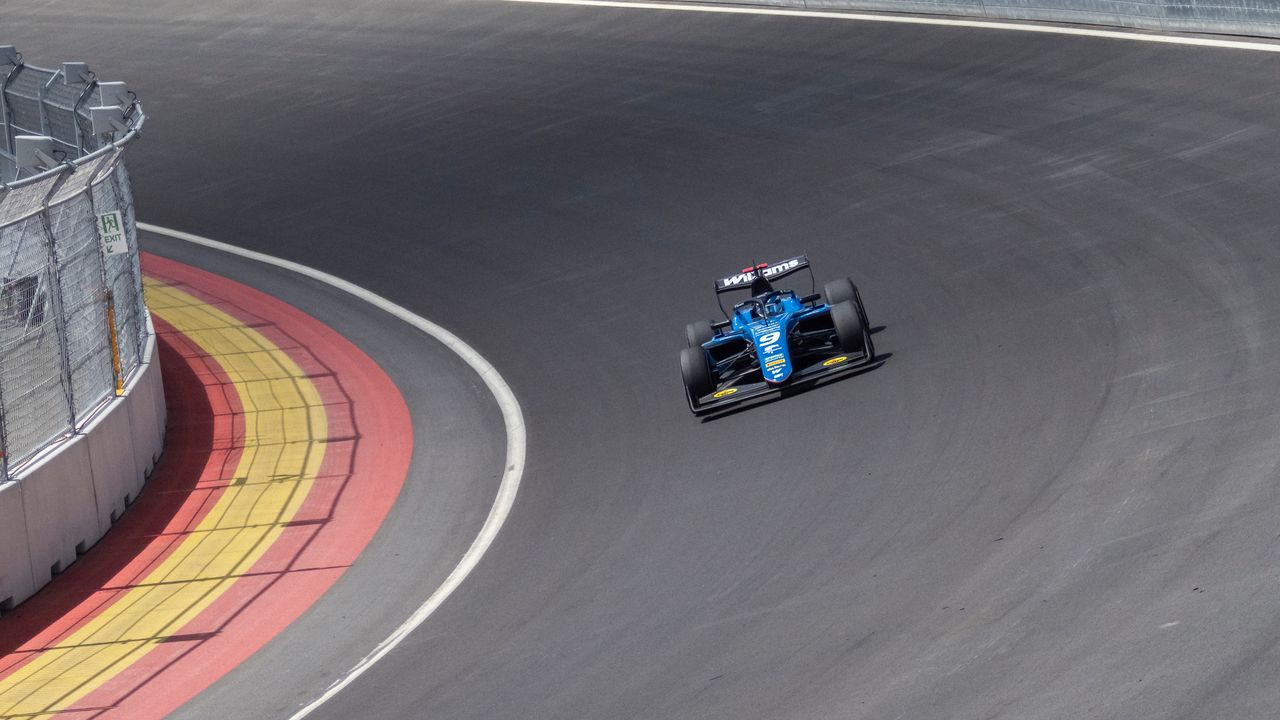
It’s been a long and hectic three years for Jarno Zaffelli.The Italian racetrack designer and founder of Dromo, a firm based in Italy, Singapore, and the United Kingdom, has built more than 200 courses for a variety of motorsports throughout his 25-year career. But this weekend, his most ambitious design will finally come to life: the Madring, a highly anticipated Formula 1 street circuit in Spain’s capital.“Testing was very positive, so I am quite excited to see what Formula 1 has to say,” Zaffelli tells AD. Street circuits, or tracks that utilize closed-off sections of public roads, are often critiqued by drivers and fans for leading to dull races because the track is too narrow for overtaking, but Zaffelli is hopeful his new design will break the mold. “No other course has this particular character, in my opinion, in terms of its flow.”In July, the Ferrari F1 team tested out the track. Courtesy of MadringIn recent years the swanky, globe-trotting motorsport has enjoyed a popularity surge thanks in large part to the success of the Netflix docuseries Drive to Survive, which humanized Formula 1 drivers—turning the likes of Lewis Hamilton and Max Verstappen into household names. The show introduced a new audience to the drama and dangers of the sport over eight seasons. As a result, new courses have popped up in Miami, Las Vegas, Saudi Arabia, and Qatar.Bringing an F1 circuit to lifeBut how exactly does a Formula 1 racetrack go from concept to completion? As Zaffelli explains, the project was a challenging three years in the making. The track needed to flow into and out of IFEMA (Institución Ferial de Madrid), Madrid’s largest convention center, while also integrating public roads in the Valdebebas neighborhood, a rapidly growing section of the city located near Madrid-Barajas airport.His team designed a 5.4 km track (utilizing 1.5 km of public roads) that features 22 turns, including, most notably, “La Monumental,” a nickname for the highly banked turn 12. The corner boasts a 24% slope gradient and a maximum peak of 10 meters, making it the second steepest turn on the Formula 1 calendar. During each lap, drivers will reach speeds exceeding 300 km per hour.La Monumental turn, under construction. Courtesy of MadringLa Monumental taking shape. Courtesy of Madring“We wanted to create something really dramatic and difficult for the drivers,” Zaffelli says. “A banked corner, on its own, can be boring—what’s interesting here is that we have 10 meters of different elevation changes in the corners preceding it. The key of circuit design is the feeling that you can give to the drivers, to make them go fast but also feel as if they’re going even faster.”One of Zaffelli’s main decisions early in the design process was determining where to put the paddock, which holds each team’s facilities and pit garages. Ultimately, he settled on using the existing IFEMA conference center on the southern side of the course. He also redesigned the initial sketches to reduce the amount of public roads used in the track, trimming it by more than half, partly to minimize disruptions to the local community and also to avoid administrative headaches.“When dealing with the public roads, you need to coordinate with 50 different entities,” Zaffelli explains, “from the transportation department to the environmental agencies to the nearby airport, and so on. That is one of the most difficult parts of designing a track on public streets.”One of Zaffelli’s proudest accomplishments with the design of Madring is the proximity of grandstands and hospitality centers to the track itself, which he kept in mind from the outset. Notably, he was able to construct two massive grandstands on either side of “La Monumental,” creating an almost stadium-like atmosphere.“The drivers need to feel the spectators, and the fans need to feel the cars,” he says. “My hope is that the audience really feels these cars—their vibrations—in the pits of their stomachs.”Construction on the course took 17 months, starting in April of 2025, and approximately one million square meters of earth were moved during the process. Now the track is ready to make its grand debut during this weekend’s 2026 Spanish Formula 1 Grand Prix, held from September 11 through September 13.All eyes on MadridIn and around the world of Formula 1, opinions are mostly positive about Madring, though some are a bit skeptical of how well the track will perform. Robert Barnard, a longtime track designer who created Australia’s Adelaide Street Circuit in 1985, worries that the Madring’s sharp corners may actually lead to a duller race.“The thing I hate are all of the blind corners,” he says. “If drivers don’t have a good sight line, they might not really attack the corner at full speed—they need to be confident there’s not another car stuck on the other side.”Barnard points to the recent Formula 3 (a junior feeder series of Formula 1) test at Madring and the fact that it brought out a staggering 19 red flags (which stop racing due to accidents, from cars spinning on the track to crashing into barriers). With the circuit new to every Formula 1 driver, Barnard speculates that drivers might be reluctant to attempt bold moves this weekend.Formula 3 cars tested out the track in August. Courtesy of MadringThe test run yielded 19 red flags. Courtesy of Madring“These drivers are brave, but they’re not stupid,” he says.Others are more optimistic. David Hobbs, a longtime Formula 1 analyst who served as the lead commentator for NBC’s coverage of the sport in the 2010s, notes that despite the red flags, feedback from the young Formula 3 drivers was all positive.“I find that Formula 3 is always a bit more prone to red flags than Formula 1,” he says. “It’ll be an interesting race, for sure. The mechanics will have to set up the cars to lift the ride height and put some stronger springs in there to counteract the G force, which will be quite high.”Hobbs covered a number of inaugural races as an analyst, including the Spanish Grand Prix in Barcelona back in 1991, and he expects that the energy in Madrid this weekend will be electric regardless of how the racing goes.Another scene from the Formula 3 test run. Courtesy of Madring“The vibes are always good at a brand-new race, and, of course, you get a lot of new fans,” he says. “Having the races in city centers, where the people are, also brings a different crowd.”As for Zafelli, he’s planning to be in Madrid to catch the race live (after making a quick trip to Kuala Lumpur—such is the life of an international racetrack designer). And he’s hopeful the track will deliver a good show.“I hope it gives the drivers and fans a unique feeling,” he says. “And I would hope that people walk away recognizing that it’s possible to build a street circuit that is not boring.”
The F1 Madring Circuit Designer Explains How He Created the Brand-New Madrid Track
Full Article
Original Source
Read the full article at Architecturaldigest →KhanList aggregates and links to publicly available news content. We do not host full articles from third-party sources. Always verify important information with original sources.