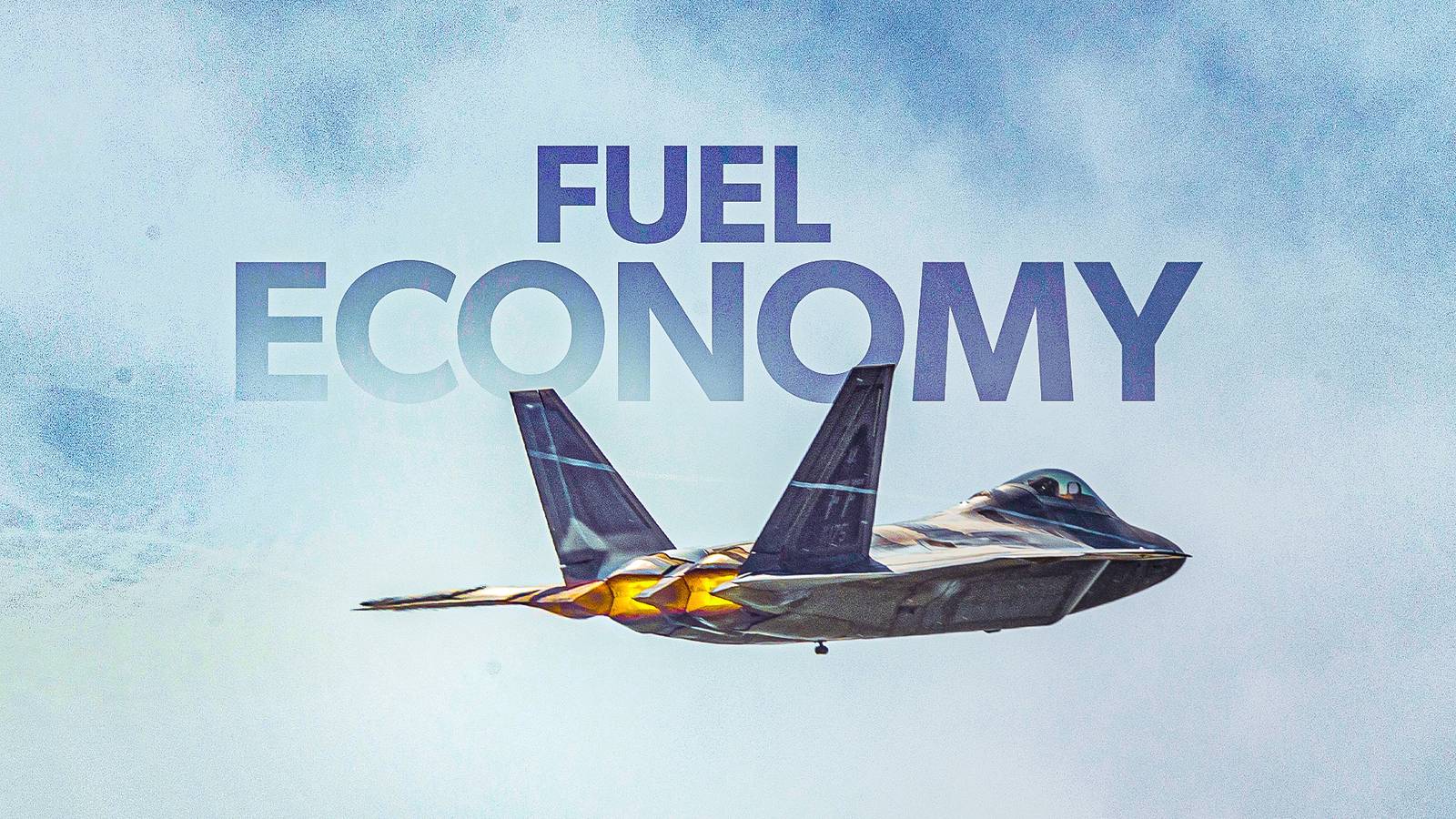
Published Jul 30, 2026, 2:00 PM EDT Luke Diaz is a freelance military writer with experience with active duty experience in the US Navy as well as defense and industrial engineering. He is a former Naval Flight Officer who performed tactical air control on the carrier-based E-2 Hawkeye. The Lockheed Martin F-22 Raptor is the only stealth fighter that refuses to compromise on kinematics. It is faster, flies higher, turns tighter, and is harder to see than any other aircraft ever built. A glance at the fuel burn of a US Air Force F-22 may make the plane seem like one of the most inefficient machines in the world. Put that same figure into a tactical context, and the calculus changes radically. In terms that are relatable to automobiles, the F-22 averages 0.30 to 0.37 miles per gallon (0.12 to 0.15 km per liter) performing the 'supercruise' flight profile. While abysmal versus a family car, that is approximately triple the fuel economy of comparable fighter jets. As the world's first fifth-generation fighter, the F-22 is primarily famed for its stealth, but the ability to cruise at supersonic speeds is a similarly powerful tool in the Raptor's arsenal. It allows the American stealth fighter to rapidly change position across an entire theater to counter enemy movements, exploit strategic openings, and support friendly forces. It can do this because its Pratt & Whitney F119 engines generate more non-afterburning thrust than many legacy jets can at full power. The exceptionally high 'dry' thrust level of the F-22's two-dimensional thrust-vectoring engines can push it over Mach 1.5 in supercruise. To match that transit speed, a fourth-generation fighter would need to light its afterburners, which bring its fuel consumption down to just over 0.10 miles per gallon (0.04 km per liter) on average. This gives the Raptor a massive combat radius that allows the pilot to dictate the terms of engagement, and on top of that, it literally grants a 'speed boost' to missiles that significantly extends its weapons range as well. Breaking Even At The Speed Of Sound Credit: US Air Force When the average fighter jet wants to fly supersonic, it has to use afterburners, which literally dump raw fuel directly into the exhaust. It gets the job done, but it burns through the gas tank in minutes. The F-22 is equipped with massive Pratt & Whitney F119 engines that generate enough pure, dry thrust to cruise faster than anything else without ever touching the afterburners. That single feature cuts its supersonic fuel burn nearly in half compared to its peers. Some other modern fighters can briefly touch Mach 1.2+ without afterburners under ideal conditions. However, the F-22 is the only one that can supercruise while carrying a full internal combat load for the majority of its mission. The F-22 can supercruise at speeds officially exceeding Mach 1.5, with some estimates placing its sustainable speed as high as Mach 1.82 depending on payload. To maximize this advantage, the F-22 flies much higher than other jets, typically above 50,000 feet (15,240 meters). Up there, the atmosphere is incredibly thin, meaning there is less air resistance pushing against the plane. The engines don't have to strain as hard to maintain high speeds, allowing the jet to get every inch of distance out of each pound of fuel. The F-22 complements this performance with a lower radar profile than any fighter currently in service. Its signature is roughly the size of a marble, putting it in a league of its own even among other fifth-generation stealth fighters. On top of that baseline stealth superiority, the F-22 goes on to compound its tactical advantage with supercruise, world-class top speed, outstanding combat radius, unmatched weapons range, and what Skunk Works calls 'supermaneuverability.' Eliminating The Afterburner Penalty Credit: US Air Force Supercruise is the unique feat of flying at supersonic speed using only the raw power of the engine and not engaging the boost of an afterburner stage. This is special and highly valuable because the ability to fly at such a high rate of speed without the afterburner means that the aircraft can burn significantly less fuel and sustain that speed for far greater times. Traveling at supersonic speed means the F-22 can get to the fight faster and stay there longer than virtually any other fighter jet. The relative economy of its fuel consumption, for what it is, means the Raptor can loiter on station for extended times, in any area of the battlespace to provide overwatch, escort, surveillance, or area denial. To understand why the F-22 is efficient at Mach 1.5, we have to look at how conventional jets achieve that speed. The F-22's Pratt & Whitney F119-PW-100 engines are highly mature and specifically built for the stresses of prolonged supersonic flight. The F119 is a twin-spool, counter-rotating, low-bypass turbofan with an exceptionally high turbine inlet temperature. By operating at much higher internal temperatures and pressures than legacy engines, the F119 produces very high 'military power' without the afterburners lit. Each engine makes roughly 26,000 pounds of dry thrust. High-Altitude Dominance Credit: US Air Force Most commercial airliners cruise between 30,000 and 38,000 feet (9,144 and 11,582 meters), and standard fighter jets typically operate under 45,000 feet (13,716 meters). The F-22 most often engages in supercruise between 50,000 and 65,000 feet (15,240 and 19,812 meters). At that altitude, the density of air is roughly 7% of what it is at sea level, and nearly half of what it is at 35,000 feet (10,668 meters). While the thin air reduces engine thrust, the Raptor's advanced digital control systems optimize the fuel-to-air ratio to glide through the upper atmosphere at remarkable speeds. This gives the F-22 superior lethality at the strategic and tactical level with peerless redeployment times and valuable fuel conservation. Even more, the engines offer stealth enhancement. Most aircraft must use afterburners to reach supersonic speeds, which creates a massive infrared signature that can be tracked by heat-seeking weapons. The F-22's ability to maintain high speed without afterburners keeps its IR signature low, preserving its stealth while it rapidly closes in on targets or escapes from a threat. Bending The Laws Of Physics Credit: US Air Force As well as being good on gas, the F-22 can perform brutal, post-stall maneuvers like the J-turn or power loop that other jets would literally fall out of the sky attempting. The F119's two-dimensional thrust vectoring exhaust nozzles and advanced FADEC control have given the F-22 true supermaneuverability. The Raptor's engine nozzles can tilt up or down by 20 degrees, which allows the pilot to use the raw power of the engines to push the nose of the plane in any direction, even at near-zero airspeed. This is almost entirely thanks to the incredible F119 engines. Most fifth-generation fighters, like the Lockheed Martin F-35 Lightning II, still rely on continuous air moving over their wings and tails to turn. If the plane slows down too much, there isn't enough aerodynamic force to move the jet, so it stalls. In a dogfight, an F-22 pilot can flip the nose of the jet to point at the enemy and fire a missile or the internal cannon while its target is still struggling to catch up through the turn. The ability to combine supercruise with supermaneuverability is what makes the F-22 an engineering marvel. In traditional aviation design, these two concepts are antitheses to one another. The F-22 solves this paradox not by relying on its wings to turn, but by using its engine exhaust as a steering mechanism. Thanks to the P&W power plants, the F-22 can perform incredible feats like a maximum-G turn and then accelerate vertically to regain altitude almost instantly. Overcoming Aerodynamic Limitations Credit: US Air Force Pratt & Whitney not only made the first stealth fighter jet engines ever, but also the first production thrust vectoring ones. Unlike traditional circular exhaust nozzles, the F-22 uses flat, rectangular convergent-divergent nozzles made of advanced carbon-fiber composites and titanium. Actuated by a high-pressure hydraulic system, they can redirect the engine's 35,000 pounds of max thrust almost instantly. As a result, the F-22 can comfortably fly at angles of attack exceeding 60 degrees while remaining in complete control. In a standard fighter jet, if you pull the nose up too aggressively, you exceed the wing's maximum Angle of Attack. The airflow over the top of the wing detaches, the wing loses lift, and the control surfaces become useless because there isn't enough air movement and the plane falls out of the sky. The Raptor ignores this limitation entirely. Because the F-22 uses the raw power of its engine exhaust to push the tail, it doesn't matter if the wings have completely stalled. If an F-22 pilot wants to pitch up while moving slowly, the flight computer angles the exhaust nozzles upward. The F119's thrust pushes the rear of the plane down, forcing the nose up into positions that would cause any other aircraft to spin out of control. This allows the Raptor to perform famous post-stall maneuvers like the Pugachev’s Cobra or the Herbst 'J-Turn' Maneuver, virtually spinning on a dime in midair. Yet, the true genius of the F-22 isn't just that it can do these tricks, but that it can do them without ruining its supersonic efficiency or its stealth. The successor to the F-22 will be Boeing's F-47, which was officially designated the Air Force Next Generation Air Dominance contract winner in early 2025. Notably, however, while it will build upon the range and weapons technology in the Raptor, it will greatly sacrifice dogfighting ability. In a complete reversal of aviation history, the F-47 intentionally trades away the F-22's legendary, back-flipping agility. This will leave the Raptor to history as one of, if not the most, truly dominating fighter jets across the spectrum of air warfare to have ever taken flight.
The F-22's Terrible Fuel Economy Is Actually Its Secret Weapon
Full Article
Original Source
Read the full article at Simpleflying →KhanList aggregates and links to publicly available news content. We do not host full articles from third-party sources. Always verify important information with original sources.