
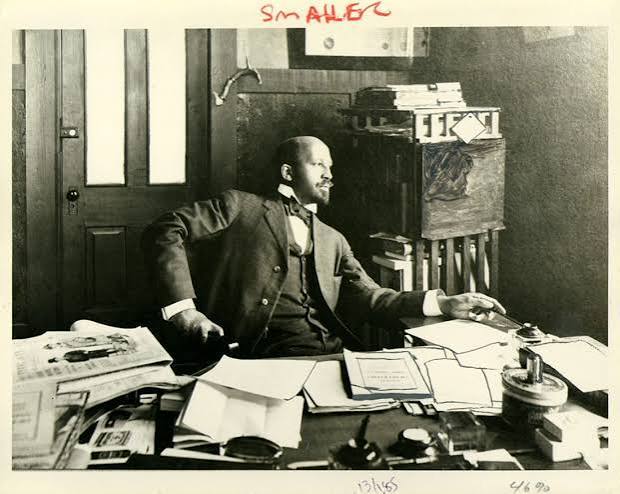
Rita Coburn‘s “W.E.B. Du Bois: Rebel With a Cause” is an extraordinary documentary about an extraordinary man, a film that spans nearly 100 years in two hours, yet never feels rushed or superficial. In her storytelling, Coburn shares with her subject a talent for distilling complex ideas and expressing them with force and clarity; the result is a movie that fully honors the breadth and depth of Du Bois’ achievements as a groundbreaking Black writer, historian, and activist. One of Coburn’s most potent tools in this regard is the music by composer Kathryn Bostic, who previously collaborated with the director on “Marian Anderson: The Whole World in Her Hands.” Bostic incorporates a wide array of styles and influences in her score, which references the various types of music Du Bois encountered and appreciated as a Black intellectual but isn’t beholden to them; as evocative of Bach and American folk music as it is of 19th-century spirituals and Asian motifs, it’s the sonic equivalent of Du Bois’ literary works. The scope of the project required Bostic to come at the material from multiple angles and perspectives. “Rita and I talked about what types of touchstones we needed to define the narrative musically,” Bostic told IndieWire. “There was the regional touchstone, the era-specific touchstone, the interior emotional aspects that we wanted to heighten with music. Then there’s always the discovery process as you begin to create.” For Bostic, that discovery process is one of the most exciting aspects of film composing. While she had a number of reference points as she began work on the score, she soon found herself following intuition to take them in different directions than initially intended. “There’s always what I call the hands-on-the-clay moment,” Bostic said. “You have your list, and you have your frame of reference, but the process is fluid.” According to Coburn, Bostic’s ability to bring a historical perspective to her scores made her an ideal collaborator for the film. “Kathryn pulled from the region of Great Barrington [where Du Bois was born] as well as New York in that time period, and then what was happening with the African-American community that Du Bois was entering,” Coburn said. “There wasn’t gospel then, so you were looking at a small group of Black people going to the churches there in New England. What were they listening to, and therefore what was he listening to?” Bostic drew on the music of the Fisk Jubilee Singers, a Black a capella ensemble that inspired Du Bois, but then moved in a completely different direction to explore his time in Berlin, when he encountered and fell in love with classical music. She also incorporated Wolof music from Senegal and the Gambia in collaboration with Coburn’s daughter, who studied classical music and worked in the music department on “Rebel With a Cause.” “She found a Senegalese professor online who worked with her so she could sing the Wolof,” Coburn said. “Kathryn and I agreed that we had to put the Wolof in the film because it connects Du Bois to his Ghanaian roots. But we had to find it, and we wanted it to be as authentic as possible.” For Bostic, the challenge was taking an audience from 2026 and presenting the music in a way that would recreate the way in which Du Bois experienced it over a hundred years earlier. “There’s the historic arc of the times, as well as what he’s experiencing emotionally,” Bostic said. In the places where her score was informed by spirituals and the work of the Fisk Jubilee Singers, the composer tried to tie the emotional subtext to the context in which she knew Du Bois was consuming the music. “When he went to Fisk University, his mother had recently died,” Bostic said. “So that music was a wellspring for his grieving, and I think that depth of sorrow and the catharsis that resulted from that sorrow inspired the sort of deep self-reflection that became such a deep part of who he was. That self-reflection led to a basic decency and humanity, and even now I think of him as being light years ahead of people in the way he embodied justice. I want to shine a light on that.” Coburn felt a similar sense of purpose, especially since the more she dug into Du Bois’ life the more she realized how relevant his insights were to America in 2026. “He speaks to this current time,” Coburn said, adding that the importance of Du Bois’ work gave her own work a sense of urgency and responsibility. “I knew that it might be 20 or 30 years before we get another Du Bois documentary. I hope not, but I looked at his life and knew that I had to do the best job that I could. We did everything we could for Du Bois because we felt he had done everything he could for us.” The greatness of “W.E.B. Du Bois: Rebel With a Cause” is that it brings the viewer into Du Bois’ perspective as his world view continues to expand over a 95-year life, and the music is a major part of that subjectivity. “Kathryn understands that music is a character in any documentary, and her music embodies the character of W.E.B. Du Bois,” Coburn said. “ In the music, we had to grow with him. We had to expand with him. We had to see that his love of Rembrandt and his understanding of classical music, of music that came from an Asian culture, that all of that was important to him. We were catching up with him, and he was driving us.” “W.E.B. DuBois: Rebel With a Cause” is currently streaming on the PBS app and website.
The Extraordinary Music Worthy of an Extraordinary Life in ‘W.E.B. Du Bois: Rebel With a Cause’
Full Article
Original Source
Read the full article at Indiewire →KhanList aggregates and links to publicly available news content. We do not host full articles from third-party sources. Always verify important information with original sources.