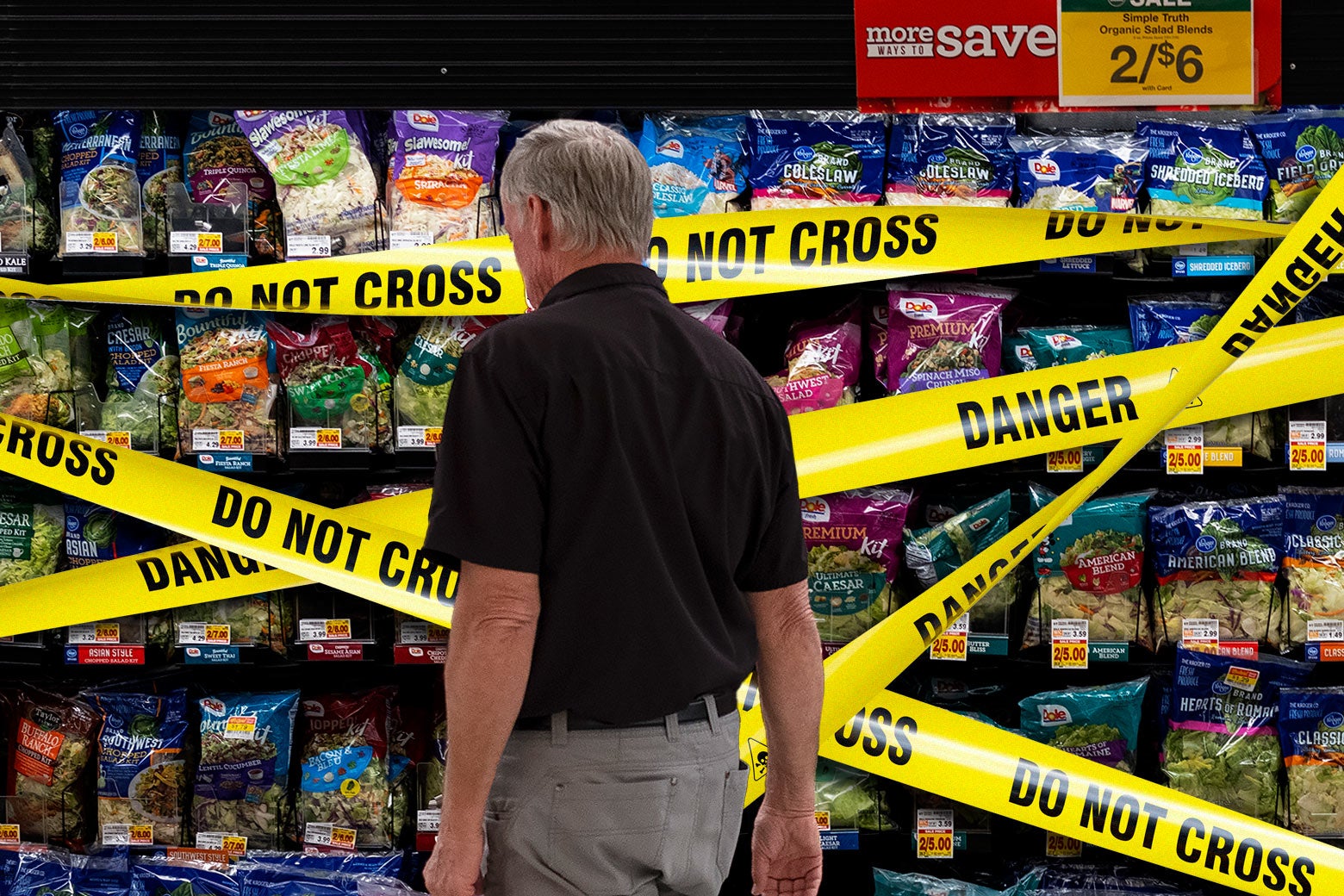
Food Why Is It Always Lettuce? Although the source of this summer’s Cyclospora outbreak is still unknown, history suggests that leafy greens could be the culprit. A food microbiologist explains why salad makes for such a good Trojan horse, and why this bug is so hard to study. By Enter your email to receive alerts for this author. Sign in or create an account to better manage your email preferences. Unsubscribe from email alerts Are you sure you want to unsubscribe from email alerts for Nadira Goffe? July 16, 20264:12 PM Photo illustration by Slate. Photos by Robert Nickelsberg/Getty Images and tiero/iStock/Getty Images Plus. Sign up for the Slatest to get the most insightful analysis, criticism, and advice out there, delivered to your inbox daily. It would be dramatic to say that lettuce is the riskiest vegetable in the produce aisle to eat, but its reputation these days is anything but squeaky-clean. In 2010, about 23,000 pounds of lettuce were recalled due to a multistate E. coli outbreak involving Freshway Foods; in 2019, three E. coli outbreaks were traced to lettuces and leafy greens from a specific area of California; and in 2020, bagged salads from Fresh Express were linked to an outbreak of Cyclospora. This summer, Cyclospora—a parasite that is giving those it infects explosive diarrhea that can last for weeks—is again rearing its ugly head, as many state departments of health report thousands of cases (numbers that, as a rule, undercount the true spread) and the Centers for Disease Control and Prevention suggests that the problem likely won’t be resolved until at least August. Perhaps most alarmingly, we don’t yet know the origins of this current outbreak. But that hasn’t stopped people from assuming, given its tainted history, that the perpetrator is lettuce. There has been speculation that nationwide restaurant chains, like Taco Bell, and their suppliers may be to blame; meanwhile, health departments are warning people to stay away from (or thoroughly cook) a wide range of produce usually eaten raw, including herbs and berries, in addition to leafy greens. Meanwhile, the International Fresh Produce Association is urging caution with reports from state health departments that might be making unfounded assertions about the source of the outbreak. It doesn’t help, either, that this administration’s early decision to gut the CDC, and thus stymie programs that trace these pathogens, have severely hindered our usual means of handling foodborne illnesses. Even if lettuce doesn’t turn out to be the perpetrator this time, it quite often has been in the past. What is it about this vegetable that makes it the stuff of bathroom nightmares? To discuss why lettuce and leafy greens are often spotted at the scene of foodborne crime, I spoke to Lee-Ann Jaykus, a food microbiologist with experience in many different organisms—including nonculturable organisms, such as Cyclospora—and a professor emerita at North Carolina State University. This conversation has been edited and condensed for clarity. Nadira Goffe: So why is lettuce one of the types of produce that always seem to come up in these conversations about foodborne illness? Lee-Ann Jaykus: Foodborne pathogens are microorganisms that cause disease associated with the consumption of contaminated foods. There are three general categories of microorganisms that do this: There’s the bacteria, which you hear about all the time, like Salmonella and E. coli. Then there are viruses, which includes my area of expertise, Norovirus. And then, the third category, which is what Cyclospora falls into, is something called parasitic protozoa. There really aren’t very many of those that are associated with foodborne disease, though some are associated with waterborne disease, like Giardia. Cyclospora is a fairly newly discovered pathogen—we’ve recognized it for only about 25 years—but unlike these other ones, it appears to be associated almost exclusively with the consumption of contaminated food, which is interesting because all these other things you can get from other mechanisms. So, immediately, if you start seeing Cyclospora cases pop up, you’re going to say, “Oh, there must be some kind of food-contamination event going on.” Over the years, we began to continually see outbreaks, and they almost always occurred in the summer months and were exclusively associated with produce items. Those items initially were berries; later on, we began to see them associated with herbs like cilantro or basil; over the years, that morphed into seeing them associated with leafy greens. There may have been other more specialty-crop types of outbreaks, but they’ve been fairly small. But really, you should always, when you think of Cyclospora, think about fresh fruits and vegetables, ones that are eaten raw, not cooked. Because if you cook it, you’re probably going to kill the parasite. So, when this popped up, we were like, Well, it’s 99 percent certain it’s associated with the consumption of the food, and those foods should fall into this category of these produce items that historically have been associated with the disease and are eaten raw. And which of those do we eat a lot of? Well, widely spread, the biggest is leafy greens. Everybody eats leafy greens. Not everybody eats cilantro, and even berries are a bit of a niche market. Of those, leafy greens are the most widely consumed and also the most widely distributed product. We still don’t know the source of this summer’s Cyclospora outbreak, but does the wide distribution of leafy greens, and lettuce in particular, make it more of a bear to deal with in regard to foodborne illnesses? Every year, we have about 1,000 cases, and they’re almost always associated with a particular product. But sometimes they can’t figure out what that particular product is. When they have been able to find those specific products, in more recent years, it’s almost always been either a specialty herb, like cilantro, or a leafy green. But usually, in the case of outbreaks, it is some kind of a combination product. Think about bagged salads. When you buy a bagged salad, you might have five different types of lettuce in there, some carrot pieces, some celery pieces, and so on. That’s what we call a mixed product or a blend product. The other major category of product that’s been associated with this has been vegetable trays. Mixtures like this can be one of the things that make it so hard to figure out exactly what product is causing it. By far, the most likely source of the contamination is during the growing phase—or potentially the harvesting phase, if you were washing the produce. (But lettuce, for example, is usually not washed in the field, so, really, the growing phase.) Let’s say you have five different leafy green types in a mixed salad or bagged salad. You don’t know which of those leafy green products the contamination is associated with. It could be your red-leaf lettuce that is contaminated, but you take that red-leaf lettuce that has Cyclospora in it, then you mix it with all these other lettuces—that’s a process called commingling—and you now have a shitload of contaminated product, for which going back and figuring out which of those lettuces was the culprit is really hard. And oftentimes, product is distributed not just to a single company but to many companies, or a product is what’s called co-packed, so one manufacturing plant that’s making bagged lettuce might produce for five different brands, like different big-box stores. When we came into this outbreak, I was relatively certain that the cause was more likely than not an herb or some kind of leafy green that’s consumed raw. And as the outbreak has gotten bigger and bigger and bigger—at this point, I think this will probably be the largest Cyclospora outbreak we’ve ever had—it’s likely to be a very large lot of product that was contaminated and then distributed widely. So it’s either a big bagged-produce supplier that distributes nationally or a big restaurant that’s a national chain restaurant, let’s say, that receives product centrally, then distributes it out to their restaurants. I can understand that leafy greens, and lettuce specifically, might be one of the biggest spreaders because of how widely they’re distributed as a product that’s eaten raw. But before all that, where does this parasite come from? We don’t know where this bug comes from. Like … at all? Hardly at all. That is one of the things, from the standpoint of trying to prevent contamination from happening on a farm, we don’t know much about. There are theories. Some people say it’s a human-only contamination; another theory posits that certain reptiles carry it and it ends up getting on produce because you can’t control animal encroachment in your growing fields. Maybe it gets into the water somehow and it happens because of irrigation. But we don’t have an answer to that question. Without an answer, then, does anyone know why it’s specifically berries, herbs, and leafy greens that get contaminated? For leafy greens and cilantro, you would immediately think it’s probably a water source. Maybe a wild animal source, but probably a water source. Berries are a little bit different, because the berries that have been associated with this are grown a little closer to the ground and they’re not irrigated in the same way that lettuce or cilantro is irrigated. And so that’s a bit of a mystery. It’s hard to justify that it could just be a water source for berries. Now, I will say that in cases when they have been able to clearly link the food-product source of contamination, it’s almost always a product that comes from Central or South America. Unless this current one is going to be a big surprise—and it may be—it doesn’t tend to be a domestically produced product. That would make sense, why it’s not zucchini or something. Well, yeah, and there also are other reasons for that, some of them technical. For example, the surface of a fruit or a vegetable can be smooth, like a zucchini, or rough and have crevices, like lettuce or berries. And oftentimes you see contaminants—it doesn’t matter whether it’s parasitic, protozoa, viruses, or bacteria—cling to those cracks and crevices. It’s also really hard to remove them, even with a water or chlorine-based wash. So there are other factors too as to why you might not necessarily see it in zucchini as you would in lettuce, for example. I was going to ask if the difficulty in cleaning these types of produce has anything to do with it. I read that even appropriately washing contaminated produce has varied results in how effectively it kills the parasite, none of them 100 percent. I understand that in life and science, there’s never really 100 percent in anything, but is cooking it the next step to, if you got 90 percent of the contaminant off from washing it, killing maybe another 6 percent? The bottom line is that if you were really concerned about your product, you would cook it. And I have friends (and I don’t necessarily agree with them) who, when they make a fruit smoothie, will cook the fruit beforehand because they’re concerned about minute chances of hepatitis A or Norovirus being in those. I think that their risk of getting those things from those products is minimal, but with that said, if you cook it, you will essentially eliminate an infectious parasite. An additional problem with Cyclospora is that we can’t culture it in the lab. We can’t really do studies where we figure out how easily it is inactivated, whether that’s by heat, chlorine, ozone, or whatever. So we don’t have a lot of data to back that up. But from what I know about these bugs in general, it’s likely that if you cooked it, you wouldn’t activate it. But who’s going to cook lettuce? I imagine that the inability to culture Cyclospora makes it difficult to answer basic questions about it. Norovirus is the same way: We really don’t have a good cultivation method for Norovirus. That’s been a huge impediment in understanding it from different perspectives, from the perspective of a food microbiologist, as well as that of a clinical microbiologist. Because if you can’t culture it, you can’t work with it. One of the problems with Cyclospora is that there are few people working on it, because the only way you can work with it is to get human poop that contains it. And then, even once you have that human poop and you can do things in the lab and try to figure out what’s going on using fancy techniques, you still can’t grow it. Gosh, what an elusive, frustrating parasite. It makes it super interesting, because our hands are tied. Parasitic protozoa tend to have different life stages. I think about it almost like a moth, which starts in a cocoon and goes through the pupal stage, et cetera. Oftentimes, Cyclospora falls into this category. It’s only a certain phase in the life cycle of the parasite when it can infect humans. That makes it even more complicated to study because it’s got to be in the right phase. So a big question is: Why is this seasonal? Well, maybe it’s because, during the warmer or more humid months, it stays in the infectious phase longer, but who knows? And the genetics are very complicated. I have been told that there are many, many strains, not all of which infect humans, and they don’t even know which strains infect humans. We’ve talked about how tough it is to culture Cyclospora, how the nature of the parasite is hard to study. Is there anything else that makes it harder to get those answers? To be honest, it’s a pretty rare disease, and a lot of physicians, particularly community physicians, are not going to think about it, and they’re not going to test for it. I mean, now they might, but it’s a pretty specialized test that you need to do in order to diagnose it. So it’s difficult to diagnose unless you have decided you’re going to look for it. Additionally, the public health infrastructure in foodborne disease surveillance has been pretty decimated, and Cyclospora is one of the organisms that’s been affected by that. [Due to this administration’s gutting of the CDC earlier this year, the government agency reduced mandatory monitoring by the Foodborne Diseases Active Surveillance Network from eight germs to two. Cyclospora is one of the pathogens that are no longer tracked.] So I think that we were late to the game because we don’t have the resources and attention to this that we had even two or three years ago. Another complication is the process of figuring out the source of the outbreak, known as traceability. We have done a lot over the past 10 years to improve traceability in fresh produce, but it is far from perfect. It’s hard to figure out the origin of a particular lot of a particular product, especially when you have the additional complicating factor of the incubation period. The way epidemiologists figure this out is they go to the patient and they do a food survey on that patient. Well, if you’re asking someone what they ate for the past two and a half weeks, they’re not necessarily going to remember, let alone the restaurant they ate it at or the brand that they ate or any of those kinds of things. So the investigation itself is tricky. This is a rapidly evolving situation that we don’t have the answers for yet, but I will tell you, people are working as hard as they can to try to figure out what’s going on with less resources, a difficult bug to study, and an imperfect set of circumstances. Get the best of news and politics Sign up for Slate's evening newsletter. Cooking Food Health Science
The “Explosive Diarrhea” Outbreak May Come Down to a Familiar Culprit. This Keeps Happening for a Reason.
Full Article
Original Source
Read the full article at Slate →KhanList aggregates and links to publicly available news content. We do not host full articles from third-party sources. Always verify important information with original sources.