
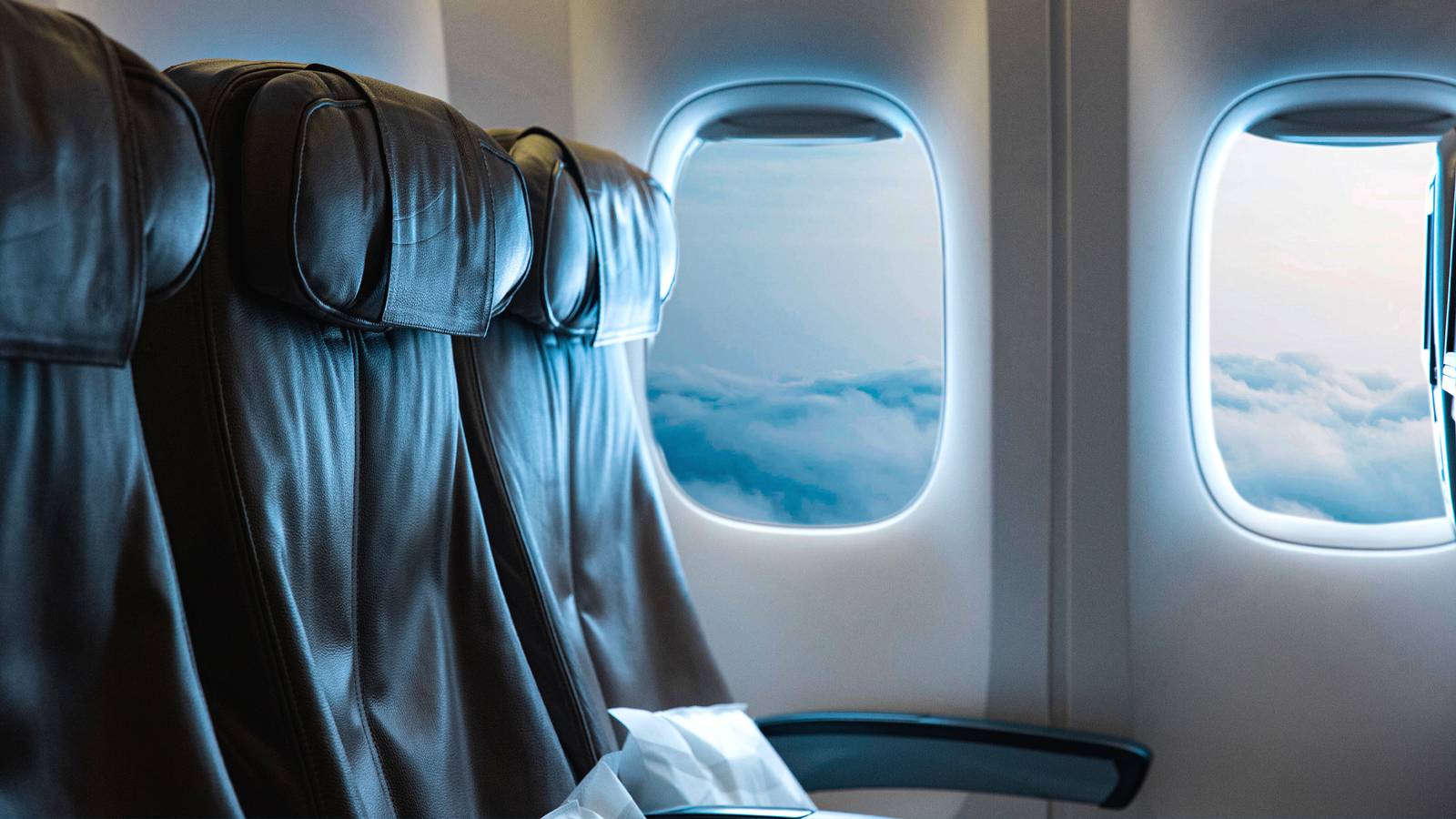
Credit: Nadir Keklik | Shutterstock | Simple Flying Published Nov 8, 2026, 1:00 AM EST Alejandro Núñez Vicente is a Spanish industrial design engineer and the founder of Chaise Longue, a pioneering aviation design startup focused on reinventing economy-class seating with innovative, two-level seats to improve passenger comfort and space. Recognized for his disruptive Chaise Longue Economy Seat concept, Alejandro’s work has drawn industry attention, including nominations for the Crystal Cabin Awards and engagements with major aerospace partners as he leads the development and commercialization of next-generation aircraft interior solutions. Sign in to your Simple Flying account Boarding a plane today means stepping into a highly structured, carefully designed world. Regardless of whether we are crammed into the last row of economy or stretching out in a first class suite, our human eyes always instinctively gravitate toward the exact same feature: the window. That small, oval piece of multi-layered acrylic and glass is our only physical connection to the absolute miracle of hurtling through the stratosphere at six hundred miles per hour. As an industrial design engineer who spends an unhealthy amount of time thinking about cabin interiors, I can tell you that the window is the most psychologically vital component of the passenger experience. In this article, we will examine the fascinating evolution of the airplane window, why it looks the way it does, and why the aviation industry's obsession with replacing it with 'digital windows' is almost guaranteed to be an absolute disaster for how we feel when we fly. From Squares To Ovals: The Engineering Reality To understand why the future of airplane windows is so concerning, you have to look at how much their engineering has evolved to keep us safe in the past. During the early days of pressurized jet travel in the 1950s, aircraft manufacturers were learning hard lessons about aerospace physics. Early commercial jets featured large, square windows that looked beautiful but structurally compromised the fuselage, leading to catastrophic failures. Today, the industry is a highly competitive, data-driven machine built on optimizing weight, fuel burn, and aerodynamic efficiency. Every actual hole cut into the side of an aircraft requires heavy structural reinforcement, which adds weight and burns more jet fuel. While we might love the view, airlines and manufacturers look at windows as heavy, expensive liabilities. This tension between structural efficiency and human psychology is pushing us toward a future of screen-based, digital windows. This is a modern approach that, while brilliant on a spreadsheet, entirely misses what human beings actually need to survive twelve hours in a metal tube. The shape of the modern airplane window is not a stylistic choice made by an interior decorator: it is an engineering mandate born from tragedy. When the de Havilland Comet, the world's first commercial jetliner, took to the skies in the early 1950s, it featured large, square windows that provided passengers with glorious, panoramic views. However, engineers soon discovered a terrifying flaw in this design. When an aircraft cabin is repeatedly pressurized and depressurized during flight cycles, the stress of that expansion concentrates heavily on the sharp 90-degree corners of square windows. Aircraft Model Structural Dimensions (Inches) Structural Dimensions (cm) Approx. Surface Area (Oval) Boeing 787 Dreamliner 10.7 x 18.4 inches 27.2 x 46.7 cm 197 sq. inches / 1270 sq. cm Embraer E-Jet Family 11.2 x 16.5 inches 28.5 x 41.9 cm 185 sq. inches / 1192 sq. cm Airbus A220 11.0 x 16.0 inches 27.9 x 40.6 cm 176 sq. inches / 1135 sq. cm Boeing 777X (Upcoming) 9.7 x 16.7 inches 24.6 x 42.4 cm 162 sq. inches / 1045 sq. cm Boeing 777 (Classic & 300ER) & 767-400ER 10.0 x 15.0 inches 25.4 x 38.1 cm 150 sq. inches / 967 sq. cm Boeing 767 (-200/-300) 10.0 x 14.0 inches 25.4 x 35.6 cm 140 sq. inches / 903 sq. cm Boeing 737 (NG & MAX) 10.0 x 14.0 inches 25.4 x 35.6 cm 140 sq. inches / 903 sq. cm Airbus A350 9.5 x 13.5 inches 24.1 x 34.3 cm 128 sq. inches / 827 sq. cm Airbus A380 10.7 x 15.2 inches (Outer Pane) 27.2 x 38.6 cm 162 sq. inches / 1049 sq. cm Airbus A330 / A340 9.0 x 12.3 inches 22.9 x 31.2 cm 111 sq. inches / 714 sq. cm Airbus A320 Family 9.0 x 12.3 inches 22.9 x 31.2 cm 111 sq. inches / 714 sq. cm This phenomenon, known as metal fatigue, led to microscopic cracks that eventually caused the aircraft to break apart mid-flight. The immediate solution was to eliminate the corners entirely, leading to the ubiquitous round and oval windows we see on every commercial jet today. By using a rounded shape, the stress of the cabin pressure flows smoothly around the window frame rather than building up in a single spot. It is a brilliant, life-saving piece of aerospace engineering. However, creating these reinforced oval holes in a cylindrical aluminium or composite fuselage is incredibly complex. The window assemblies are heavy, requiring thick, multi-pane acrylic layers to withstand freezing temperatures, immense pressure differentials, and the occasional bird strike, all while being perfectly sealed. This brings us to a massive, silent frustration for the modern passenger: the dreaded 'windowless' window seat. Because cutting holes in the airframe is so dictated by the structural ribs of the Original Equipment Manufacturer (like Boeing, Airbus or Embraer), the windows are placed at fixed, mathematically rigid intervals. But airlines want to squeeze as many seats into the plane as possible. Using the modern seat-track system on the floor, airlines tend to compress the seat pitch with zero regard for where the actual windows are. This is why you often pay extra for a window seat, only to spend a six-hour flight staring at a blank, curved plastic wall where the seat rows have completely fallen out of sync with the aircraft's architecture. The Dimming Revolution & The Loss of Control In the last decade, we witnessed the first major disruption to the airplane window in half a century: the removal of the physical plastic window shade. When Boeing introduced the 787 Dreamliner in 2009, they debuted massive, electronically dimmable windows. Airbus, a while later in 2022, followed suit on the A350. Instead of pulling down a piece of plastic to block out the sun, passengers press a button, and an electrical current passes through a special electrochromic gel sandwiched between the windowpanes, slowly turning the glass from fully transparent to a deep, dark blue. From an industrial design standpoint, this is a remarkable piece of technology. It eliminates the mechanical failure of plastic shades snapping off their tracks or breaking, reduces cabin weight, and allows passengers to look outside without letting blinding, harsh sunlight flood the cabin and ruin the contrast of everyone's IFE screens. This feels like magic the first time you use it. However, it also introduced a subtle, highly controversial shift in cabin dynamics: it transferred environmental control from the passenger to the cabin crew. In my opinion, this is not bad at all, since it lets airlines control the circadian rhythm of the majority of their guests and takes away the possibility of a single passenger disturbing the rest and sleep of a whole cabin of passengers just because they want to see the view. This shift, however, profoundly affects the passenger experience. With electrochromic windows, the flight crew has a master override switch in the galley. On a daytime flight across the Atlantic, the crew can lock every window in the cabin to the darkest setting to force a sleeping environment, effectively trapping passengers in artificial twilight. While this is great for minimizing jet lag and keeping the cabin quiet, it is deeply frustrating for the aviation geek who wants to see Greenland from 38,000 feet. Giving the passenger a personal window but electronically denying them the ability to look out of it perfectly illustrates the modern airline's desire to manage passenger behavior through cabin design. The Case For 'Digital Windows' If dimmable glass was a big evolution, the next big idea circulating in aerospace design circles is a total revolution: the complete elimination of physical passenger windows, replaced entirely by high-definition 'digital windows' (the fancy name for a simple screen) that show a live video feed from external cameras. We have already seen the first iterations of this in the industry. Indeed, Emirates famously installed 'virtual windows' in the middle-aisle first class Game-changer Suites on its Boeing 777s. These are highly advanced, ultra-high-definition screens shaped exactly like airplane windows. They display a real-time feed from fiber-optic cameras mounted on the exterior of the aircraft, and are probably the only justifiable application (and a genius one indeed), to have digital window screens on an aircraft. To an airline accountant or an aerospace engineer focused on sustainability and cost savings, a windowless fuselage is like the holy grail. If you remove all the windows, you can build a perfectly smooth, uninterrupted metallic or carbon-fiber tube. The aircraft becomes significantly lighter, massively more aerodynamic, and burns drastically less fuel. Furthermore, supersonic jet concepts, which are highly sensitive to drag and structural integrity, frequently feature windowless cabins as a baseline requirement. Airlines would save millions on fuel and give the passenger a 4K screen that looks just as good as the real thing. However, for the passenger experience and well-being, that just doesn't cut it, as a screen is fundamentally not a window. When you look out of a real airplane window, your eyes focus on infinity. As you move your head, your perspective of the clouds and the ground shifts, a geometric phenomenon known as parallax. A digital window, no matter how high the resolution, is a flat, two-dimensional light-emitting surface placed two feet away from your face. The camera on the outside of the plane captures one single perspective, and no matter how you move your head in your seat, the image on the screen remains static. Your brain instantly recognizes this physical disconnect, shattering the illusion of transparency. The Psychological Toll Of Artificial Reality Credit: THICHA SATAPITANON | Shutterstock The most severe consequence of implementing digital windows across an entire cabin is the immediate psychological toll it will take on the passengers. Humans are biologically hardwired to seek natural light and spatial awareness, especially when placed in confined, moving, and vibrating environments like the interior of a car, train, or aircraft. The physical window is the ultimate antidote to claustrophobia. It proves to our panicked subconscious that there is a vast, open world just on the other side of that glass oval. Replacing that organic connection with a glowing LCD screen turns the aircraft from a flying ship into a flying submarine. Beyond claustrophobia, digital windows will wreak havoc on our circadian rhythms. Natural sunlight contains a complex, full-spectrum biological signal that tells our brains what time of day it is, helping us adjust to new time zones. A digital screen, conversely, is just a matrix of red, green, and blue pixels heavily biased toward the blue light spectrum. Staring at a high-definition monitor disguised as a window for a 14-hour flight will increase eye strain, induce fatigue, and confuse our internal clocks. We are already surrounded by screens, such as the in-flight entertainment screens, our phones, and our tablets, so turning the actual architecture of the cabin into yet another screen will become a sensory overload that steps away from the ultimate passenger experience. Then there is the very real issue of motion sickness. The human vestibular system (the inner ear that controls balance) is highly sensitive to mismatched inputs. When an aircraft banks, turns, or hits turbulence, your inner ear feels the motion. If you are looking out a real window, your eyes see the horizon tilt, and your brain reconciles the two inputs perfectly. With a digital window, any microscopic latency, also known as digital delay, in the camera feed, or any distortion in the screen's refresh rate, means your eyes and your inner ear will fall out of sync. This sensory mismatch is the exact recipe for aggressive, cabin-wide motion sickness, headache, and nausea, which airlines want to avoid at all costs when transporting hundreds of paying passengers. The "Service Recovery" Nightmare Of A Broken Screen As an engineer, one of the first questions I always ask myself when evaluating a new cabin product is what happens when it breaks? Because everything on an airplane breaks, eventually. Liquid gets spilled, heavy bags are dropped, and complex electrical systems degrade over time due to the extreme vibrations of flight. A traditional acrylic window is incredibly robust: even if the inner protective plastic gets scratched by a passenger's ring, the window still functions perfectly. It still lets light in, and you can still see outside. A digital window, however, introduces a massive, unnecessary layer of technological fragility to the core architecture of the cabin. What happens when the fiber-optic camera on the outside of the fuselage is obscured by ice, insect impacts, or heavy rain? The passenger is left staring at a blurry, pixelated mess. What happens when the screen panel inside the cabin suffers a backlight failure or a dead pixel matrix? Instead of a view of the Alps, the passenger who paid extra for a window seat is forced to sit next to a glowing blue screen, or worse, a completely black, dead monitor for an ultra-long-haul flight. This creates an absolute nightmare for in-flight service recovery. If a passenger's in-flight entertainment screen breaks today, a good flight attendant can apologize, offer them an iPad, or give them some frequent flyer miles to make up for it. However, if the actual window breaks, and the passenger is plunged into claustrophobic darkness while their window-mates have working screens, there is no iPad that can fix that anxiety. The maintenance burden on the airlines not only would be astronomical, but would also require specialized technicians to ground the aircraft simply to fix or replace a glitchy screen on the sidewall. This would entirely defeat the operational cost savings that the windowless fuselage was supposed to provide in the first place. The Verdict & The Future Of The Cabin Credit: Cosmotop Spin | Shutterstock When we take a step back and look at the trajectory of cabin design, it becomes clear that the push for digital windows is a classic case of engineering for the spreadsheet rather than engineering for the human. Yes, a windowless fuselage is lighter. Yes, it burns less fuel. However, an airplane is not a cargo drone: it is a vehicle designed to transport living, breathing, anxious, and sometimes claustrophobic human beings across the globe. The physical airplane window is the last remaining organic connection we have to the outside world when we fly. It is the only thing that proves we are suspended in the heavens, participating in the greatest technological achievement of the 20th century, rather than just sitting in a loud and vibrating waiting room. The commercial aviation industry, and especially widebody aircraft manufacturers such as Airbus and Boeing, must remember that passenger comfort is not just about the density of the seat cushion, the width of the armrest, or having some fancy mood lighting. Rather, it is deeply rooted in psychology and spatial awareness. Stripping away the natural light, the true horizon, and the infinite focal depth of a real window, only to replace it with a simulated, two-dimensional broadcast, is a profound downgrade to the passenger experience, as it trades our mental well-being for a marginal increase in aerodynamic efficiency and profit. As we look toward the next generation of aircraft design, we have to ask ourselves where we draw the line between structural optimization and human dignity. Furthermore, we should place a red line for decision-makers in the industry to ensure they pursue true innovations that really elevate the passenger experience, rather than degrade it even further. If we are willing to accept artificial screens disguised as windows simply to save some pounds of jet fuel per flight and manufacturing costs, how far are we willing to let the passenger experience decay before we realize that looking at a video of the sky won't ever replace the magic of being in it?
The Evolution Of Airplane Window Design
Full Article
Original Source
Read the full article at Simpleflying →KhanList aggregates and links to publicly available news content. We do not host full articles from third-party sources. Always verify important information with original sources.