
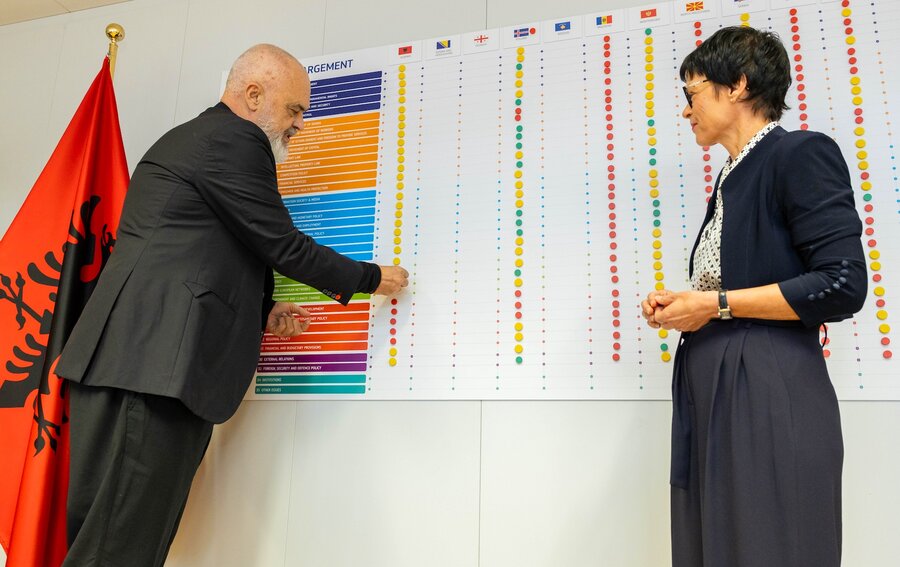
The rule of law across Europe is on a “broadly positive trajectory,” according to the just-released 2026 European Commission Rule of Law Report. Reforms that bolster independent justice systems and align anti-corruption rules to continentwide principles are part of this arc.In a global context, where democratic norms appear to be on the back foot and several governments are flexing authoritarian muscles, this is good news. But in a note of caution, the same document also points to uneven progress – particularly among Eastern and Central European countries.The report found that 47% of its 2025 recommendations for improved rule of law had been acted on. Other data shows that citizens in 17 EU countries, and businesses in 18, perceived judicial independence as having improved or stayed stable from the previous year. And despite some evidence of hostility to journalists, the EU-Balkans zone remains in first place in regional rankings in the latest World Press Freedom Index.Alongside these findings, there is a renewed openness to new members joining the 27-country union. Last week, the EU held talks with Albania and Montenegro, which have already completed more than half the requirements to join, and with Moldova and Ukraine, which are only just beginning negotiations.“It’s really a super Tuesday for enlargement,” Le Monde reported EU Commissioner Marta Kos as saying on July 14, the day of the most recent membership discussions. “For more than two decades, we haven’t had four accession conferences in one day.”The last time a new member was added to the EU was 13 years ago – Croatia, in 2013. To overcome this expansion inertia, EU founding nations France and Germany have called for a new process of “structured gradual integration.” This would grant candidate countries some early trade and integration benefits, but would hold off on granting full voting and representation rights until all required structural and governance changes are in place. The prime minister of Albania had earlier indicated a willingness to waive voting and veto rights, to speed up inclusion.EU members are supportive of enlargement, Commissioner Kos noted, “but only if the candidate countries are delivering” on good governance.Her comment points to the stalled membership negotiations with countries including Serbia, Bosnia-Herzegovina, and North Macedonia, over failure to implement reforms. Even EU members such as Slovakia and Hungary have seen declines in rule-of-law indicators. But with April’s decisive popular vote against longtime autocrat Viktor Orbán, Hungary now signals hope for democratic renewal and recovery.“A new, active political generation is beginning to unfold before our eyes,” a Hungarian political analyst told The Associated Press. Its “strong sense of justice,” the analyst said, is incompatible with “the authoritarian exercise of power [and] the corruption.”This trend is in evidence across the region, where voting constituencies have consistently protested corruption and called for democratic decision-making in recent years.The citizens of Central and Eastern Europe prize the rule of law as much as the rulemakers in the EU. Both forces, together pushing for transparent, honest governance, will likely be hard to resist in the long run.
The EU moves forward on expansion – and the rule of law
Full Article
Original Source
Read the full article at Csmonitor →KhanList aggregates and links to publicly available news content. We do not host full articles from third-party sources. Always verify important information with original sources.