
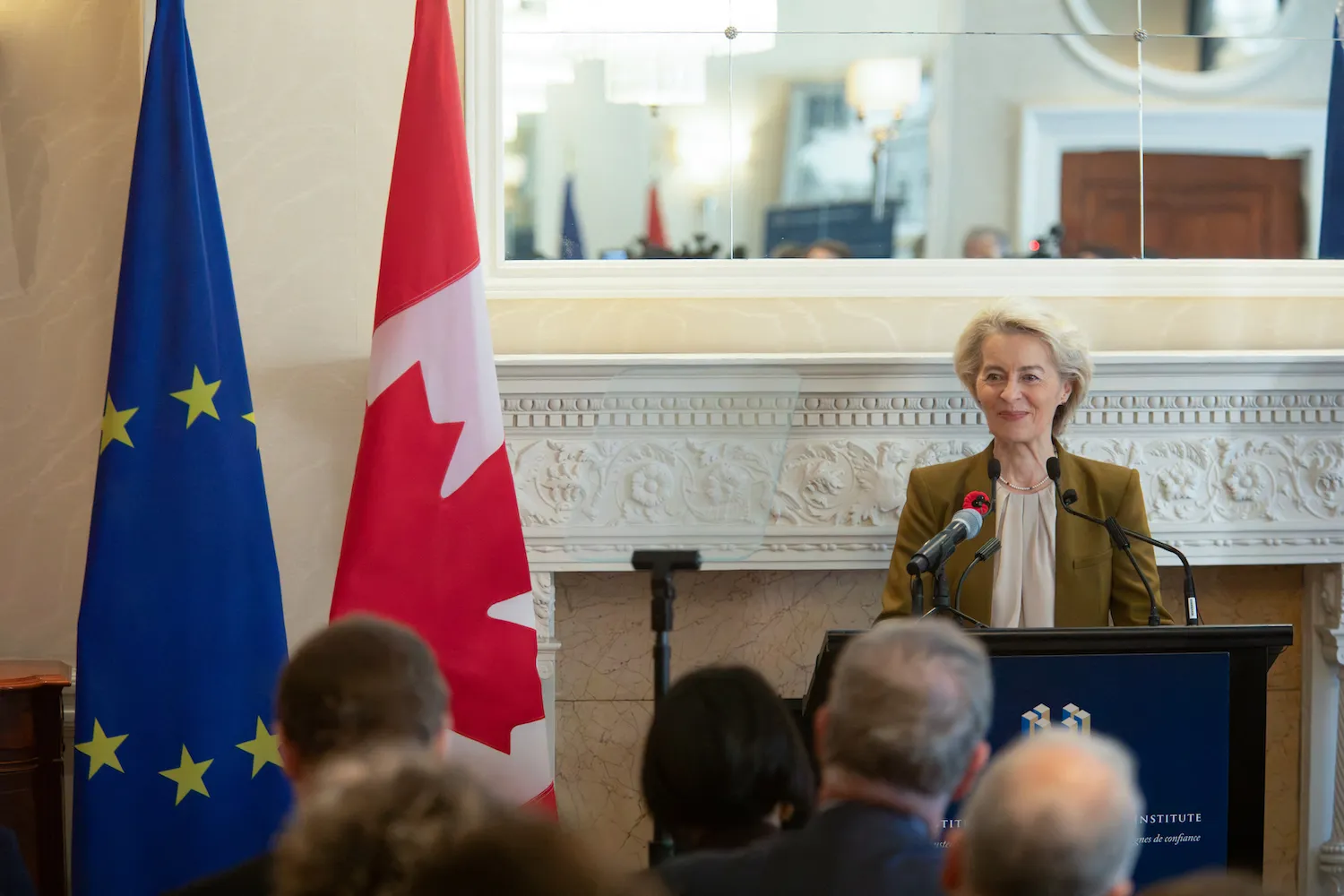
Welcome back to World Brief, where we’re looking at how deep Canada-EU ties will go, the resignation of European Central Bank President Christine Lagarde, and China’s latest political and military purge. Relationship Status: It’s Complicated Canadian Prime Minister Mark Carney hosted senior European Union officials in Montreal on Thursday to discuss bolstering trade and defense ties. Notably downplayed, though, was the EU’s previous offer to make Canada an “associate member” of the 27-nation bloc. Welcome back to World Brief, where we’re looking at how deep Canada-EU ties will go, the resignation of European Central Bank President Christine Lagarde, and China’s latest political and military purge. Relationship Status: It’s Complicated Canadian Prime Minister Mark Carney hosted senior European Union officials in Montreal on Thursday to discuss bolstering trade and defense ties. Notably downplayed, though, was the EU’s previous offer to make Canada an “associate member” of the 27-nation bloc. Last month, European Commission President Ursula von der Leyen floated the idea during her annual State of the European Union address. “We must urgently reimagine our partnerships,” von der Leyen said while standing beside Carney. “We share one ocean, one set of values, one way of seeing the world. And we will now build our shared future as well.” Canadian officials applauded the proposal, with Jonathan Wilkinson, Canada’s ambassador to the EU, saying at the time that Ottawa wants “to get as close as we possibly can” to the bloc. Yet a statement prepared for this week’s annual Canada-EU summit included a watered-down version of such a future. Rather than explicitly noting the proposed associate member status, the draft text offered “an ever closer association of Canada to the EU, short of full membership itself,” Politico reported on Wednesday. According to Reuters, a previous draft had included at least two direct mentions of Canada’s associate member status while adding that defining the term would take another year. “Canada cannot become a full-fledged member of the EU because of geography, but we both want to bring our relationship to the highest level possible,” von der Leyen said on Thursday. She described this type of relationship as open “only to our closest partners outside of Europe who are ready to open a new frontier together,” and she stressed that associate member status is not fully off the table. Von der Leyen’s decision to back off from her full-throated appeal for associate Canadian membership may have been made due to some member nations’ hesitance. Several EU countries, particularly Germany, had argued that they would not approve such a designation, as it had no legal precedent and had not been fully fleshed out. Others accused von der Leyen of not discussing the idea with European leaders first. “Nobody was consulted about associate membership apart from [von der Leyen’s] closest staff, it would seem,” one diplomat told the Guardian. “This is all about fixing the plane while it is flying.” The EU’s move to soften the language is likely to appease at least one foreign leader: U.S. President Donald Trump. Trump had called the EU’s initial proposal “laughable” and warned that such a designation could be considered a “hostile act” that could prompt the White House to cut off trade with Europe in certain areas. Already, U.S. trade relations with Canada and the European Union are greatly strained, with Trump repeatedly returning to his tariff war for economic leverage. Still, Carney appeared to be unconcerned by Thursday’s language shift. “The good news is it doesn’t matter about specific names or nomenclature,” Carney said. “What matters is the difference it will make to the lives of Canadians.” Today’s Most Read Dramatic Changes Are Unlikely in Israel, Even if Netanyahu Is Ousted by Steven A. Cook How to Not Change Your Mind by Stephen M. Walt Dawn of the Data Centers by Christina Lu What We’re Following Who will run the ECB next? European Central Bank (ECB) President Christine Lagarde announced on Thursday that she will step down from her role in February, officially triggering a race to determine who will take up the mantle of one of the European Union’s top posts. Her eight-year term was set to end in October 2027; her early departure allows the EU to choose her successor before one of its members, France, holds a consequential presidential election that could upset the bloc’s balance. In April, France will hold a highly anticipated presidential vote that could see far-right National Rally candidate Marine Le Pen take power. Eurozone members had worried that a Le Pen victory could affect who is selected to be the new ECB president, as the populist lawmaker has previously criticized EU financial institutions and expressed disinterest in choosing another mainstream central banker to lead the body. Lagarde resigning early therefore allows outgoing French President Emmanuel Macron to have a say in her replacement instead. Among the front-runners for Lagarde’s post are former Spanish Central Bank head Pablo Hernández de Cos and former Dutch Central Bank chief Klaas Knot. Whoever is chosen will have to contend with energy price shocks, bond market turmoil, and persistent high inflation. Meanwhile, it is unclear what’s next for Lagarde, who was the first woman to serve as the ECB president. “I want to have the freedom of speech, the freedom of expression, and the freedom to engage on matters that are not monetary policy matters,” Lagarde said on Thursday. Some analysts believe that Lagarde, who is a French citizen, aims to become more vocal in the country’s politics, which have faced weeks of upheaval due to sweeping student-led protests. Xi’s latest purge. The Chinese Communist Party (CCP) confirmed the expulsion of 33 senior political and military officials on Thursday, in one of President Xi Jinping’s most sweeping purges since taking office in 2012. Those removed include Liu Jianchao, the former head of the CCP’s International Department; former Politburo member Ma Xingrui; Zhang Youxia, once the country’s most senior general; and Zhong Shaojun, a top military secretary to Xi. It is unclear what charges these members faced beyond “serious disciplinary and legal violations.” But the expulsions are part of Xi’s extensive anti-corruption campaign targeting those considered disloyal to the party, and it comes as the longtime leader is preparing to clinch a fourth term in office. “While maintaining a tough stance against corruption, we should also strengthen checks on and oversight over the exercise of power,” read a communiqué released by the CCP’s Central Committee on Thursday. The announcement concluded this year’s multiday Central Committee meeting in Beijing. Only 279 officials attended the annual conference, compared to 376 members when the current body was formed in 2022. This was the first time during Xi’s term that the plenary’s attendance dropped below 300 people. That suggests that nearly 100 officials were likely purged from the party over the course of just four years, China experts say. National mourning. Spanish search-and-rescue operations stretched into Thursday following a deadly high-speed train crash the day before. At least 69 deaths have been confirmed thus far, with some 50 individuals still hospitalized, and local authorities fear that the death toll could rise. Madrid declared three days of national mourning starting Thursday. Early Wednesday, a high-speed passenger train believed to be going around 120 miles per hour slammed into a stopped train near the central Spanish city of Toledo. An initial investigation found that an information technology failure involving railroad switching equipment was to blame. However, critics have accused the Spanish government of failing to provide adequate oversight and maintenance of the world’s second-largest high-speed rail network, particularly after another train crash on the same line killed 46 people in January. “It is clear that we need to reinforce the safety of our train service to rebuild the trust in our high-speed rail,” Spanish Prime Minister Pedro Sánchez said on Wednesday. “It is not acceptable for a country like Spain to endure two high-speed train accidents in the same year.” With the country holding snap parliamentary elections next month, public transportation reform will likely be a top concern among voters. Odds and Ends The Vatican Museums opened a new exhibition on Thursday that celebrates more than 100 years of papal travel. Dubbed “A Century of the Popemobile,” the showing features eight Mercedes-Benz vehicles that popes have used since 1930 to travel among the faithful. Notable design alterations include Pope John XXIII’s 300 d Landaulet, which included removable rear side windows to allow the pontiff to reach out to those he passed on the road, and Pope John Paul II’s 230 G, which added the car’s transparent dome for greater viewing access.
The EU and Canada Struggle to Define Their Relationship
Full Article
Original Source
Read the full article at Foreignpolicy →KhanList aggregates and links to publicly available news content. We do not host full articles from third-party sources. Always verify important information with original sources.