
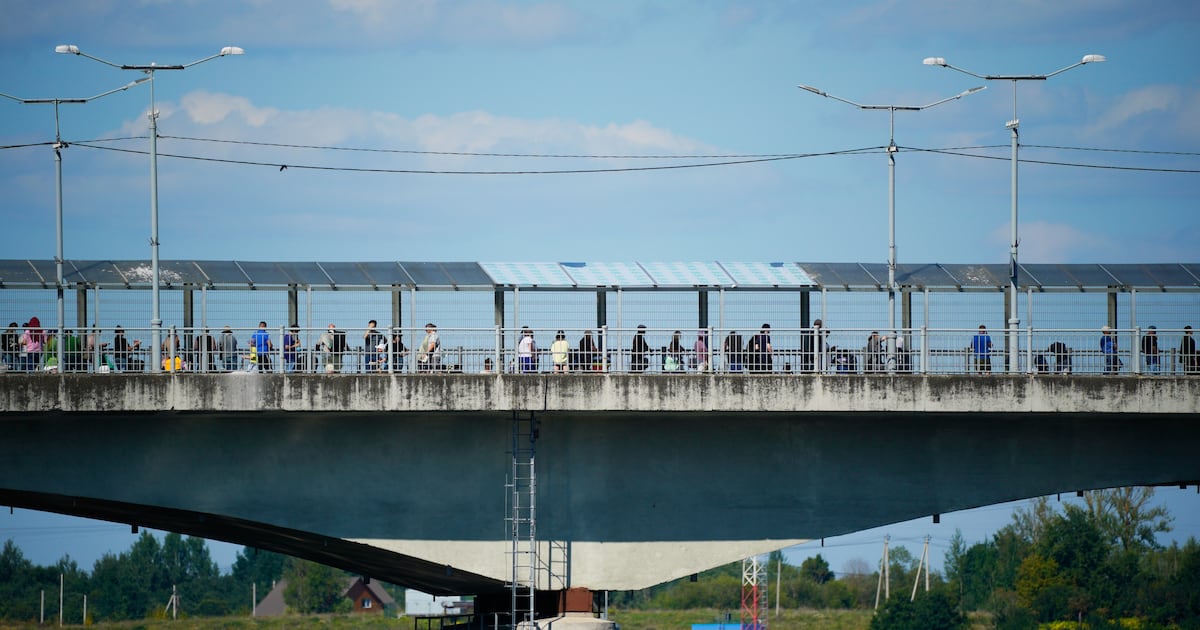
Once a symbol of co-operation, the Friendship Bridge that connects Estonia to Russia bears an increasingly ironic name. Heavily fortified, its approaches are lined with anti-tank obstacles, the concrete pyramids known as “dragon’s teeth”. On a quiet midweek morning, the only sound is the clacking wheels of a rolling suitcase being pulled across the otherwise empty bridge over the Narva, the river that separates the two countries. The border crossing here in its namesake, the city of Narva, has been closed to vehicles and pedestrian traffic is restricted. Most travellers pull their luggage across on foot.Only a couple of hundred people are allowed to make the journey each day, entering the European Union from Russia at this border crossing and vice versa. The queue moves slowly. READ MORE“Last time it took me seven hours, the queue was all the way back around”, says one woman in the line who is heading into Russia to visit relatives. “We live in London.”Direct flights from many European cities to Russia have been suspended since the full-scale invasion of Ukraine four and a half years ago. It is much cheaper to fly to Estonia and cross by foot at Narva than connecting through Turkey. Those who came prepared for a long wait have brought umbrellas to provide some shade from the hot August sun. A few have camping chairs with them. Narva is not a typical European city. Some 95 per cent of the 50,000 people living here speak Russian. The Friendship Bridge, which connects the Estonian city of Narva to Russia. Photograph: Freddy Davies/Anadolu/Getty It was flattened by Red Army bombs when the Soviets pushed the Nazis back to Berlin during the second World War. In Moscow’s occupation of the small Baltic state that followed, Narva was rebuilt in the image of a small Soviet industrial town. Many Estonians were prevented from returning to their homes after the war, others were deported to Siberia, and factory workers were brought in from Russia and other parts of the USSR. Today, many here get their news from Russian media. A government ban on broadcasting Russian television channels in Estonia is easily circumvented using cheap antennas, given the proximity to the border. There is a fear Russian leader Vladimir Putin could use the large Russian-speaking minority in Narva as the pretext for a military incursion, intended to test the Nato western military alliance, or European solidarity, in the coming years. “I won’t say how many people – I don’t know exactly – but there are people [in Narva] who are waiting for liberators,” says Maj Neeme Brus, of the Estonian Defence League, a voluntary organisation of military reservists and others who train regularly, to defend against an attack from the east. Major Neeme Brus of the Estonian Defence League. Photograph: Jack Power Efforts to bring the older generation of ethnic Russians “closer” to the state in the years after Estonian independence in 1991 had largely failed, says Brus. “They didn’t learn any word of the language of this nation”. A few months ago images started circulating on Telegram and other social media channels talking about a “people’s republic of Narva”, mirroring language used by Russian-backed separatists in eastern Ukraine.Local officials play down any suggestion that Narva could be “next”, stressing that the population, particularly the younger generations, have no desire to join the Russian Federation. The Russian-speaking minority in Estonia is not a homogeneous group, says Marek Kohv, from the Tallinn-based International Centre for Defence and Security (ICDS) think tank. There has been a tendency by some in the West to assume they are all “Putinists,” but this is wrong, he says. “Most of them enjoy and understand what are the benefits of living in democratic country ... I think those ‘Narva next’ scenarios are a little bit of lazy thinking,” says Kohv, a former senior analyst in the government’s national security bureau. The hypothetical situations sketched out usually involve a Russian surprise attack, or the playbook used to annex Crimea, where Russian troops in unmarked uniforms helped to seize the Ukrainian territory. Kohv says both ignore the extent to which Estonian intelligence keep a close eye on any Russian military movement on the other side of the border. “There will be no surprise attack against Estonia,” he says. InvasionWhether the large ethnic Russian population in Narva is used as some pretext for a future military encroachment or not, Estonians view the threat of an invasion by their big neighbour to the east as very real. The small Baltic country of 1.3 million people is spending 5 per cent of its GDP on defence, a significant amount of its annual budget. Money has been put towards expanding the size of its professional and reserve army, building up ammunition stockpiles, and investing in longer-range missiles. Estonia doesn’t have a network of cold war-era bunkers, so the government has also been identifying sites that could act as public bomb shelters and adapting existing buildings. Certain properties have been chosen as safe houses in the event of an occupation. The country has a standing army of about 4,000 troops, and another 38,000 reservists who undergo regular combat training. Defence plans are drawn up based on this combined force. An additional 40,000 people have received training but are no longer active reservists.Estonian soldiers at a military camp in Tallinn during a visit by Britain's Prince William last March. Photograph: Victoria Jones/WPA/Getty The idea is to mobilise the whole society, one way or another, towards the defence of the nation in response to an armed attack. Conscription is mandatory for young men when they finish school, for a minimum of eight months. From next year it will increase to a year.“How our society sees conscription is pretty much like the extra year of school,” says Markus Rosin, a senior defence ministry official overseeing the reserves programme. “Our small democratic country cannot defend itself only through a relatively small number of professional soldiers. Our defence must be rooted in society.” After completing the period of military service, most young men will move into the army reserves, where they will be called up for training exercises to keep sharp, usually as part of the same local unit. The outcome of the war in Ukraine is going to determine what Russia’s threat is going to look like— Kristjan MäeThat involves weeklong training camps in the spring, at weekends, or “snap” exercises with little notice, to test how quickly the reserve force can mobilise itself. Reservists who fail to show up and who do not have a valid excuse can be fined. Volunteer members of the Estonian Defence League, who often will also be reservists, meet more regularly, “to train for something that we hope is not coming,” says Brus, a former army officer.“We lost our freedom many times in recent history … We have to do everything we can [so] something like this doesn’t happen again.” DefenceThe defence of Kyiv in the early weeks of the Ukraine war, when weapons were handed out to citizens to man checkpoints, was a good example of how ordinary people with some training could play an important role in the “worst-case scenario”, Brus says.A revanchist Russia is a problem for the whole of Europe; an invasion wouldn’t stop at Warsaw, he adds. “I think the biggest enemy for preparation is thinking that something is unthinkable,” says Kristjan Mäe, the Estonian defence ministry’s director of policy planning. At the moment Russia is throwing “almost all” of its resources and attention into its grinding and costly war in Ukraine. There is no intelligence to suggest Moscow is considering an attack on Estonia or any of the other Baltic States in the short term, but nothing could be taken for granted, he says. “The outcome of the war in Ukraine is going to determine what Russia’s threat is going to look like.”The past two decades had shown time again how some in Europe has underestimated Putin’s ability to take risks that western governments had viewed as irrational gambles, he says. [ Europe must end its juvenile taboo against talking to RussiaOpens in new window ]There was the 2008 invasion of Georgia, the annexation of Crimea in 2014, the backing of pro-Russian separatist forces in the Donbas, and of course the 2022 full-scale invasion of Ukraine. “Misunderstanding how serious Russia can be in terms of actually achieving its objectives, I think, is something that we need to be very mindful of,” says Mäe.In Tallinn, attitudes towards Russia are clear. A shoulder-high metal barrier has been constructed in front of Moscow’s embassy in the capital, which people have covered in pro-Ukraine banners and messages. It stretches the length of the building. Photos of Putin dabbed in red paint have been tied to the barrier, beside pictures of bombed Ukrainian cities. A barrier outside the Russian embassy in Tallinn bears placards, flags and images in protest against Russia's war on Ukraine. Photograph: Peter Charlesworth/LightRocket/Getty An annual survey commissioned by the defence ministry found a third of Estonians felt a military attack on the state was quite probable or very probable. That’s an increase on the 11 per cent who feared an attack was likely in 2021. Kohv, head of security policy at the Estonia-based International Centre for Defence and Security think tank, says the best deterrence is to stiffen Europe’s defences and equip its armed forces to the point Russia would be dissuaded from contemplating any attack. “It is highly improbable that Russia will attack a Nato country in the near future. But of course, with Russia, you never know. I mean they are the masters of miscalculations and we always have to be prepared for their miscalculations,” he says. [ There is ‘naivety’ in Ireland over Russian threat, says TaoiseachOpens in new window ]Current assessments would be upended if Ukraine lost the war, however.Advances in drone warfare have forced governments and militaries on the EU’s eastern flank to think about how they would defend their cities and civilian populations from the type of aerial assaults that have wreaked havoc in Ukraine. Swarms of mass-produced drones, in combination with high-speed ballistic missiles, have exhausted and overwhelmed Kyiv’s air defences. In a war of attrition, shooting down each Shahed drone, which costs about $50,000 to make, with a Patriot or similar air defence missile that cost multiple times more to produce, is a problem when the other side can manufacture more drones quicker than you can buy or source additional interceptor missiles.Frankenburg Technologies, a defence start-up founded in Tallinn two years ago, is one company hoping to provide part of the answer to that problem. A missile capable of hunting drones being field tested at an undisclosed location last year. Photograph: Frankenberg Technologies Chief executive Kusti Salm says the company is developing an air defence system that launches cheap guided missiles to take out incoming drones. “Hit a bullet with a bullet in the air,” as he puts it. Speaking from his office looking out over Tallinn Airport, Salm says the logic is to mass produce air defence interceptor missiles at a cost that is cheaper than Russian or Iranian-made drones, flipping the economic equation back around. If just one out of every 100 enemy drones got through and hit its target, it would become “economically unattractive” for Russia to pursue its current strategy, he says. [ ‘Will you e-marry me?’: Estonia goes fully digitalOpens in new window ]It is a “geographical fact” that the closer a country is to Russia, the more they feel the looming threat, Salm says. European and western governments need to defend a world order that puts a check on bigger nations imposing their will on smaller ones by force, he adds. The alternative would mean “this generation is the first generation in the last almost 100 years where we have failed, and we have failed to deliver what our grandfathers and grandmothers fought for [in the] second World War”. Normal lifeFar below all the high geopolitics, life on the border in Narva plods along. It’s a sunny day. People are out enjoying the weather on a promenade that runs down the Estonian side of the river. A young boy is casting a fishing line into the fast-moving water, without success. Tourists amble around the battlements of Narva castle, which faces the Ivangorod fortress on the opposite bank. Narva castle in Estonia (left) and the Ivangorod fortress (right) in Russia, on the border between the two countries. Photograph: Jack Power The fortresses on either side of the Narva river are only about 100 meters apart. Photograph: Freddy Davies/Anadolu/Getty Only about 100 meters separate the two fortresses, built in the 13th and 15th centuries. Two tourists are walking along one of Ivangorod castle’s turrets and enjoying the view, while a large Russian flag flaps in the wind above them. Wednesday: Part 2 of the series: Finland prepares for what may come, by Paddy Smyth
The Estonian town that fears it’s next on Putin’s list
Full Article
Original Source
Read the full article at Irishtimes →KhanList aggregates and links to publicly available news content. We do not host full articles from third-party sources. Always verify important information with original sources.