
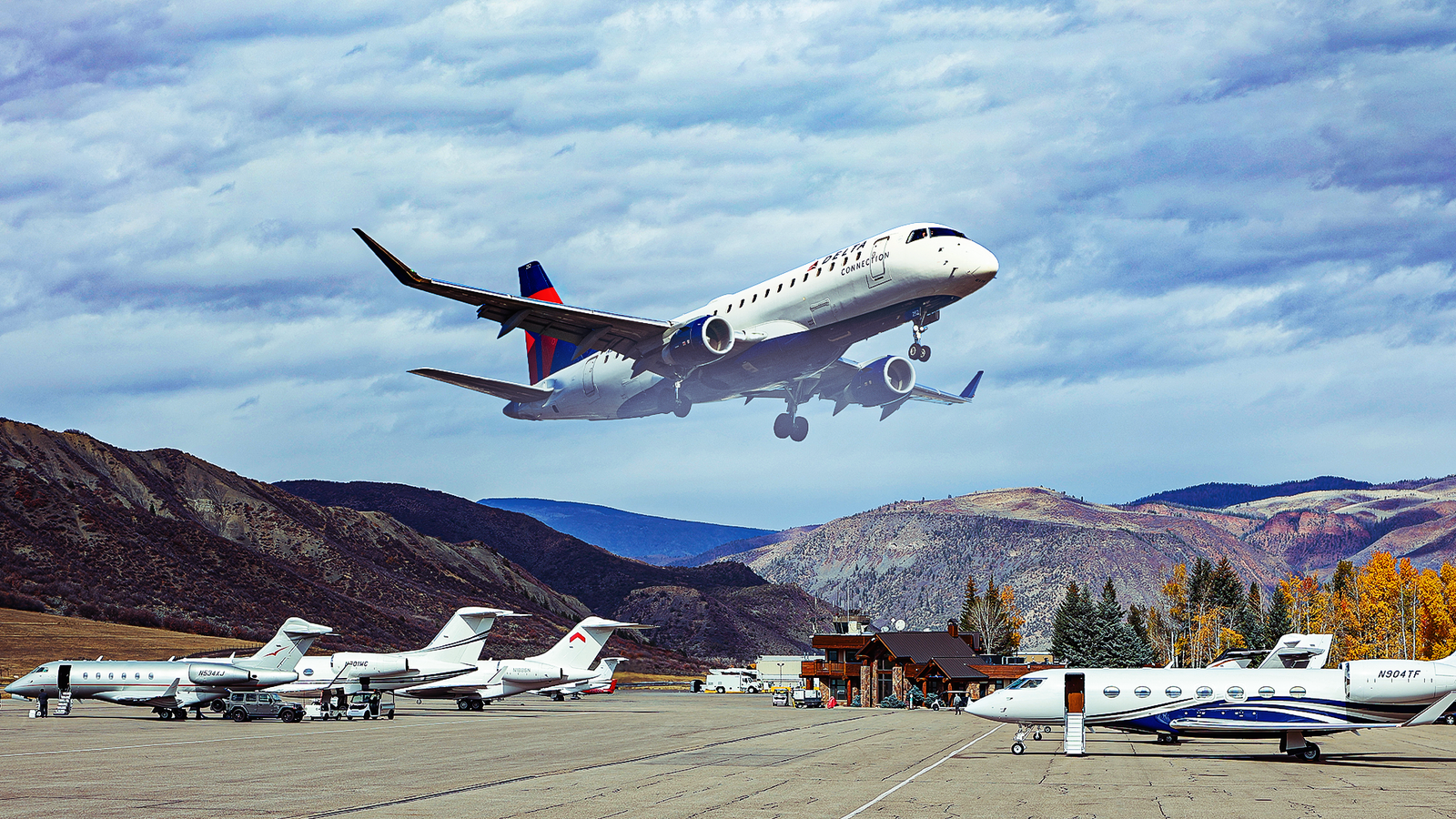
Published Sep 28, 2026, 3:00 AM EDT Airline and Airport Management Graduate, Student Commercial Pilot and Commercial Aviation Writer. Based in London & Nagoya Aspen/Pitkin County Airport (ASE), sitting at an elevation of 7,820 feet (2,384 meters) is one of the most challenging airports in the United States. High density altitude in warm weather is a huge problem for jet engine thrust, often forcing regional carriers to restrict passenger seats or leave baggage behind. These mountain airfield penalties kept the Embraer E175 from replacing aging Bombardier CRJ700 aircraft on high-yield resort routes. The E175 sat on the sidelines, deemed only marginally capable of meeting the airfield's steep obstacle-clearance requirements. That operational ceiling finally broke when Delta Air Lines and operating partner SkyWest Airlines deployed the E175 on nonstop flights into Aspen from Atlanta and Los Angeles. Gaining access to the airport did not require any airframe redesigns or heavier engine hardware. Instead, Embraer, General Electric, and SkyWest engineered a Full Authority Digital Engine Control software modification that extracts 1% to 3% more thrust from the GE CF34-8E powerplant. Combined with recalibrated takeoff and landing speed schedules, the digital enhancement allows the aircraft to meet demanding climb gradients while carrying full passenger loads. Pushing The Limits Of Airport Infrastructure The E175 was long restricted at Aspen due to a harsh combination of elevation, summer temperatures, and mountain topography. At 7,820 feet (2,384 meters) above sea level with an 8,006-foot (2,440-meter) runway, the airfield is particularly challenging for hot-and-high performance. To comply with strict Federal Aviation Administration (FAA) climb-gradient rules after a simulated engine failure on takeoff, dispatchers usually imposed heavy weight restrictions, making daily summer operations financially non-viable. According to Aspen Journalism and AirlineGeeks, the lighter CRJ700 previously dominated the airfield because its narrower wing and lower empty weight required less runway under limiting conditions. In contrast, the standard E175 carried a performance penalty that frequently required leaving ten to 15 seats empty during hot afternoon departures. Leaving seats unfilled stripped away the revenue advantage of operating a larger 76-seat regional cabin. As a result, regional carriers had to keep aging CRJ700 fleets going, leaving Delta and operating partner SkyWest Airlines searching for an engineering solution to modernize their mountain routes. Airframe geometry was another strict boundary, as Aspen enforces a rigid 95-foot (28.96-meter) wingspan limit across all taxiways and ramp areas. The E175 features a 93-foot 11-inch (28.63-meter) wingspan, sitting just under the airfield maximum with two feet (0.61 meters) of clearance to spare. However, fitting on the ramp meant nothing if the twinjet could not safely clear surrounding peaks following an engine failure at decision speed. That reality meant Embraer and General Electric had to shift focus from airframe modifications to the digital algorithms governing engine thrust. Gaining A Small But Mighty Performance Boost How can a software recalibration turn latent engine capacity into reliable mountain-climb performance without altering airframe hardware? How modern turbofans manage thermal and mechanical limits has a big impact on this. The General Electric CF34-8E engines powering the E175 were originally designed with built-in thermodynamic margins to preserve long-term component life. Under standard operating conditions, the Full Authority Digital Engine Control, or FADEC, limits thrust output well below the core's absolute capabilities. After updating the engine control software, engineers modified digital fuel-metering schedules and variable-geometry vane parameters, which commanded the fuel-metering unit to squeeze additional performance from the engine during high-load takeoff regimes. The software adjustment added 1% to 3% more takeoff thrust, specifically when throttles are pushed fully forward into the maximum-rating detent. While a 3% increase might sound modest on paper, at an airfield elevation of 7,820 feet (2,383 meters), it is a critical operational threshold. Combined with recalibrated flight control software that optimizes flap configurations and adjusts target approach speeds, the performance-enhanced E175 generates the climb gradient needed to meet single-engine balked landing and terrain-clearance requirements. Crucially, because this enhanced thrust schedule only activates during full throttle applications, normal cruise and descent fuel burn parameters remain virtually untouched during routine flight segments. With flight trials validating the technical solution, the focus shifts to fleet integration and the logistics of deploying these modified regional aircraft. Regional capacity provider SkyWest Airlines has spearheaded the effort by establishing a dedicated subfleet of Aspen-capable E175s, according to Aspen Journalism, comprising both newly delivered airframes from Embraer and retrofitted older units. By the end of 2026, SkyWest plans to operate 25 of these specialized jets, allowing both Delta and United Airlines to expand regional service into high-altitude mountain destinations across the western US. Out With The Old, In With The New SkyWest Airlines routes these FADEC-modified E175s dynamically through major hubs like Hartsfield-Jackson Atlanta International Airport(ATL) and Los Angeles International Airport(LAX). Importantly, the software update adjusts full-throttle thrust without changing standard cruise economics, so airframes can rotate seamlessly between mainline regional routes and mountain sectors. Delta Connection benefits greatly from this, as fleet utilization can remain high and mountain arrivals can meet mandatory single-engine climb gradients. The operational shift materialized in November 2025, when Delta retired the CRJ700 on Aspen flights from Atlanta and Los Angeles. Operated by SkyWest under the Delta Connection brand, the upgraded E175 carries six additional passengers per flight under limiting conditions compared to the outgoing jet. Expanding total seat capacity improves baseline economics, but doubling first class inventory drives route profitability further. Upgrading from six First Class seats on the CRJ700 to 12 on the E175 targets high-yield luxury demand into the resort. Aspen's challenge is that added seat capacity delivers value only when flights arrive reliably through mountain storms. That is where the advanced avionics suite inside the E175 cockpit and its capability to navigate severe weather challenges comes in. An Interesting Curved Approach The E175 features a Honeywell Primus Epic avionics suite equipped for advanced Required Navigation Performance with Authorization Required. These digital flight management systems enable the jet to fly the RNAV M Rwy 15 approach, a curved-path trajectory that threads through surrounding mountain peaks, as detailed in Simple Flying coverage. The aircraft continuously calculates position using multi-sensor navigation inputs, keeping precise lateral and vertical guidance along steep valley descent corridors, lowering cloud ceiling and visibility approach minimums far below standard instrument limits. As documented by Aspen Public Radio and the Aspen Times, United initially proved the concept at the airfield in December 2024 using SkyWest-operated E175s, and Delta Air Lines jumped on that operational groundwork to transition its own routes from Atlanta and Los Angeles. The combination of precision curved approaches and FADEC thrust updates drastically reduces weather-related diversions to Grand Junction or Denver. Preventing diversions remains vital for route yield, as Delta's 12 First Class seats cater directly to luxury travelers paying top-tier fares for uninterrupted nonstop service into the resort valley. High schedule completion rates reduce the high costs of ground transport and passenger hotel accommodations during winter storms, protecting feed into major hub networks. Now that Delta and United are beginning to cement their E175 fleets at Aspen, this technology change creates a great competitive divide against operators still tied to older regional airframes. One Carrier Left Behind Credit: Wikimedia Commons Delta and United's deployment of software-enhanced E175 jets is leaving American behind, isolated as the final legacy carrier relying on the CRJ700. Operating through regional partners SkyWest and Envoy Air, American remains bound to the older airframe on flights from Dallas/Fort Worth International Airport(DFW) and Phoenix Sky Harbor International Airport(PHX). Though its competitors offer 12 first class seats and expanded main-cabin capacity, American's CRJ-700s feature only nine premium seats. This seating deficit limits high-yield revenue capture during peak winter ski seasons, when affluent travelers demand premium products. American's reliance on the CRJ700 exposes its mountain operations to persistent hot-and-high summer penalties. On afternoon departures from Aspen, dispatchers can leave up to 10 seats empty on the 65-seat CRJ700 to satisfy single-engine climb clearance. In contrast, Delta and United can use the E175's software-enabled 14,626 pounds (65.06 kilonewtons) of peak thrust and 93-foot 11-inch (28.63-meter) wingspan to carry full passenger loads. Furthermore, without the RNP AR precision approach avionics natively integrated into the E175 flight deck, American's regional flights face higher weather diversion rates into alternate airports during heavy Rocky Mountain snowstorms. The passenger experience and reliability gap puts plenty of pressure on American to modernize its regional fleet strategy for mountain destinations. SkyWest is expanding its dedicated subfleet to 25 Aspen-capable E175s by the end of 2026, and so American will eventually be forced to adopt the software-modified jet or concede market share to rival network carriers. Replacing the CRJ700 completely across the US regional ecosystem extends far beyond a single resort airfield, and is altering how regional carriers manage high-altitude operations across the American West. A Global Revolution? Software-defined thrust management is one of the key changes helping regional carriers overcome airfield constraints across the American West. Rather than waiting for manufacturers to build niche aircraft for small, high-altitude markets, airlines can use engine control updates to unlock the true potential of existing airframes. With aging CRJ700 fleets facing retirement limits over the next decade, the software-modified Embraer E175 establishes a new baseline for luxury resort connectivity. As these modified jets integrate into daily schedules for Delta Air Lines and United Airlines, market pressure will inevitably push American Airlines to adopt the software update or lose market share. Meanwhile, local debates over Aspen's 95-foot (28.96-meter) wingspan limit continue. Until county officials widen taxiway clearances for larger aircraft, the digitally enhanced E175 is still the largest aircraft permitted on the ramp. Beyond Pitkin County, engine manufacturers General Electric and Pratt & Whitney are monitoring how digital thrust upgrades affect long-term maintenance cycles. Operating turbofans at higher thermal thresholds during takeoff increases core wear, necessitating tighter inspection intervals for turbine components. Ultimately, operators must figure out how to make these performance boosts sustainable for long-term operations, but it will likely lead many other operators to adopt these software enhancements.
The Engine Software Tweak That Finally Lets Delta Air Lines Fly The Embraer E175 Into Aspen
Full Article
Original Source
Read the full article at Simpleflying →KhanList aggregates and links to publicly available news content. We do not host full articles from third-party sources. Always verify important information with original sources.