
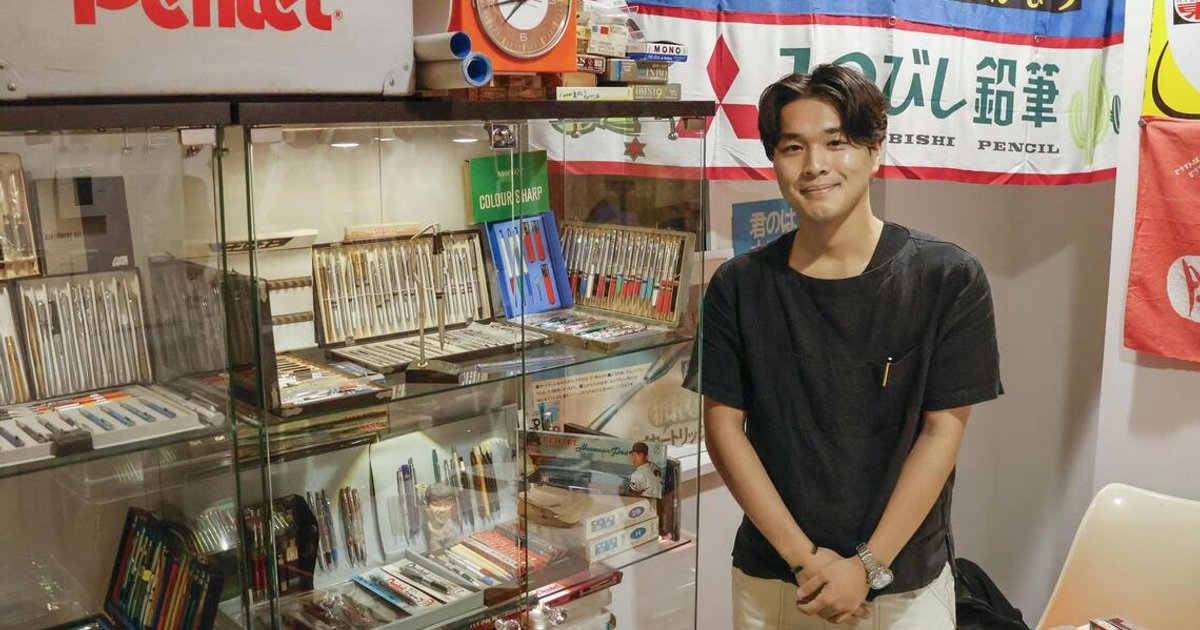
TOKYO – Kengo Hirose’s love for the mechanical pencil runs so deep that the 21-year-old opened a gallery in his native Kyoto in June, featuring a collection of about 1,000 pencils amassed since his childhood.And that is just a fifth of his personal collection. The third-year Ritsumeikan University undergraduate’s by-reservation-only Mechanical Pencil Museum displays rare, discontinued models from the 1960s to 1980s.“There are feelings you can truly understand only by holding a pencil and writing with it,” he was quoted as telling domestic media.His passion for the mechanical pencil – a device perfected by Sharp founder Tokuji Hayakawa – feels like a quiet, deliberate act of resistance amid the global wave of digitalisation.Yet, as I have discovered over years of reporting in Japan, this affection for pen and paper is not merely romantic nostalgia. It is a cultural anchor that recently sparked a national conversation about what it means to stay human in an automated world.On Oct 2, Japan’s Agency for Cultural Affairs revealed that a national survey found 80.4% of respondents believe the habit of writing by hand “should be preserved”, though this is down from 91.5% in the last comparative survey 11 years ago.Despite this decline, 82.3% nonetheless expressed a clear preference for handwritten correspondence – or, if printed, with the “human touch” of a handwritten comment.Third-year Ritsumeikan University undergraduate Hirose’s museum features a collection of about 1,000 pencils amassed since his childhood. PHOTO: R__OBB__Y/INSTAGRAMThe survey also found that 68.2% felt that handwriting expresses individuality and emotional nuance that standardised digital fonts cannot convey.What I found most striking about the data is that this devotion is not driven by the sentimentality of older generations, but is actively embodied by young people like Hirose.The so-called “smartphone generation” championed handwriting more strongly than any other age bracket: 84.8% of teenagers insisted that the value of handwriting must not be allowed to diminish in the future.Putting pen to paperIn Japan, the Kanji Aptitude Test (known colloquially as the Kanken) tests applicants on their written mastery of Chinese characters.Unlike the multiple-choice Japanese-Language Proficiency Test for non-native speakers, the Kanken features writing components across 12 tiers, with Level 10 the most basic and geared to first-graders.The highest tier is Level 1 – there is also a Pre-Level 1 and Pre-Level 2 – that tests about 6,000 characters, including obscure classical kanji.Having taken and passed Level 2, which tests the 2,136 characters most commonly used in general adult life, I am often met with bewilderment when I tell Japanese friends that I am thinking of attempting Pre-Level 1, where the pass rate sometimes falls below 15%.Most Japanese adults stop at Level 2, if they take the exam at all. And I get asked: Is taking the Kanken even necessary when character suggestions auto-populate as you type? How often do you actually need to write kanji by hand?This scepticism is reflected in a broader decline: Total Kanken applicants across all levels peaked at 2.89 million in 2008 and have since dropped significantly to around 1.29 million.Yet, my desire to take the test is not merely about language improvement, but also about enchantment by the written word in an overwhelming digital environment.There is, of course, added appeal in Japan’s rich stationery culture, ranging from the exquisite leather-bound Traveler’s Company Traveler’s Notebooks to the ubiquitous Kokuyo Campus Notebooks to Pilot’s smooth ballpoints and delicate fountain pens. Little wonder that Zebra’s flagship luxury pen, The Zebra Hamon, launched in March at 59,400 yen (S$483), quickly sold out in many stores across Japan.Offline refugeIn a country where many are glued to their devices, and journalists have long typed away on laptops rather than take notes by hand at press conferences, the mere act of jotting down thoughts can be a potent tool for a digital detox.Putting pen to paper in physical planners or journals can offer distinct mental health benefits, helping to organise complex thoughts and process emotional stress.The affection for pen and paper recently sparked a national conversation in Japan about what it means to stay human in an automated world. ST PHOTO: AZMI ATHNIIn August, a survey of high school students by stationery brand NOLTY found that those who used pen and paper reported being 14 percentage points better at understanding the underlying causes of their emotional stress, and 11.6 percentage points better at “resetting their minds after failure”, compared with non-users.Journalling by hand, clearly, should not be regarded as an archaic chore, but as an offline sanctuary for self-reflection and mental clarity.In 2021, research led by University of Tokyo neuroscientist Kuniyoshi Sakai found that putting pen to paper triggers significantly stronger brain activity and memory recall compared with typing on laptops or smartphones.To be sure, modern economic and digital pressures have reshaped longstanding customs, such as the traditional practice of sending nengajo (New Year’s greeting postcards) by post. A 2024 poll by The Asahi Shimbun revealed that 57% of Japanese adults no longer send nengajo as higher postage fees and the proliferation of messaging apps lead millions to digitalise greetings.Yet, far from signalling the death of penmanship, this shift has transformed handwriting from a routine administrative task into an intentional, highly valued gesture – much like how a barista’s message on a coffee cup can brighten one’s day.A handwritten note reveals a physical presence that feels intimate in a digital era.Hirose himself was so driven by this philosophy that he began handcrafting his own brand of mechanical pencils, which he sells at his Kyoto museum for 11,000 yen each to fund the venue’s rent.As young people like Hirose lead the charge, the art of writing will surely withstand the test of time.
The enduring intimacy of writing by hand in digital Japan
Full Article
Original Source
Read the full article at Straitstimes →KhanList aggregates and links to publicly available news content. We do not host full articles from third-party sources. Always verify important information with original sources.