
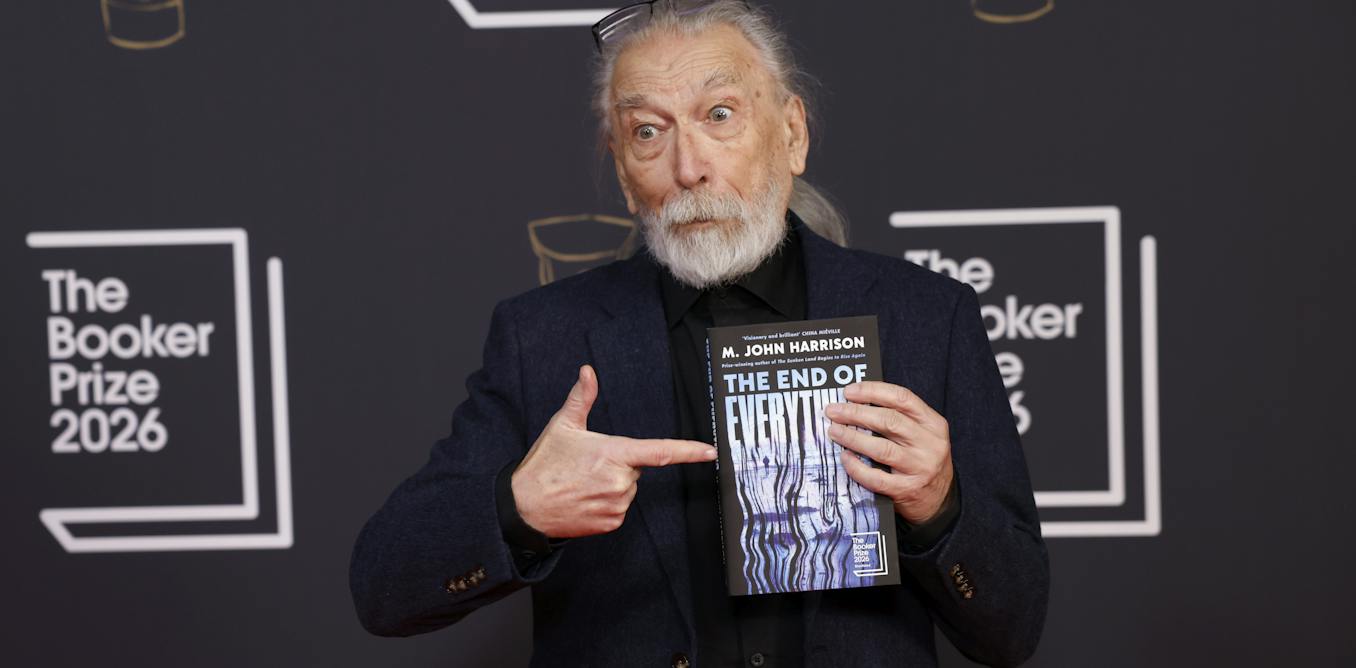
The backdrop of M. John Harrison’s 2026 Booker prize-winning novel, The End of Everything, is that staple of science fiction – an alien invasion. An ineffectual war is being waged by humans against the indifferent and sardonically named aliens, the iGhetti (a riff on tech company Apple’s naming conventions). These amorphous entities have leaked into our reality, we are told, “from the astral plane”. They have gravitated towards the great financial centres of the world, which means in Britain, where the novel is set, they’re confined to London’s Square Mile. The most notable impacts of the iGhetti are the biological gadgets and adaptive artefacts that are turning up around the world as well as “bad patches” – localised spots where reality seems to come undone. Phillip Tennent, a beachcomber somewhere on the Kent coast, finds one of the iGhetti artefacts washed up by the tide. This device slowly begins to ape human behaviour and take on a human appearance. The discovery initiates a weird road trip round the south east of England for Tennent and his ageing, forgetful aunt Marnie. A plot synopsis cannot convey the power of this bizarre, destabilising novel. In fact, as Harrison writes in his 2023 “anti-memoir”, Wish I Was Here (2023), “story is fine, but plot is like chemical farming”. His style is violently fragmented, yet holds together so well that the structure itself carries as much weight as the words. A jarring event towards the end of the novel splits the book, but allows the poignant second part to move beyond loss and into something like acceptance. Harrison is a writer of speculative fiction, but he has a playful contempt for the conventions of the genre. His 60-year literary career has been one of burrowing out of the constraints of genre, while also baulking at the idea of moving into literary fiction – which he maintains can be as trope-bound as the most commercial fantasy, science fiction and horror. Harrison’s earliest work, including stories later collected in The Machine in Shaft Ten and Other Stories (1975), was associated with the new wave of British science fiction in the 1960s and 70s. The writers in this group rejected traditional “hard” science fiction and American pulp space adventures in favour of literary experimentation, psychological depth and counterculture themes. Harrison existed within the orbit of Michael Moorcock’s New Worlds magazine, which served as the movement’s ideological centre. Despite this, however, he can only loosely be thought of as a writer of science fiction. Two early novels, The Committed Men (1971) and The Centauri Device (1975), are certainly written in a science fiction style. However, Harrison moved away from science fiction throughout the 1970s and early 1980s with a series of increasingly experimental fantasy stories set in a city called Viriconium, starting with the novel The Pastel City (1971). Subsequent work embraced a range of speculative fiction, alongside gritty realism, occult fiction and experimental short stories. His literary influences are eclectic, and include the forgotten and abstruse alongside the established. References to the work of horror writer Arthur Machen and the Soviet and Russian science fiction writers the Strugatsky brothers have peppered his corpus. Harrison’s previous novel, 2020’s Goldsmiths prize-winning The Sunken Land Begins to Rise Again, explicitly alludes to both the supernatural-theological thriller writer Charles Williams and Victorian writer Charles Kingsley. But the uninitiated may be surprised to know that his writing is as, if not more, influenced by the domestic but socially critical worlds of English novelist Elizabeth Taylor and Kiwi writer Katherine Mansfield as it is by that of science fiction pioneers such as JG Ballard and William S. Burroughs. A term Harrison has used to describe his own work is “weird”. This draws on the lineage of weird fiction – a blend of classic horror, fantasy and early sci-fi. Coining the term the “new weird” in his introduction note to the writer China Miéville’s 2002 novella The Tain, he wrote his take has particular emphasis on what he called a “pick & mix” approach. The new weird was a return to a “marvellous and uncorrupted time of the world, [when] everything could still be all mixed up together – horror, [science fiction], fantasy – and no one told you off or said your career was over with their firm if you kept doing that”. In Wish I Was Here, Harrison calls the weird “a way of writing about the real,” something which thrives on irresolution and ambiguity, and which “stands for the unwritten, the unwritable: that which, the reader must sense, lies behind the text”. It is this provocative engagement with our hectic and uncertain times – touching on financial collapse, climate change and the rise of artificial intelligence – which The End of Everything offers readers. And there is a genuinely radical quality to Harrison’s work. Much experimental literature struggles to move past the techniques of modernism – the emphasis on interiority which comes with stream of consciousness, a certain kind of linguistic play which emphasises the rift between words and the things they point to. Harrison, however, recognises these devices were capable only of articulating something about the crises of the inter-war period and that we must now wrestle with very different concerns. He is less interested in our inner lives and the exhaustion of language than he is in our capacity for acts of imaginative meaning-making with words. He is concerned “by the performance [through] which,” as he put it in a piece for the journal Foundation in 1989, “instant to instant, we repossess our lives”. Perhaps that is why, for all the cruel banality of The End of Everything’s depiction of a wan post-invasion world, the book is suffused with a sense of quiet, but profound, hope. This article features references to books that have been included for editorial reasons, and may contain links to bookshop.org. If you click on one of the links and go on to buy something, The Conversation UK may earn a commission.
The End of Everything by M. John Harrison wins the 2026 Booker prize – a wonder of weird fiction for our incomprehensible times
Full Article
Original Source
Read the full article at Theconversation →KhanList aggregates and links to publicly available news content. We do not host full articles from third-party sources. Always verify important information with original sources.