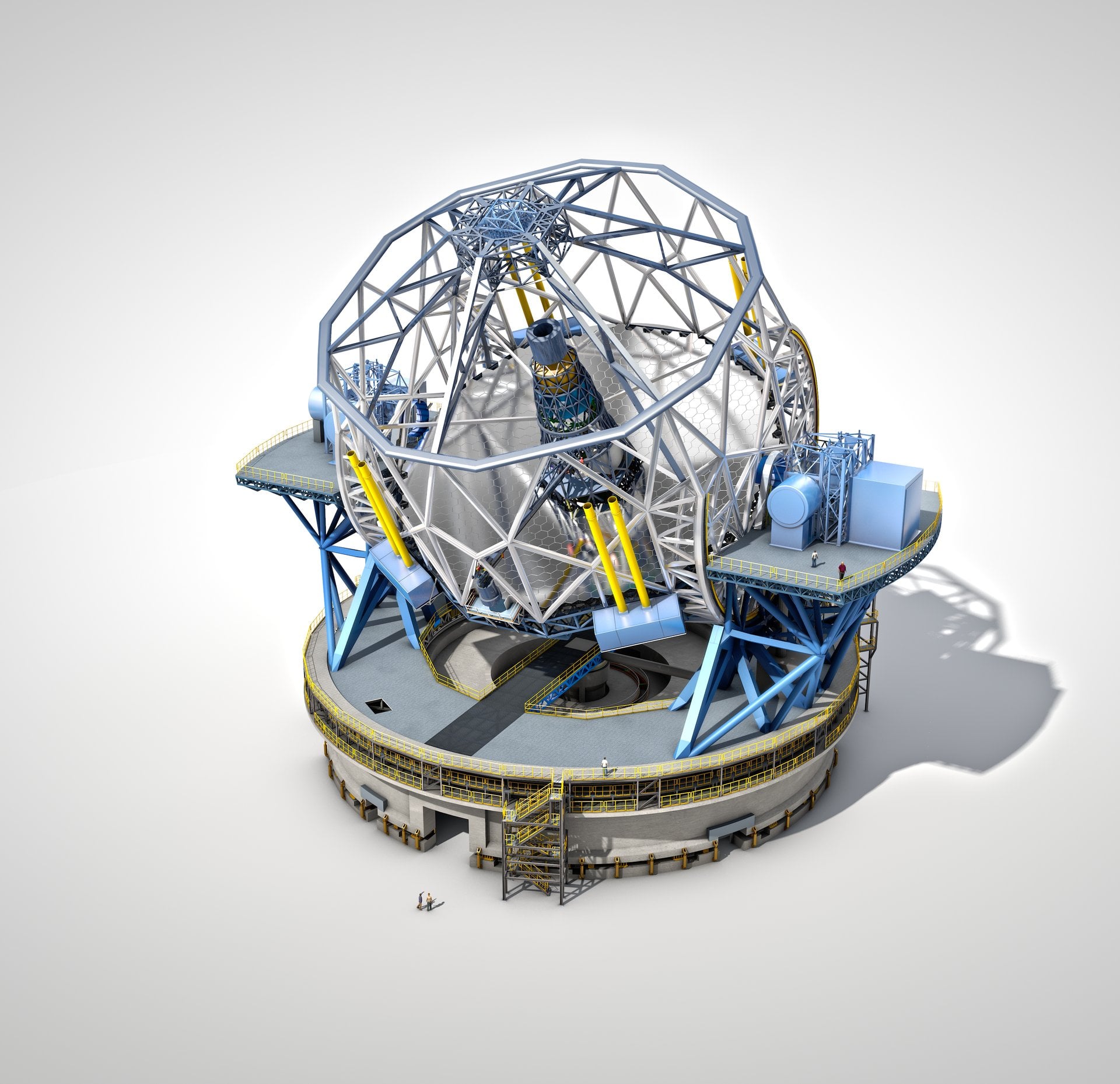
Before any major telescope commissioning, there are dozens of papers that attempt to define what we can expect from it. We’re starting to see some come through for the Extremely Large Telescope (ELT), which hopefully will get a more imaginative name when the 39m behemoth is officially commissioned in Chile in the 2030s. A new paper from Evann Kurzawa-Ferrandez and his co-authors at NASA’s Jet Propulsion Laboratory, and available in pre-print on arXiv, showcases what kind of biologically relevant gases we can find on some of our nearest exoplanets. Those gases include carbon dioxide, water vapor, methane and oxygen - each of which has its own distinct spectral signature. To detect those lines, the ELT will use a specially designed instrument known as the ArmazoNes high Dispersion Echelle Spectrograph (ANDES), and previously known as HIRES. As one of the main instruments on the ELT, ANDES will be responsible for capturing the light from these planets as they transit in front of their star. There are a lot of transiting exoplanets out there, though, so the researchers had to narrow down their potential selections. They decided on 18 known, potentially habitable rocky planets that pass in front of their host stars. These include several from the famous TRAPPIST-1 system, which hosts several interesting candidates for potential biosignatures. Frase talks about how we might find biosignatures. Noise is always an issue when attempting to collect data on a far-away planet, and even more so for telescopes that are ground-based and have to deal with Earth’s atmosphere. To eliminate some of the noise, the authors turned to a mathematical framework known as Bayesian cross-correlation function, which accounts for “noisy” correlations between the atmosphere and the telescope data. But to be clear, for now at least, this was all done in simulation. When they looked at the exoplanets being simulated, it immediately became clear that water is the easiest molecule for ANDES to detect. For the TRAPPIST-1 planets, it would take between 10 and 19 transits to statistically prove whether water was in a planet’s atmosphere or not. That is actually a relatively short time in terms of the overall amount of time - 19 transits of the outermost planet would only be equivalent to 380 days, or a little longer than a year back here on Earth. However, oxygen came out definitively the most difficult biosignature to detect. It would take roughly four times as many transits to detect oxygen as it would to detect water. But for the easiest planet - TRAPPIST-1d, that still only took around 36 transits, and ANDES was able to detect all of the gases on that planet. However, only 8 of the 18 planets could yield a decisive detection of at least one of the gases within a 100 transit limit. That doesn’t bode well for using the ELT for biosignature detection of the majority of planets in our near neighborhood. Frase talks about the necessary factors of finding a truly habitable exoplanet. Admittedly, the authors also are very candid about some optimistic assumptions they made as part of the work. They assumed there wouldn’t be any clouds or hazes in these planets, but in reality exoplanets are almost always cloudy. In a simulation, the authors can easily subtract out the interference from the Earth’s atmosphere, but in reality, reaching the “photon-noise limit” as they did in simulation would be a monumental data-processing challenge. Also in the simulation, they didn’t account for any stellar flares or sunspots, both of which are incredibly common in stars with exoplanets, and can introduce significant amounts of noise into the data that isn’t dealt with using the data processing techniques described in the paper. Despite those challenges, this is still one of the most realistic, mathematically sound forecasts we have of ELT capabilities to date. And the ANDES instrument won’t be alone in this quest. The instrument already includes an adaptive-optics-assisted integral-field-unit (IFU) mode in the near infrared, which is designed for diffraction-limited observations and high-contrast/reflected-light applications. Instead of relying on transits, these technologies would allow ANDES to monitor the starlight reflecting off the day-side of non-transiting exoplanets. Integrating those two data sets is another task on the engineering list for the ELT designers. They’ve still got a while before the telescope itself is up and running. But this surely won’t be the last paper that we see that lays out the expectations we should have for this next generation of game-changing ground telescope. Learn More: E. Kurzawa-Ferrandez, A. Bello-Arufe, R. Hu - Biosignature detectability on transiting habitable worlds with ELT/ANDES UT - Life Beyond Biosignatures: A New Method In The Search For Life UT - Forget Searching for Individual Biosignatures. Instead, Find Their Patterns UT - Astronomers Think They've Found a Reliable Biosignature. But There's a Catch
The ELT's Spectrograph Could Sniff Out Biosignatures on Other Worlds
Full Article
Original Source
Read the full article at Universetoday →KhanList aggregates and links to publicly available news content. We do not host full articles from third-party sources. Always verify important information with original sources.