
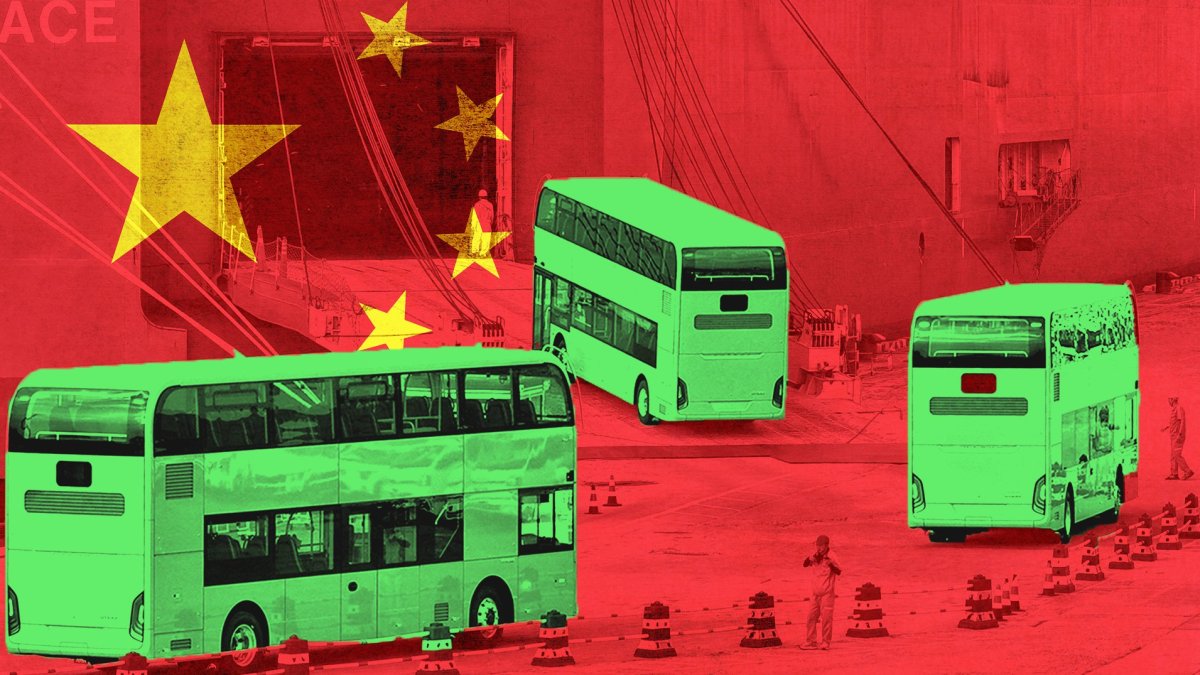
UK roads risk being left gridlocked by immovable buses with built-in ‘kill switches’ if councils ramp up purchases of cheaper Chinese electric vehicles to replace ageing fleets, a leading security figure has warned. Hundreds of Chinese electric buses, which can be remotely deactivated by on-board SIM cards, have already been purchased by UK councils in a bid to meet financial and environmental pressures. Security experts fear the influx will gather pace following the Government’s decision to devolve more spending powers to councils, which are increasingly attracted to the lower cost of Chinese vehicles compared to Western counterparts. Luke de Pulford, co-founder of the Inter-Parliamentary Alliance on China, said more regional spending decisions are likely to result in “an increasing amount of the purchasing of risky Chinese tech outsourced to councils”. He said: “As we move towards a greener economy, there is heavy pressure on public authorities to procure green vehicles,” adding that lower prices will put “pressure upon local authorities to get them from Chinese sources”. “We’ll be talking buses used to transport senior citizens and everybody else.” Security fears over components in Chinese EVs have seen such vehicles banned by the Ministry of Defence over spying concerns, while the National Cyber Security Centre (NCSC) found it was “technically possible” for electric buses from China already on Britain’s roads to be remotely stopped by Beijing. Electric buses on offer from China are typically cheaper, with Jean-Marc Gales, chief executive of Wrightbus, recently warning the vehicles are a threat to British manufacturers who can’t compete because the companies receive huge state subsidies from Beijing.Cheaper prices have also seen soaring sales of Chinese-owned EVs, which now account for 15 per cent of all new cars registered in the UK. The Jaecoo 7 was the best selling electric car in the UK last month – retailing from £23,500, compared to the Citroen C5 Aircross, billed as the nearest competitor by car sale site Carwow, which costs £31,000. Intelligence officials have warned of the risk of some EVs having in-built microphones and cameras that can be turned on remotely, risking eavesdropping, tracking and filming of locations, while GPS could be used to identify drivers’ home addresses. Chinese buses with ‘kill-switch’ Iain Duncan Smith, co-chair of the Inter-Parliamentary Alliance on China (IPAC), told The i Paper he is highly concerned about councils opting for Chinese electric buses. He said: “The Government should impose substantial tariffs on Chinese vehicles. They are artificially cheaper than British buses because they are illegally subsidised by the Chinese Communist Party.” He echoes concerns that internet-connected components from China could “theoretically be used to sabotage the UK” by shutting down not just buses, but other systems containing them, including other electric vehicles owned by drivers across the country, as well as energy grids and medical devices. Yutong buses are connected to the internet by onboard SIM cards in order to carry out software updates. Security experts warn these can double as an effective “kill-switch” to deactivate the buses remotely at any time. Around 640 Yutong buses are operating in England – including 62 purchased by publicly-owned Nottingham City Transport and six by Leicester City Council – while a £45m fund from the Scottish government this year for zero emissions buses will see half of the electric fleet supplied by Yutong. Yutong electric buses, such as this one in Bristol, have come under scrutiny over security fears (Photo: Geography Photos/Universal Images Group via Getty Images) Meanwhile, First Bus operates more than 300 Yutong buses in towns and cities such as Aberdeen, Basildon and south Essex, Taunton and Western-Super-Mare. Stagecoach runs more than 200 of the vehicles in areas such as Teesside, Coventry, Inverness and South Yorkshire. The firm also announced it had purchased 22 new Yutong buses along with Surrey County Council in June. Norway’s public transport company Ruter investigated their fleet of Yutong buses in 2025 and implemented strict security measures to curtail the risk of unauthorised remote access as a result. However, the UK transport secretary, Heidi Alexander, in May described the decision to continue England’s use of Yutong buses as a “a managed risk”. She said the buses are in line with current “security expectations”. A government spokesperson said: “National security is the first duty of government. There is no cause for passenger concern, and these buses continue to operate safely and any suggestion otherwise is irresponsible. “We will take robust action against any suppliers in the public sector that may pose a threat to the UK.” It is understood all buses on UK roads have software update protocols consistent with National Cyber Security Centre guidance and that last year, legislation was introduced to increase resilience to cyber attacks and regulate software updates of vehicles. Yutong Bus, a private Chinese company and the world’s largest exporter of electric buses, has previously said that its buses cannot be remotely controlled because their internet-enabled software is not connected to the main driving controls, including braking and steering. Graeme Downie MP, chair of the Coalition on Secure Technology, said new devolved powers could provide an opportunity to make more council bosses aware of a threat that’s “already there”. He said; “Increased devolution is an opportunity to make sure that security services engage better with [them] around this threat. “It’s part of how do we better inform people to see security as something that is everyone’s responsibility.” Remote controlled cameras and mics Downie, who has repeatedly raised the issue of security risks from Chinese components along with former head of MI6 Sir Richard Dearlove, is pushing for the public – not just those in power – to be made more aware of the risks. “We need to be more trusting of the public and give them information. That’s the way you make the public more aware of the more dangerous world that we’re living in and the nature of threat now, which is not the same as 10 years ago,” he said. The risk posed by Chinese-made components is not restricted to electric buses, but also many electric vehicles, with Downie’s comments coming shortly after Dutch intelligence (AIVD), in a rare intervention, issued a public warning over the security risks of smart components built into modern vehicles. It did not mention any countries, but spoke of the risk from “various parties, including state actors”. The intelligence agency shared a report highlighting that hostile states could snoop on those using components in smart, electric cars. It detailed how in-built microphones and cameras can be turned on remotely, risking eavesdropping, tracking and filming of locations. “Be aware of what the camera inside the vehicle might be able to see,” the report warned, “Do not use a vehicle with an external camera to travel to a sensitive location”. It also warned electric car users to stop connecting their phones to the vehicle using bluetooth or Wi-Fi, warning “technically, it is possible for malicious actors to gain access to the vehicle’s internal systems via all these connections and to extract data from connected devices from within the vehicle.” Infotainments systems and built-in GPS were also highlighted as features that could be used to track people’s locations and also their data, such as their home addresses. The i Paper has previously reported how a Chinese tracking device was found in a UK government car, used by the Prime Minister in 2022 – the year Boris Johnson, Liz Truss and Rishi Sunak led the country. Consumers are not aware of the value of their personal data, de Pulford warned, adding : “We haven’t had the kinds of warnings that we ought to have had. Our security services are fully alive to this issue, but we haven’t seen any comparable guidance from MI5 on the risks of Chinese EVs or the risks of Chinese cellular modules. “We’re just buying this stuff hand over fist.” No silver bullet The affordability of Chinese-made EVs is also in part down to Britain’s decision not to impose tariffs on them, unlike other parts of Europe. This could change, with No 10 reportedly mulling a change in direction as part of potentially joining the “Made in Europe” scheme, designed to protect European manufacturing. Downie warns there is a danger in thinking that putting restrictions on Chinese EVs solves the problem, given the components they use are so widespread. He said: “I wouldn’t consider any kind of move on Chinese EVs to be a silver bullet. “We’ve got to be careful we don’t detract from the discussion about technological threat and think if we’ve restricted Chinese EVs, it’s problem solved.”
The electric buses that China can stop in the road – coming to a town near you
Full Article
Original Source
Read the full article at Inews →KhanList aggregates and links to publicly available news content. We do not host full articles from third-party sources. Always verify important information with original sources.