
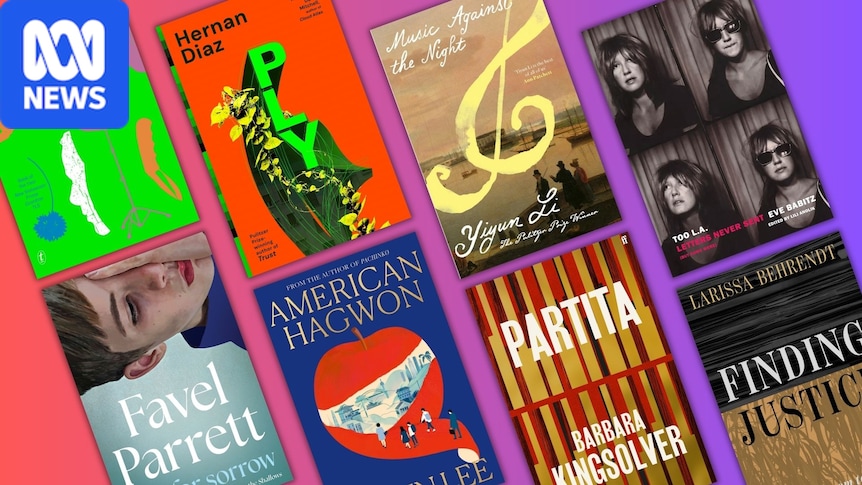
October was a huge month for books.Barbara Kingsolver — whose 2022 bestseller, Demon Copperhead, transfixed readers the world over — returned with the much-anticipated Partita, a novel of music and what-ifs.Fellow literary heavyweight Min Jin Lee, of Pachinko fame, questions the role of education in a family saga set in the influential world of for-profit tutoring businesses known in Korean as hagwons.And a Pulitzer Prize winner, Hernan Diaz, imagines a dystopian future where the United States has fractured and electricity is currency.Our critics review these books and more this month. Enjoy!American Hagwon by Min Jin LeeOne for Sorrow by Favel ParrettPly by Hernan DiazToo LA by Eve BabitzSpent Light by Lara PawsonMusic Against the Night by Yiyun LiFinding Justice by Larissa BehrendtPartita by Barbara KingsolverAmerican Hagwon by Min Jin LeeFourth Estate"The Hagwon is a very central part of being a Korean person," Min Jin Lee told ABC Radio National's The Book Show. (Supplied: HarperCollins Australia)American Hagwon is both an epic yet intimate story of family and perseverance. Author Min Jin Lee balances social commentary with deep character work as the Koh family is buffeted across Korea, Australia and America by the winds of a personal betrayal and the 1997 Asian financial crisis. At the heart of this book is a conversation about education: what does it look like, who has access to it, what is it for and how can it change your life?In her third novel, Lee — known for her exploration of the Korean diaspora in works such as Pachinko — introduces the reader to the world of hagwons, Korean private after-school tutoring businesses or "cram schools". The reader, as well as the novel's characters, must grapple with the efficacy and purpose of these businesses. Are they further perpetuating the pressure many children feel to get the best grades and entry into the best schools or are they spaces of learning necessary for success?Helen and John Koh sacrifice much for their three children, Bo, DH and Mido, who come to learn that educational success is fundamental to their identities and self-worth. We follow the children as they go from students to teachers themselves, continuing to live by the tenet that education is the gateway to freedom from financial and societal vulnerability. Lion, a hagwon owner in California who employs Bo and Mido, is desperate for his community to reject this thinking, proclaiming "our children should not have to save us". However, he is met with exasperation and reticence by parents who want a better life for their children and see only one path.Lee is a master of building rich, character-led stories. We follow characters' journeys rather than a plot-driven narrative, showing how each member of the Koh family rises to the challenge when met with obstacles and barriers over the course of their lives.— Rosie Ofori WardOne for Sorrow by Favel ParrettHachette AustraliaFavel Parrett's debut, Past the Shallows, was number 173 in ABC Radio National's 2026 Top Australian Books. (Supplied: Hachette Australia)Award-winning Australian author Favel Parrett's long-awaited fourth novel for adult readers was conceived during a writer's residency in Trondheim on the shores of Norway's third longest fjord. That intimate connection — notably with the landscape and seasons of that unique city, but also with its culture and people — pulsates through the prose, providing a rich backdrop to what deftly evolves into a heart-stopping tale of love and betrayal.A two-hander told through the eyes of a child and his teacher, One for Sorrow opens with the now grown Einar returning to his hometown of Trondheim for a nostalgic sojourn. There he is persuaded to take an impromptu tour around his old school building where he is touched and somewhat perturbed by memories of an inspirational teacher. He visits his parents' and sister's graves but, we are told with an ominous thud, the teacher, Herr Kristiansen, "is not here".The story then jumps back to 1939, when Einar is at primary school. Johan Kristiansen has struggled to find a teaching position in Oslo and is prepared to embrace a more parochial existence in this northern outpost, with its snowy and sometimes bleak beauty. Johan is vibrant, progressive, young; so different to the hated Herr Berg he is replacing, and Einar is quickly enthralled.Johan reads to the class and later shares Ernest Hemingway's work with Einar, whom he recognises as a fellow scribe. A bond forms. But a clandestine passion has also been ignited between this charismatic teacher and Einar's mother. That love affair is painted with erotic tenderness that morphs into fevered desperation when Nazi occupation changes everything. Short chapters, written with a lilting cadence and sophisticated spareness, build tension and a brooding intensity reminiscent of Parrett's Miles Franklin award-shortlisted 2011 debut, the equally compelling Past the Shallows.— Juliet RiedenPly by Hernan DiazPicadorHernan Diaz — In the Distance (2017) and Trust (2022) — was born in Argentina and lives in the US. (Supplied: Pan Macmillan Australia)Ply, the third novel by Pulitzer Prize-winning author Hernan Diaz, is set in an unnamed American city centuries in the future.While people still prosper in the countryside, life in the city — reminiscent of New York — is hardscrabble. Life expectancy and the birthrate are low, and health care is primitive — a minor wound can prove fatal.In this dystopian world ruled by gangsters and militarised corporations, humans rely on their ingenuity. The novel's narrator is a pincher, someone who makes a living from stealing electricity from the grid — controlled by a single energy giant, Tensor, and patrolled by private police force CTS — storing it in a "brick" and selling it on. The pincher, whose mother was a type of DIY mechanic or engineer known as a tinker, has developed a new, more powerful brick that promises her financial security.The first 200 pages are a pleasing mix of world-building and plot, as the pincher reveals her past in flashbacks. She soon realises she is being followed — but by who? Thugs covetous of her high-powered brick? CTS contractors? Another malevolent actor?In Part Two, the perspective unexpectedly shifts from the first to the third person as the pincher embarks on a project with Pola, an eccentric and, unusually for their world, mature-age scientist. Here, large blocks of scientific exposition act as a brake on the narrative but soon the plot picks up again, as the pincher and Pola plan an ambitious heist.Diaz's play with perspective enables him to explore the idea of universal consciousness as a counterpoint to the individualism of contemporary Western society. He renders the world of Ply in lyrical prose, paying close attention to the unexpected beauty of the rewilded landscape. And while much of Ply is given over to high-energy physics, Diaz also describes more organic human pursuits, particularly music, in loving detail. Subatomic particles can generate unprecedented energy, he seems to be saying, but so can human connections.— Nicola HeathToo LA: Letters Never Sent (But Some Were) by Eve Babitz, contributions by Lili AnolikAtlanticLili Anolik is a contributing editor at Vanity Fair and has published three books on the life of Eve Babitz. (Supplied: Allen & Unwin)Continuing Lili Anolik's chronicle of Eve Babitz's life — her previous book, Didion and Babitz, was reviewed here — Too LA puts Babitz's correspondence in conversation with Anolik's sassy commentary.Born in the 40s to artist parents, Babitz was a chronicler of 60s and 70s LA, a masterful "gossip storyteller" who embedded herself within its cultural and artistic scenes. Her voice is at once intimate, excitable and fragile.Anolik presents the material in a style that speaks to Babitz's own, appending photos, drawings and diary entries, annotated by Anolik's footnotes. What emerges is not only a picture of Babitz but LA in its hedonistic heyday. With her taste for good times and good company, names drop like nobody's business.One moment she's in Florence, a city she dismisses for its "small town kind of atmosphere", dating "this typical La Dolce Vita type — handsome, rich", the next, her letters take on a spurned lover-esque quality as her other obsessions — notably Joan Didion — turn sour. The bubbly, charming, vivacious Babitz gives way, in the 70s, to a more brittle persona as her earlier success fails to grow.Babitz channels her insecurities into diva strength, her hijinks showing how braggadocio and chutzpah can put life in the world. A 1964 letter to Joseph Heller inviting him to read her first novel (he responds that the draft "is eminently readable, but probably not publishable") becomes weightier when, several years later, she writes to him again, criticising the boxes in which female artists are placed. Responding to a man who says disappointment has made her "disciplined", she says: "Because I didn't ball him he assumes I must have some fantastic discipline."Full of quotable tales and telling quotes, memorable side remarks and bristly, frank divulgences, Too LA is incisive and quietly moving. It has a lot to say about the City of Angels and about being a woman, a scenester and a lover of life.— Declan FrySpent Light by Lara PawsonText PublishingLara Pawson's Spent Light was shortlisted for the Goldsmiths Prize in 2026. (Supplied: Text Publishing)It starts so simply: the unnamed narrator's neighbour gives her a toaster after his wife dies. Inspecting the item sets our protagonist off on a wild train of thought: "Above each light, fractionally off centre, a word is printed in the same restrained font found in CIA documents. Together, they form a synopsis of the anthropocene: REHEAT DEFROST CANCEL."London-based author Lara Pawson's experimental novel, her third book and first work of fiction, only gets more audacious from there. In every simple task she does lurks reminders of horrific chapters of history: "Standing here, in front of the cooker, peering down on the black grates that straddle the hob, swastikas are what I see. Looking at the dials, turning on the gas, who could fail to consider the camps?"There's strange beauty, too. Someone mentioning Impressionist art on Antiques Roadshow sparks a reflection on how a moth trap "ripples and glistens, a little like Monet's lake with the water-lilies". These successive digressions take the place of a plot, as darkly funny stream-of-consciousness discursions reveal the ingenuity and tangled history concealed in the objects we use every day without a second thought.Where other fiction strains for relatability, Spent Light takes a different tack, following its narrator's oddest impulses down endless rabbit holes. You may find yourself siding with the shopkeeper who bustles her out the door when she asks about knitting items from discarded dog's hair. On the other hand, if you've ever felt goaded by your toilet's immobility and "developed the urge to wrench it from the floor and shove it out of place", you may find a kindred spirit here.In its disdain for formal convention, Spent Light captures something unique that a more traditional novel can't: the way the human mind pinballs between tenuously connected tangents, unpredictably bouncing from the fraught to the frivolous. You'll never look at your toaster the same way again.— Daniel HerbornMusic Against the Night by Yiyun LiFourth EstateYiyun Li's memoir Things in Nature Merely Grow won a Pulitzer Prize in 2026. (Supplied: HarperCollins Australia)American author Yiyun Li was born and raised in China, moving to the US in her 20s, but writes exclusively in English. Her books include fiction (The Book of Goose and others) and a memoir that includes reflections on the death by suicide of both her sons (Things in Nature Merely Grow).The reason to mention these personal details is both to say that her latest novel, Music Against the Night, is drenched in grief and includes many stories of the death of children, and also that it is not in any way a work of autofiction or disguised autobiography.Instead, this is a beautifully realised imaginative work of music and time, striving and finding, and lives that eventually meet — without sentimentality but with plenty of art.The story centres upon the fictionalised lives of two real people born at the end of the 18th century: the Irish composer John Field, inventor of the nocturne, destined for acclaim — and a life soaked in vodka — and Adelaide Percheron, a mixed-race musical genius born in India, who also believed she was destined for greatness. They marry but soon become estranged; when he dies while they are living in Russia, she carefully selects her widow's weeds so they show her to her best advantage.None of this is straightforward, and it begins at the end rather than the beginning. We know, as readers, that these two characters will meet, marry and separate and yet somehow remain entwined, without quite knowing how or even why. Along the way, we meet them as children, allowing for an exploration of race and ambition, prodigies and discipline, pianos and melody as they grow into adulthood. Time marches on and then retreats, beats out peculiar rhythms, suddenly flashes forward to the present and hints at what is to come — all of it tautly controlled and evocatively played. — Kate EvansFinding Justice by Larissa BehrendtUQPLarissa Behrendt has published three novels, including After Story (2021), and numerous non-fiction titles. (Supplied: UQP)Gamilaroi/Eualeyai woman Larissa Behrendt (host of ABC Radio National's Speaking Out) came of age in Paul Keating's Australia, a world that seemed ready for change. But the promise of reconciliation created by the Redfern Speech and native title reform soon gave way to the callous, begrudging hostility of the Howard years (to say nothing of the long period of inertia since).Legal victories — in parliament, courtrooms and constitutional reform — do not always feel like justice. Convinced justice is more than statutes and policy, courts and parliaments, Behrendt examines the lessons Country, lore, kinship and culture have for all peoples, a lived practice of justice and care that is essential to survival and flourish.What emerges in Finding Justice is a highly personal account of what justice means, with Behrendt reflecting on her mentors and heroes, on elders, activists, colleagues and family members. She writes about the experiences that went into her award-winning novels and films, asking: what does justice really look like?At its best, the book is memorably punchy and heartfelt — there are moving passages about Behrendt's parents and family, her mentors and comrades. At times, though, it has a rhetorical, TED talk, corporate quality that occasionally becomes repetitive (through, for example, an over-reliance on "not X, but Y" formulations: "It wasn't one great defeat, but a series of small ones.")It's a truism to say that the law is about stories: who tells them, who sustains them. It's also a brutal reality. Finding Justice shows a writer, lawyer and tireless advocate for whom justice is relational: a story that belongs to more than one person, and that it is being told, and retold, each and every day.— Declan FryPartita by Barbara KingsolverFaber FictionBarbara Kingsolver is the author of 11 novels, including The Poisonwood Bible (1998) and Unsheltered (2018). (Supplied: Allen & Unwin)What does it mean for a clever girl to escape a small town and a bitter mother in search of something larger and more expansive? To long for music and art? Not to be belittled for daring to step into the spotlight, daring to receive applause?But what if, somehow, she ends up back there anyway, with a ruined hand that can no longer stretch the required octave-plus on a piano keyboard. Despite her once-held dreams, it's a fate she seems to accept.This is the mystery at the heart of Barbara Kingsolver's latest novel, Partita. Kingsolver has long written powerful Appalachian stories of underclasses and inequality, most recently in Demon Copperhead. Art and beauty have also been themes in her work, as in, for example, The Lacuna, which circles the lives of Frida Kahlo and Diego Rivera. All these themes come together in this latest novel.Livia finds both discipline and expression in the piano, which as a child she can only access after hours, in the local church. Eventually, against her mother's wishes, she wins a musical scholarship to a university, where her life begins to expand — even in the face of poverty, discrimination and mistreatment as someone with the wrong clothes, hair and accent. She feels that clashing counter-tune again and again: you don't belong here.Then, she meets a charismatic young man, a sexy class warrior, and the world begins to sparkle … and unravel.In a story told across two timelines, the question of how our hero ends up where she ends up creates an anxious tension. We meet her as an older woman, married to a farmer in her hometown; but we also follow her as a young woman, leaving that same town and never looking back. Between those two different trajectories, what happened? How did she get there, and what are all those skeletons stuffed into every cupboard in her dreadful childhood home, secrets and objects and scraps of paper her mother hoarded? What does family — and found family and kindness, love and getting by — mean for the shape of a life? Perhaps Kingsolver is playing a duet with the idea of fate.— Kate EvansTune in to ABC Radio National at 10am on Mondays for The Book Show and 10am on Saturdays for The Bookshelf.
The eight books our critics couldn't put down this month
Full Article
Original Source
Read the full article at Abc →KhanList aggregates and links to publicly available news content. We do not host full articles from third-party sources. Always verify important information with original sources.