
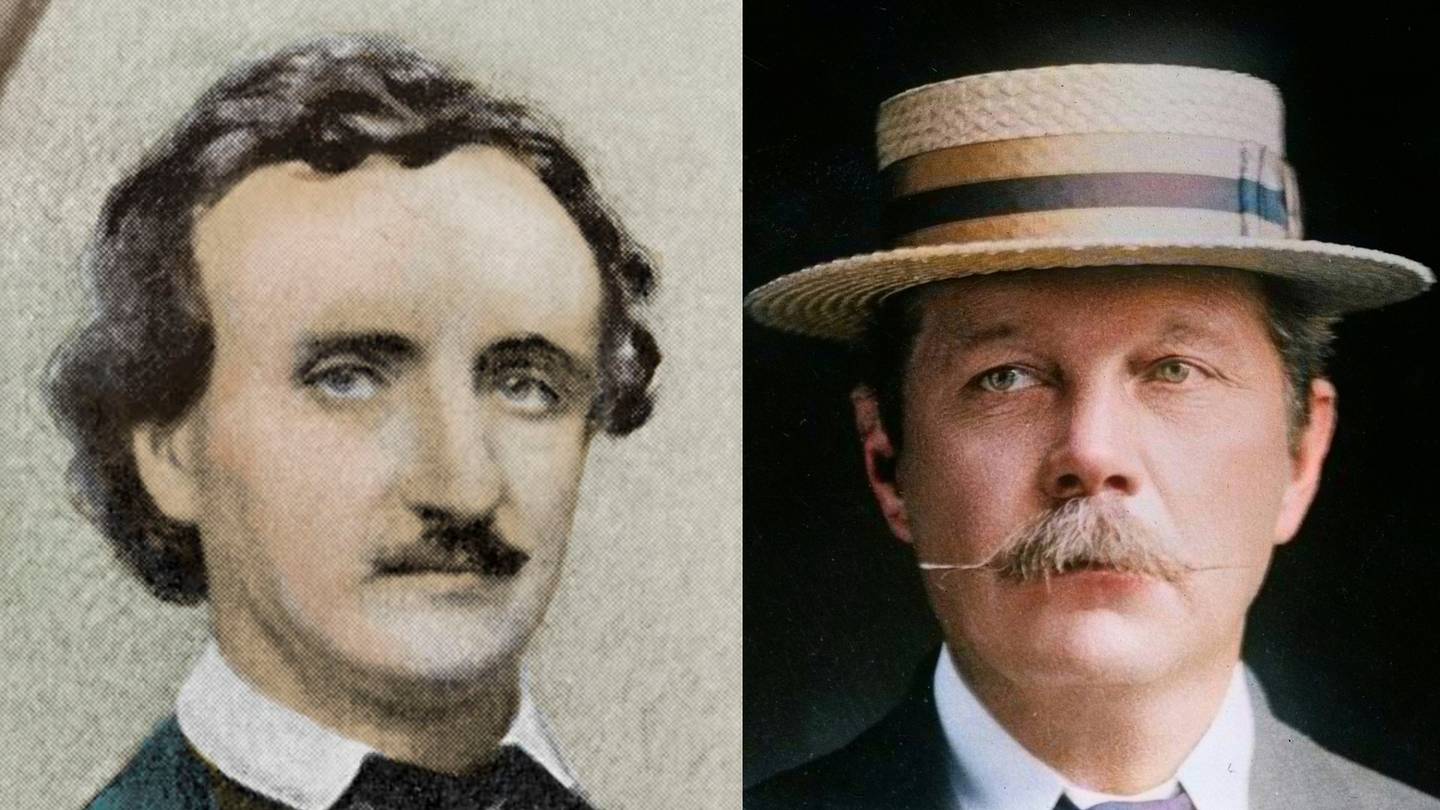
Edgar Allan Poe published "The Murders in the Rue Morgue" in 1841 and built the detective story out of nothing: a brilliant amateur named C. Auguste Dupin, an ordinary friend who narrates, a police force out of its depth, and a killing in a room nobody could have entered or left. Arthur Conan Doyle, born 18 years later, never denied he was inspired by Poe. "Poe's masterful detective, M. Dupin, had from boyhood been one of my heroes," he wrote in his 1924 autobiography, in the paragraph where he settles on the name Sherlock Holmes. What that sentence leaves out is the itemized list. Here’s how the British writer was influenced by the American poet.The Inspiration Conan Doyle Took From C. Auguste Dupin StoriesSir Arthur Conan Doyle | Bettmann/GettyImagesPoe also invented the narrator: he has no name, meets Dupin by accident at "an obscure library in the Rue Montmartre," and pays for the decaying house they share in the Faubourg St. Germain. Doyle described building that figure himself: Holmes "could not tell his own exploits, so he must have a commonplace comrade as a foil," he wrote, "an educated man of action who could both join in the exploits and narrate them. A drab, quiet name for this unostentatious man. Watson would do."Then there is the amateur's opinion of the professionals. Dupin cracks the Rue Morgue murders after the Paris police have given up and tells his friend why: "our friend the Prefect is somewhat too cunning to be profound," and he is satisfied "with having defeated him in his own castle." He beats him again in "The Purloined Letter," where the police search room by room for a week apiece while the document hangs in a card-rack on the mantelpiece. Holmes hands down that verdict in English on Scotland Yard, where Gregson and Lestrade are "the pick of a bad lot," "quick and energetic, but conventional."Edgar Allan Poe | Bettmann/GettyImagesThe locked room came over intact. Poe's murder scene is sealed—nailed windows, a fastened door, an impassable chimney—and the answer turns on a broken nail and a concealed spring. Doyle rebuilt it for "The Adventure of the Speckled Band" in 1892: a door "fastened upon the inner side," shutters with "broad iron bars," a chimney "barred up by four large staples," and a ventilator nobody at the inquest asked about."The Mystery of Marie Rogêt," which Poe began serializing in 1842, is the case solved from a chair: the narrator collects "a copy of every paper" on a real killing, and Dupin reads the pile from "his accustomed arm-chair." Watson asks Holmes in A Study in Scarlet whether "without leaving your room you can unravel some knot which other men can make nothing of" and gets a yes; four years later Holmes makes it a principle in "The Five Orange Pips": "Problems may be solved in the study which have baffled all those who have sought a solution by the aid of their senses."That leaves the borrowing that produced the insult. Walking near the Palais Royal, neither man having spoken "a syllable for fifteen minutes at least," Dupin says, "He is a very little fellow, that's true, and would do better for the Théâtre des Variétés"—exactly what his friend had been thinking about a cobbler turned tragic actor. So when Watson says the Afghanistan deduction reminds him of Dupin, Holmes takes it badly, and objects to that precise scene: "Now, in my opinion, Dupin was a very inferior fellow. That trick of his of breaking in on his friends' thoughts with an apropos remark after a quarter of an hour's silence is really very showy and superficial." A quarter of an hour is Poe's 15 minutes, timed by a man who had read it closely.Sherlock Holmes statue in London | Mike Kemp/GettyImagesSix years on, Doyle had Holmes do the trick anyway and name the source while doing it: in "The Cardboard Box" he breaks in on Watson's unspoken thoughts and recalls "the passage in one of Poe's sketches in which a close reasoner follows the unspoken thoughts of his companion," which Watson had waved off as "a mere tour-de-force of the author." Doyle kept paying in his own voice, chairing the 1909 Authors' Club dinner for the centenary of Poe's birth and, two years earlier, calling detective writers Poe's "monstrous progeny" in Through the Magic Door, where he priced the debt: "If every man who receives a cheque for a story which owes its springs to Poe were to pay tithe to a monument for the master, he would have a pyramid as big as that of Cheops."
The Edgar Allan Poe Character Who Helped Create Sherlock Holmes
Full Article
Original Source
Read the full article at Mentalfloss →KhanList aggregates and links to publicly available news content. We do not host full articles from third-party sources. Always verify important information with original sources.