
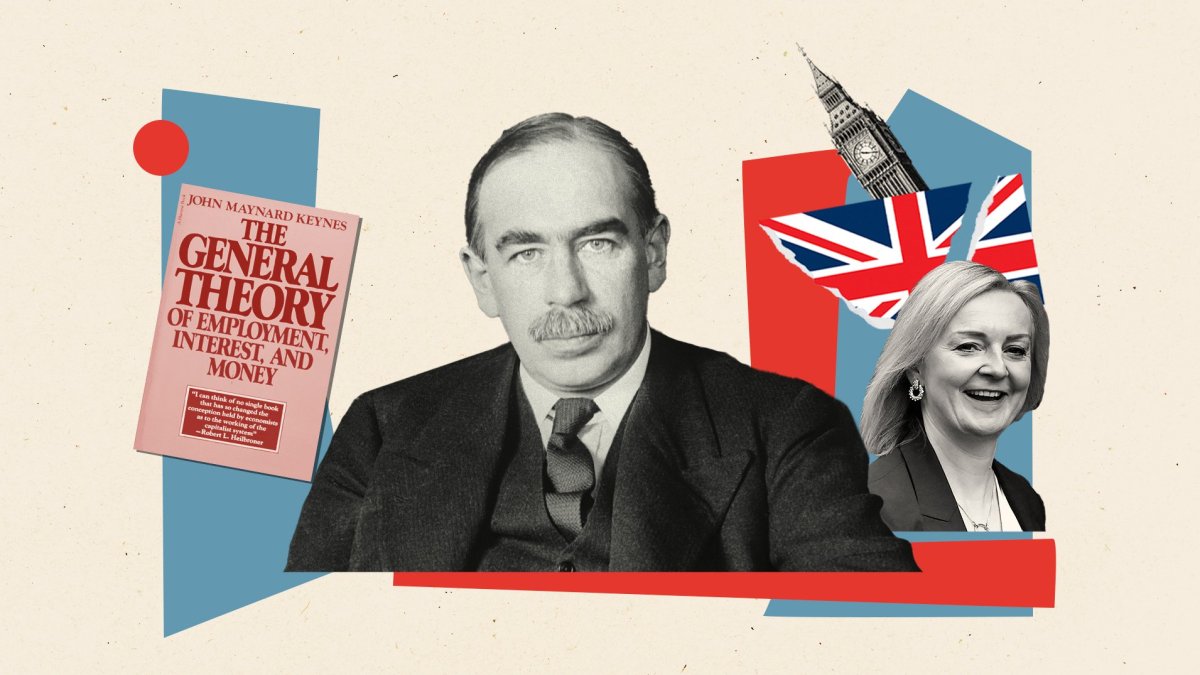
Who broke Britain? Welcome to The i Paper’s opinion series in which experts and writers debate the issues that concern them about modern Britain. • Martin Lewis: the money-saving expert… who accidentally cost Britons billions• The American woman who ripped the heart out of Cadbury• The union leader who did his job… and left millions of children counting the cost It’s monstrously unfair and it wasn’t his fault. But if you want to know why the UK’s national debt has passed £3trn and we are spending more than £10bn a month in interest to service it, it’s the misapplication of the ideas of the economist John Maynard Keynes. Lord Keynes, as he became, has a good claim to be the most influential economist of the 20th century. He completely changed the way we think about the role of governments in managing the economy, specifically that it was their duty to offset economic downturns by increasing public spending. His most influential book, The General Theory of Employment, Interest and Money, was published in 1936, when the world economy was still emerging from the Great Depression of the 1930s. It’s an over-simplification, but basically, up until then, the classical theory of economics held that economies were self-regulating. If demand fell and unemployment started to rise, wages would come down, interest rates would fall and other costs would decrease – so people would be able to buy more goods for the same amount of money and demand would pick up again. (For anyone interested in the way Keynes’s ideas changed economic theory, the best book I have found is Andrew Leigh’s The Shortest History of Economics, published in 2024.)Through the 19th century there were big swings in the economies of the developed world, but as industrialisation spread, living standards gradually rose. There were large variations over time in output and unemployment, but the automatic adjustment mechanism did seem to work. However, in the 1930s this no longer happened. As more and more people became unemployed, they bought fewer goods and services, so demand fell. That led to yet more people losing their jobs, pushing down demand still further. Unemployment reached around one quarter of the workforce in both the UK and US in 1933, and peaked at about one third of the workforce in Germany when Adolf Hitler became chancellor that year. The idea that governments could use their borrowing and spending power to drive demand was around before 1936. For example, US president Franklin D Roosevelt’s New Deal presented public works as “pump-priming” the economy. But it was Keynes who developed this into his general theory, and it was this book that changed the whole idea of the role of government. It has made him a folk hero for many people. There is a play on his life by James Graham, The Standard of Living, running now at the Theatre Royal in the West End, with Keynes played by Rory Kinnear. A lot of it is about the Bloomsbury Group and their romantic relationships, as well as his wife, the ballet dancer Lydia Lopokova. But there’s also a session about the clash of ideas between Keynes and the Austrian free-market economist, Friedrich Hayek. It’s an apparently true episode that took place during the Second World War when they both happened to be fire-watchers on the roof of King’s College, Cambridge, and argued their different views of government’s role in society. Hayek’s opinion, at its simplest, is that Keynes’s arguments in favour of government intervention in the economy take individual responsibility away from people and lead to an oppressive totalitarian society. It is the markets – driven by personal choice – rather than governments that safeguard our liberties, in Hayek’s view. HIs famous work setting this out, The Road to Serfdom, was published in 1944, and became the intellectual driving force behind the reforms of Margaret Thatcher’s government of 1979-90. So you can see Keynes’s side in the clash of ideas about the proper role of government, and to suggest that he broke Britain might seem to be a pro-Tory, anti-Labour position. Actually, if you look at what both parties actually have done, the distinction is more subtle. The problem has been that Keynsian advocacy of a government using fiscal policy to manage demand has been taken too far. Both Labour and the Conservatives have been tempted to try to boost the economy by pumping up spending or cutting taxes – thereby borrowing more. The most eloquent rejection of this policy came from James Callaghan, Labour prime minister at the time of the IMF bailout in 1976, and the emergency austerity budget of chancellor Denis Healey. Just ahead of that, at the Labour conference in September of that year, Callaghan told delegates: “We used to think that you could spend your way out of a recession and increase employment by cutting taxes and boosting government spending. “I tell you in all candour that that option no longer exists, and in so far as it ever did exist, it only worked on each occasion since the war by injecting a bigger dose of inflation into the economy, followed by a higher level of unemployment as the next step.” Meanwhile, the most extreme attempt to boost economic growth by unfunded tax cuts – hence increasing government borrowing – came not from Labour but from the Tories. This was The Growth Plan 2022 of Liz Truss and her chancellor Kwasi Kwarteng. We know how that one ended. Indeed, if you want to take further the argument that this is not a party issue, you could point to the two events that have dramatically increased the national debt this century. One was Labour’s reaction to the global financial crisis in 2008/09, when rising borrowing increased the debt from around 35 per cent of GDP to 70 per cent by the end of 2010. It went to 80 per cent by 2014 despite the so-called austerity policy of the Tory-led coalition. The other event was the Conservative reaction to the pandemic of 2020, which pushed the national debt to just below 100 per cent of GDP, where it is now stuck. So the idea that more government borrowing is the appropriate reaction to an economic shock is not a party political issue. Both are in thrall to the ideas of John Maynard Keynes, ideas that they have carried to excess. The irony is that he saw this coming. There are a string of famous quotes, including the one mocking economists who argue that markets adjust in the long run: “In the long run we are all dead.” But there are two statements that are even more appropriate in considering his legacy. One acknowledges the likely misuse of his ideas, for in his General Theory, he wrote that practical men were “usually the slaves of some defunct economist”. Best of all was his retort to the charge that he was changing his argument: “When the facts change, I change my mind. What do you do, sir?” The facts have now changed. We are not in the middle of a worldwide depression. But we are in Keynes’s “long run”, and a generation of young Britons now have to pay higher taxes to fund huge government debts run up by politicians who were slaves of his ideas. And of course he would have changed his mind, wouldn’t he?
The economist worshipped by Labour… who gave Britain its dangerous debt addiction
Full Article
Original Source
Read the full article at Inews →KhanList aggregates and links to publicly available news content. We do not host full articles from third-party sources. Always verify important information with original sources.