
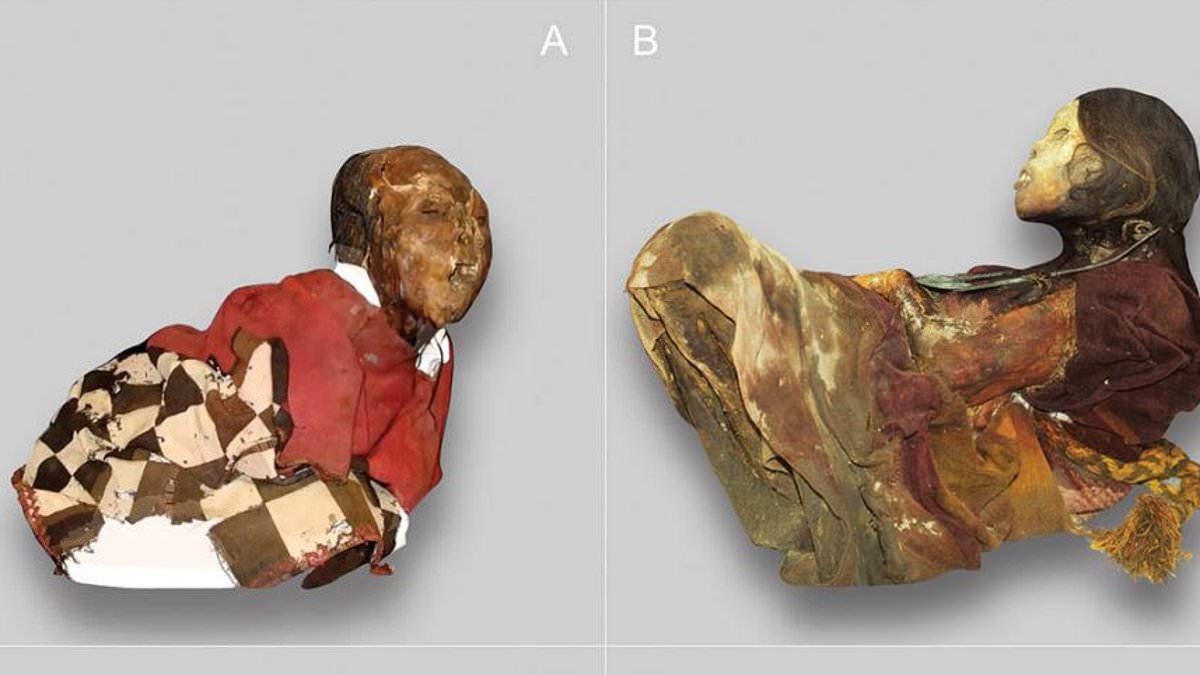
The bodies of sacrificed children have been found across the Incan Empire – and now a chilling detail about their final moments has been revealed.A toxicological analysis of the mummified remains showed that they had been fed cocaine, alcohol, and ayahuasca before being killed.Strikingly, all eight of the mummies tested were found to contain the chemical traces of cocaine.This strongly suggests that chewing coca leaves in the months leading up to their death was a key part of the ritual.Although coca leaves played an important role in Incan religious beliefs as offerings to the gods, they may have also had a more practical role.With some of the sacrifices taking place on desolate mountaintops over 19,685ft (6,000m) high, the coca leaves could have helped reduce altitude sickness and fatigue during the gruelling final journey.Meanwhile, four of the eight mummies were found to have been plied with alcohol in the form of a maize beer called Chicha.According to the researchers, this would have been used to dull the children's senses and keep them calm during the ritual's deadly conclusion. Scientists have uncovered evidence that the Incan victims of child sacrifice (pictured) were given alcohol, cocaine, and even ayahuasca before being killed on remote mountaintops In a ritual known as capacocha, children from across the Incan Empire were killed and turned into mummies (picture) to act as intermediaries between the living world and the godsIn the early 15th century, during the height of the Incan Empire's power, a ritual practice of child sacrifice known as 'capacocha' started to emerge.Children from around the empire were chosen for their perceived purity and exceptional beauty and taken to Cuzco, the political and religious heart of the empire.From there, they would be taken out on long, elaborate pilgrimages that eventually led to remote mountaintop shrines.After being bludgeoned to death with a club, the child would be mummified and entombed in the shrine, serving as a conduit between the living world and the gods.Their shrine would typically become the centre of religious cults, often led by their own family members, who treated the mummified bodies as oracles.Previous studies and historical records suggest the Incans used psychoactive plants; little is known about how these were used during the capacocha ritual.Luckily, the incredibly dry and cold mountain air means that these mummies are in exceptionally good states of preservation.In this new study, published in the journal Antiquity, the researchers took samples of hair and fingernail material from eight mountaintop mummies.Scientists tested the hair and fingernails from eight child mummies, eight of which showed signs of eating coca leaves before death Scientists think that the children may have been given coca leaves to help with altitude sickness and fatigue during the long pilgrimage to their mountain resting places The keratin in these materials can trap the traces of psychoactive chemicals, making a detailed record of drug use.Lead author Dr Dagmara Socha, from the University of Warsaw, says: 'Earlier analyses either produced negative results or focused primarily on coca leaves.'Our aim was to identify a broader range of psychoactive substances administered to the children and to determine whether patterns in their use could provide new insights into how capacocha ceremonies were conducted at different locations.'While all eight appeared to have been chewing on coca leaves, the amount and timing of these drug doses seemed to vary.One of the mummies showed a rapid change in coca use in the final month before their death with extremely high levels of consumption, likely linked to the final stages of the ritual preparation.Meanwhile, other mummies showed more prolonged drug consumption over an extended period of preparation.However, cocaine wasn't the only psychoactive drug that might have played a role in the capacocha ritual.Dr Socha says: 'One of the most intriguing findings concerns the famous Lady of Ampato, also known as Juanita, in whom we detected traces of harmine. The practice of child sacrifice was widespread throughout the Incan Empire (dark area), but each ritual site seemed to use a different pattern of drugs By looking at the different sections of preserved hair (x–axis), the researchers can see how their cocaine consumption changed in the months leading up to their sacrifice. Each section represents a roughly one–month period of the child's last six months of life 'Harmine is an alkaloid associated with Banisteriopsis species, one of the principal plants traditionally used in the ayahuasca beverage.'It may indicate that a harmine–containing beverage had a specific role in ceremonies connected with this particular sacred mountain.'The researchers aren't entirely sure what role this ayahuasca drink would have played in the ritual, but it might have been intended to enhance the child's prophetic powers.Likewise, while the reason for the drug taking is unclear, the researchers say that it shows just how much the ritual varied depending on the mountain, local cult, and potentially even the deity involved.Dr Socha says: 'Five hundred years after these children were sacrificed during one of the most important Inca rituals, new technologies are allowing us to uncover details of their lives and Inca religious practices.'What we are seeing is that the capacocha was not a single standardised ritual, but rather, the Incas appear to have adapted it to different cults and local religious traditions.'WHY DID ANCIENT SOUTH AMERICAN CULTURES SACRIFICE THEIR CHILDREN?Child sacrifice seems to have been a relatively common occurrence in the cultures of ancient Peru, including the pre-Incan Sican, or Lambayeque culture and the Chimu people who followed them, as well as the Inca themselves.Among the finds revealing this ritual behaviour are the mummified remains of a child's body, discovered in 1985 by a group of mountaineers.The remains were uncovered at around 17,388ft (5,300 metres) on the southwestern ridge of Cerro Aconcagua mountain in the Argentinean province of Mendoza. Child sacrifice seems to have been a relatively common occurrence in the cultures of ancient Peru. Among the finds revealing this ritual behaviour were the mummified remains of a child's body (pictured), discovered in 1985 by a group of mountaineersThe boy is thought to have been a victim of an Inca ritual called capacocha, where children of great beauty and health were sacrificed by drugging them and taking them into the mountains to freeze to death.Ruins of a sanctuary used by the Inca to sacrifice children to their gods was discovered by archaeologists in at a coastal ruin complex in Peru in 2016.Experts digging at Chotuna-Chornancap, in north Lima, discovered 17 graves dating to at least the 15th century. This included the graves of six children placed side by side in pairs of shallow graves. Capacocha was a ritual that most often took place upon the death of an Inca king. The local lords were required to select unblemished children representing the ideal of human perfection. Ruins of a sanctuary used by the Inca to sacrifice children to their gods was discovered by archaeologists in at a coastal ruin complex in Peru in 2016. Experts digging at Chotuna-Chornancap (pictured), in north Lima, discovered 17 graves dating to at least the 15th centuryChildren were married and presented with sets of miniature human and llama figurines in gold, silver, copper and shell. The male figures have elongated earlobes and a braided headband and the female figurines wore their hair in plaits.The children were then returned to their original communities, where they were honoured before being sacrificed to the mountain gods on the Llullaillaco Volcano. The phrase Capacocha has been translated to mean 'solemn sacrifice' or 'royal obligation.'The rationale for this type of sacrificial rite has typically been understood as commemorating important life events of the Incan emperor, to send them to be with the deities upon their death, to stop natural disasters, to encourage crop growth or for religious ceremonies.
The drugs of death: Inca child sacrifices were given cocaine, alcohol and ayahuasca before being killed on mountaintops, gruesome study reveals
Full Article
Original Source
Read the full article at Dailymail →KhanList aggregates and links to publicly available news content. We do not host full articles from third-party sources. Always verify important information with original sources.