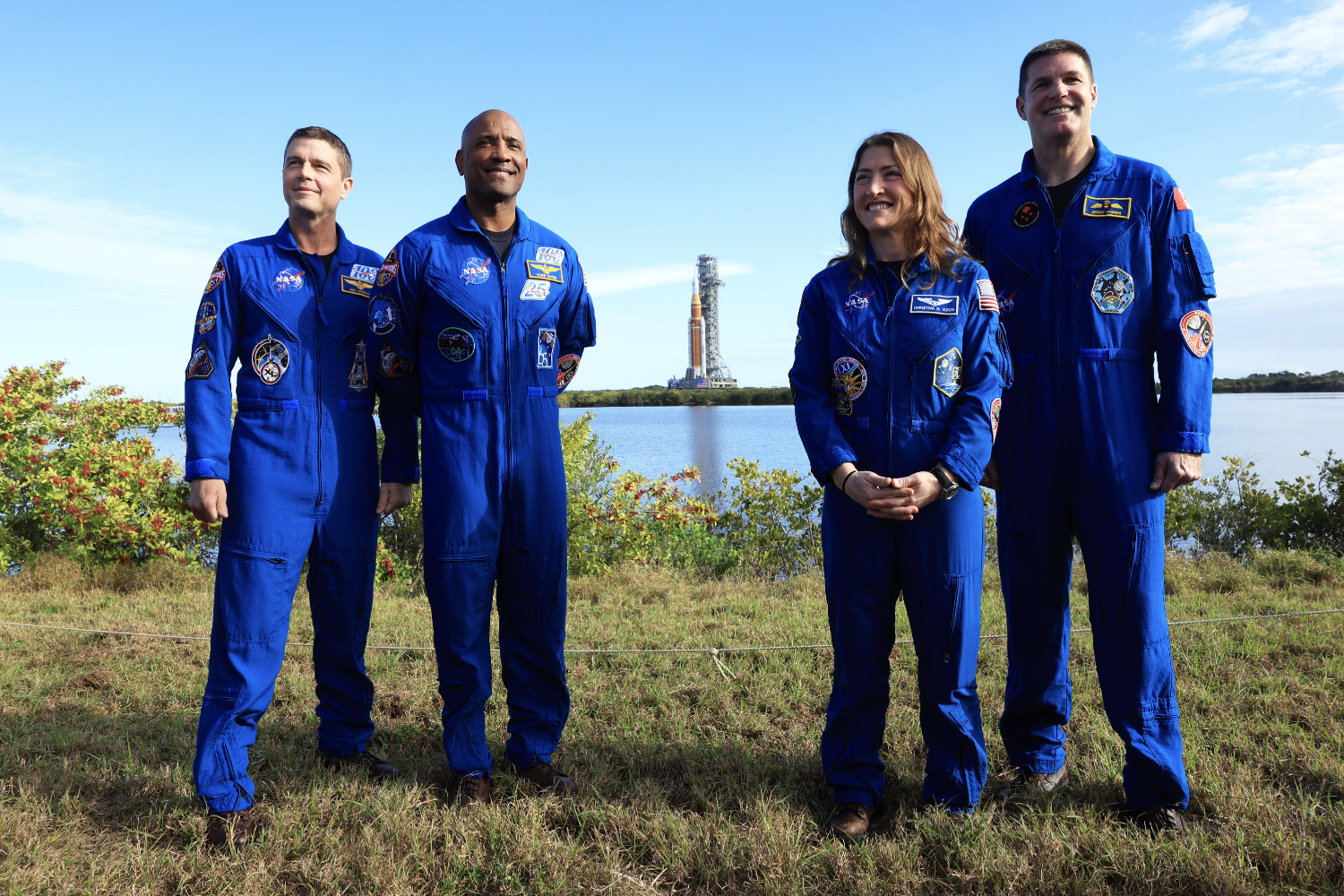
In April, a handful of humans boldly went where no one has gone before. The four-person crew of NASA’s Artemis II mission broke the record set by Apollo 13, back in 1970, traveling more than 406,000 kilometers from Earth. Billionaire-funded space missions have sent Katy Perry and William Shatner into space (courtesy of Jeff Bezos’s Blue Origin) and launched a flying car (Elon Musk’s SpaceX). NASA offered a more sober and heartfelt vision of what space could be: an earnest and representative crew; the commemoration of the commander’s late wife; the stark beauty of a total solar eclipse; the reminders of NASA’s rich heritage; the promise of future lunar surface missions. Sometimes, the slow, steady footage sent back to us seemed like communications from another world—the past, perhaps, or a future that we could still have. It was like something from Star Trek, and there’s good reason for that. Few TV shows have been more influential on the way we see the universe—or more contested. If the current crop of moonshots reveals the deep ideological divide that has emerged over who should take on the exploration of space and what we should be doing once we’re out there, Star Trek has in turn been a battlefield for warring visions of the American dream. Sixty years since its first transmission, battles for intellectual control over both its cultural legacy and the futures it offers have become increasingly pointed. In April, a handful of humans boldly went where no one has gone before. The four-person crew of NASA’s Artemis II mission broke the record set by Apollo 13, back in 1970, traveling more than 406,000 kilometers from Earth. Billionaire-funded space missions have sent Katy Perry and William Shatner into space (courtesy of Jeff Bezos’s Blue Origin) and launched a flying car (Elon Musk’s SpaceX). NASA offered a more sober and heartfelt vision of what space could be: an earnest and representative crew; the commemoration of the commander’s late wife; the stark beauty of a total solar eclipse; the reminders of NASA’s rich heritage; the promise of future lunar surface missions. Sometimes, the slow, steady footage sent back to us seemed like communications from another world—the past, perhaps, or a future that we could still have. It was like something from Star Trek, and there’s good reason for that. Few TV shows have been more influential on the way we see the universe—or more contested. If the current crop of moonshots reveals the deep ideological divide that has emerged over who should take on the exploration of space and what we should be doing once we’re out there, Star Trek has in turn been a battlefield for warring visions of the American dream. Sixty years since its first transmission, battles for intellectual control over both its cultural legacy and the futures it offers have become increasingly pointed. Gene Roddenberry’s vision of a diverse and equitable future was actualized in the diverse casting of his crew: The presence of Nichelle Nichols as Uhura on the bridge inspired a young Mae Jemison to become an astronaut, and Nichols was dissuaded from quitting the show by Martin Luther King Jr. The episode “Plato’s Stepchildren” (1968) contained one of the first interracial kisses on U.S. television, only a year after Loving v. Virginia struck down laws banning interracial marriage. The progressive politics of Star Trek were well established by the time the considered utopianism of The Next Generation, in which the moneyless and post-scarcity aspects of the Federation are foregrounded, appeared in the late 1980s. Yet lazy accusations of “wokeness” began from the moment Star Trek: Discovery, which premiered in 2017, had the temerity to open by foregrounding two women of color. The latest entry in the franchise, Starfleet Academy, has been subject to vituperative review-bombing. The author of Project Hail Mary, Andy Weir, notoriously dismissed almost the entirety of the franchise’s recent offerings as “shit,” and has stated his preference for “watch[ing] Romulans and the Federation shoot at each other.” Shots, we might say, have indeed been fired. That recent iterations of Paramount’s most enduring and successful IP have tended towards nostalgia (or perhaps, stated more generously, draw upon the program’s rich heritage) is undeniable. Discovery establishes that its lead character, Michael Burnham, is the adopted sister of Spock, allowing that most iconic of characters to appear in the show. This, in turn, led to the commissioning of Strange New Worlds—set on the USS Enterprise under the captaincy of Christopher Pike, immediately prior to the arrival of Kirk (who also looks, rather charmingly, as if he’s measuring for curtains each time he comes on board). A substantial part of the pleasure of Strange New Worlds lies in connecting the dots between its stories and characters and those from the original series. Musician Katy Perry celebrates a successful landing of Blue Origin rocket New Shepard (April 14, 2025) Musician Katy Perry celebrates a successful landing of Blue Origin’s New Shepard rocket near Van Horn, Texas, on April 14, 2025.Blue Origin Picard—which, at the outset, had an entirely new cast surrounding its venerable lead—had, by the end of its third and final season, leaned almost completely into its roots in The Next Generation. As well as bringing back most of the earlier characters, from Will Riker and Deanna Troi to Worf and Beverly Crusher, the storyline concluded with the perhaps unintentionally reactionary revelation, strangely evocative of the far-right paranoia about the “woke mind virus,” that the younger generation of Starfleet cadets had been affected by the individuality-stripping Borg, and only the efforts and the wisdom of their elders could release them. The story’s emotional focus on the relationship between Picard and his hitherto unknown adult son, Jack Crusher, not only called back to The Wrath of Khan’s revelation about the existence of Kirk’s adult son, David Marcus, but reaffirmed patrilineality as Trek’s central dynamic of interest—unsurprising, perhaps; the focus on father-son relationships throughout U.S. film and televisual media is so pervasive as to constitute a cliché. Characters throughout numerous iterations of Star Trek are revealed to have difficult relationships with their fathers, from Spock and Sarek, through Picard and his father, Maurice, to a whole host of minor and recurring characters. (A rare exception here is the relationship between Benjamin Sisko (Avery Brooks), the lead character and captain in Star Trek: Deep Space Nine, and his son, Jake; this tender relationship is partly down to Brooks’s insistence on representing a positive and loving relationship between a Black man and his son.) Seen in this light, the unfairly maligned Starfleet Academy becomes a considered and thoughtful addition to the show’s history. The series is set in the far future, the 32nd century, after a cataclysmic event known as “the Burn” has led to the near-collapse of the United Federation of Planets and its institutions. The last season of Discovery attempts to reconstitute the Federation and breathe new life and meaning into that fading vision; with the appearance of former Georgia gubernatorial candidate Stacey Abrams as the president of United Earth, we are surely meant to interpret this as the United States approaching its 250th anniversary. Star Trek was, and always will be, one of the prisms through which the United States refracts its dreams, hopes, and anxieties. This is, of course, why it is such contested terrain. In Starfleet Academy, we follow the story of the first cohort of cadets to attend the institution since the Burn. Stories focus on missions gone wrong, cadet pranks, and relationship complications, but the background setting of post-Burn reconstruction lends these harmless narratives particular poignancy. Many of the young characters come from backgrounds of privation and loss; those from more privileged origins feel this as a burden in the context of fragmented and hostile universe which lies beyond their own, comfortable worlds. William Shatner (from left), George Takei, Nichelle Nichols and Robert Hooks in Star Trek III: The Search for Spock William Shatner (from left), George Takei, Nichelle Nichols, and Robert Hooks in Star Trek III: The Search for Spock.Sunset Boulevard/Getty Images Yet this is the cohort being asked to take on the real burden of physical, ethical, and moral reconstruction; their teachers and mentors—some of whom, by virtue of longevity or time travel, remember the Federation at its height—are deeply invested in bringing to maturation a generation equipped for the task. The show’s central relationship, between the academy’s chancellor, Nahla Ake (Holly Hunter in splendid form), and Caleb Mir (Sandro Rosta), a young delinquent whom a Federation court (overseen by Nahla) separated from his mother at early age, refocuses the central dynamic on matrilineality, on mothering as a significant task. Rather than the strained father-son relationships which have been a staple of Star Trek over the years, we see instead a wide range of mentor-mentee relationships configured around themes such as what is owed by older generations to those in their care; how to instill decency, courage, and commitment; and—most of all—how to know when to let the children go. Starfleet Academy reaches into Trek’s rich heritage to take what it needs to tell stories about the reconstruction of a collapsed polity, and how we might take fragments from those ruins to constitute a society based upon values of mutuality and care. It is a shame—with the show’s perhaps inevitable cancellation—that we will not get to see more of how this might have played out. When we take moonshots—either literally, in the race for space, or figuratively, in the fantasies we put on screen—we are telling ourselves a story about what kind of future we wish to have, what kind of world we want to bequeath. Starfleet Academy passes over the collapse to ask, when we have exhausted our rage, our anger, our divisions, our dissolution into violence, what do we do next? What will we choose to build and how? In a 2015 book, The Utopia of Rules, the late anthropologist David Graeber draws a distinction between “poetic” and “bureaucratic” technologies. Poetic technologies are, in Graeber’s words, “the use of rational, technical … means to bring wild, impossible fantasies to life.” They are the means by which we actualize our grand visions: moonshots, vaccinations, terraforming, instant transmission of matter, democracy, peace. Or, perhaps, a gilded luxury resort on the dark side of the moon; longevity for a chosen few; a boot stamping on a human face forever. Against these, he contrasts bureaucratic technologies, which bring about ever-increasing means of administrating ourselves. The purpose of these, Graeber argues, is greater labor discipline, increased surveillance, and the furtherance of governability or social control. These are the technologies by which we define, categorize, and determine the ranges of possibility we impose upon each other, and our relationships with each other; the ways in which we determine who gets to inhabit the future; who gets to go to the moon. And what vision do we take with us? Yes, we can fill that blank with hierarchy and hate; we can instrumentalize even the void, but we can be aware, too, that it’s a choice we make. Other visions are available, if sometimes out of reach. As astronomer Ellie Arroway (Jodie Foster) says in Contact on her encounter with the sublimity of deep space: “No words to describe it. … They should have sent a poet.”
The Dreams of ‘Star Trek’ Aren’t Dead
Full Article
Original Source
Read the full article at Foreignpolicy →KhanList aggregates and links to publicly available news content. We do not host full articles from third-party sources. Always verify important information with original sources.