
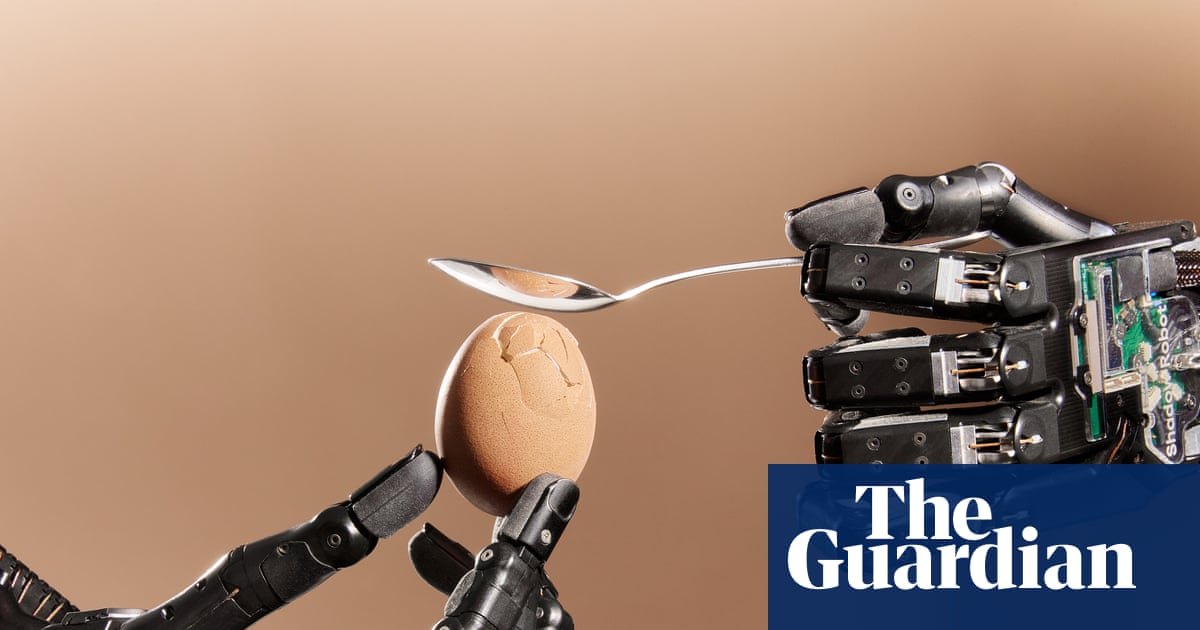
Just outside Luton, in an Amazon warehouse the size of four football pitches, yellow shelving units pirouette in a digitally choreographed dance. Tubs containing a Lego Spider-Man kit, followed by dishwasher tablets, followed by a pouch of muscle building protein powder whiz along conveyor belts, until they arrive at a human being tasked with stacking the shelving unit that has come to a stop in front of their workstation. This, Amazon says, is the “symphony of people and technology” to which the retail giant owes its success.Following a barrage of negative publicity about working practices, Amazon began to open up its fulfilment centres to carefully controlled free public tours a decade ago. Our guide tells us about the competitive rates of pay Amazon workers receive, their pensions, dental cover and options for flexible working. Her delivery is somewhat robotic.“You will see robots and humans working in harmony,” she declares as we move between different stations of the warehouse. Everything is designed to maximise what humans are good at, she continues, and what robots are good at – “working without getting tired”.Almost every judgment call here seems to be made by a computer – not just where to stow items when they arrive at the warehouse (the system shines a light on to the spot on the specific shelf where the worker should place each item) but also which size box to pack something in once it’s been ordered, and even precisely how much tape to use to seal that box. The human beings are here to provide the hands, not the brains.So far, at least, there is no hardware or software to rival a human hand. Humanoid robots – often called “embodied AI” – have made great strides over the past decade (literally, as evidenced in China’s recent five-day robot Olympics). But producing a robot that can pack a shelf, tighten a bolt and also pick a raspberry – actions that would make them useful rather than simply entertaining, actions most of us perform without any conscious effort – has proved surprisingly difficult. Replicating the breadth of function of the human hand is one of the biggest remaining challenges in robotics. Until robots are dexterous, human workers will always be necessary.But investors are now gambling on humanoid robots soon becoming as much a part of everyday life as AI-powered large language models are for many of us today. The Chinese government has pledged to invest more than £100bn in robotics and high-tech industries over the next two decades. Earlier this year, Tesla halted production of its Model X and Model S cars so that factories could focus instead on producing Optimus humanoid robots. “Human hands have evolved to be this incredibly sophisticated machine. Your hand is actually a remarkable thing,” Tesla chief executive Elon Musk told a conference last year. “In order to create a robot that can be a generalised humanoid, you must solve the hands problem.”Robot hands sewing – videoAmazon employs more than 1.5 million people worldwide today. But from what I can see on the warehouse floor, it seems that if a task could be done more efficiently by a machine, Amazon would rather leave it to a robot. What will happen to these workers when the “hands problem” is solved?And what will happen to the rest of us? Artificial dexterity combined with artificial intelligence will be hugely consequential for humanity. Forget retraining as a plumber in the age of AI – if engineers manage to replicate human hands, then potentially no job will be future-proof.Dexterous robots that can rival a human hand are not here yet, but they are coming. What makes hands so difficult to reproduce in hardware and software? How close are robotics engineers to getting it right? And what will happen to the world of work when they do?“The hand is our conduit between the brain and the world,” says Alistair Hunter, a hand and wrist surgeon at University College London hospitals. “The hand is our way of turning thought into action.” Hunter has spent most of his professional life seeking to understand how hands work, and how to return them to normal function when they don’t. “Hands are special because they are very complicated anatomically,” he tells me over coffee in north London. “There are 27 bones in the hand; there are nerves and muscles that control it. But behind all that is the brain, which is interacting millisecond by millisecond to understand what the hand is sensing, adjusting to that, and then providing action.”We might assume that we owe our evolutionary advantage to our intelligence, but Hunter argues it’s actually the combination of our cognitive power and our dexterity that has given us the edge. Over the millions of years that the frontal cortex of our brains was developing, the hand evolved to differentiate itself from limbs, allowing for the development of fingers that could grasp branches and climb trees. Thumbs came next. All the great apes might have them, but ours are larger. “The joint at the bottom of the thumb – the trapeziometacarpal joint – is one of the main advances in evolution to allow us to do very fine pincer grip, very fine dexterous control between thumb, index and middle finger, but also incredible power, incredible grasp. That allowed us to manipulate things like stones and rocks, so three million years ago we started to develop tools.”The brain is constantly coordinating the interaction between larger muscles in the forearm, which allow for power and strong grip, and smaller muscles in the hand itself that give us fine control. It also receives huge amounts of data from the hand. “The density of nerve fibres and sensory endings in the hand is enormous,” Hunter continues. As well as the nerve endings, the hand has specialist receptors that can tell our brains about very fine details: different corpuscle cells to detect vibration, roughness and smoothness, or how our fingers and hands stretch and conform around objects. “It’s that interplay between the sensory side, the motor side and the brain that makes the hand wonderful – and so difficult to replicate.”When you pick a raspberry, your fingers sense how soft it is, whether it’s slippery, how the skin in your fingertips conforms around it. Your brain compares this information against what it expected to experience, and then recalibrates accordingly, slowing down the compression force if it feels as if the raspberry is being crushed. “That feedback loop takes about a tenth of a second,” Hunter tells me. “We’re also able to predict what that raspberry feels like – that’s called feed forward. Even before I’ve grasped it, my fingers and my hand know what pressure to put on it to pick it and not to squash it. That’s partly why you see a baby making a mess before they’ve learned that feed forward mechanism. Their hand is clumsy because it hasn’t got that predictive model.”From striking a match to throwing a spear to playing piano, the range of tasks hands can perform is enormous. We can use them to catch, or cup them to turn them into a drinking receptacle. And they allow us to communicate – with gestures, with pens, with our thumbs over pocket-sized screens. Our hands are constantly adapting to our ever-changing needs.It’s this breadth of function combined with adaptability that Hunter says would be such a challenge for any engineer seeking to replicate human dexterity in a robotic hand: being able to feedback and feed forward at the same time, using a model learned from years of experience and interaction with the world. That’s why robot engineers previously focused on creating task-based robots, able to perform a specific function, he adds, rather than trying to emulate everything a human hand can do.“I think at some point they’ll be able to do it. We’ve got many, many years ahead of us, and you can see that already robots are able to walk and run. But building a computer that is able to predict the outside world and also deliver the right amount of sensory information back – that’s going to be difficult.”If there ever was a symbol of dystopian tech, it is the robotic hand left clutching at Sarah Connor’s throat in the final scenes of the original Terminator movie. That’s the first thing I think of when I walk into the HQ of Shadow Robot, Europe’s premier manufacturer of dexterous hands, and see one of its prototypes – skeletal and grasping – mounted on a high shelf a few metres from the entrance. Then one of the office dogs bounds up to me, and I remember that I am in a cheery workspace a minute away from London’s Hampstead Heath.Shadow Robot began in the 1980s as a collective of hobbyists and robot enthusiasts who met up in a north London attic to tinker around with scavenged materials, hoping to one day build a full humanoid. The company was founded after they received their first commercial order – for a leg – in 1997. For the last decade or so, their exclusive focus has been on hands.In the demo room, the Shadow Dexterous Hands they have set up for me to see look almost friendly. Mounted on two outstretched motorised arms, their palms are open with their fingers curled slightly inwards, as if waiting to give me a hug, but we begin by shaking hands instead. Its right hand moves slowly towards mine, the fingers splayed, the wrist cocked in anticipation. Its grip is gentle – natural, even – but I don’t want to shake it too hard for fear of crushing it: it’s made of MDF and nylon, with textured magnetic sensors on its fingertips, and it feels very delicate. The starting price – without any kind of software or operating system – is £20,000 per hand; the full system costs £100,000. But my instinct to be gentle is mostly because it seems so human: it moves in an expressive way, as if it were animated by some sort of soul. Photograph: David Vintiner/The GuardianAnd it kind of is. It’s being operated by Liem Tran, robotics deployment and support manager at Shadow Robot, who is wearing gloves with sensors that track his movements, which the robot hands copy in real time. This teleoperation is a way of training the robot, showing the hands what to do, giving them a reference point on what constitutes a successful motion for any given task. Through machine learning, the hand will ultimately be able to replicate that movement without human help. The Shadow Robot company builds the hardware and basic systems; their customers – in industry, manufacturing and academic research – typically develop their own software to get what they want from the hands.It’s a great time to be a hand roboticist, Tran says. “We don’t have anything that’s industry standardised, or anything that’s fully developed and ready for use. It’s exciting, because we’re essentially dictating what happens next with the tech. I like the idea of replicating a human in machine form and seeing where it takes us … Do you want a grape?”The left robot hand reaches down to a brown paper bag on the table in front of us and pulls out a bunch of white grapes, holding the stalk with a delicate pincer movement between thumb and index finger. The right hand deftly plucks a lone grape and drops it into my palm. Each hand weighs roughly 4.5kg, Tran tells me, but the grape is resolutely unsquashed. I eat it. It passes me another.This is only the first of several party tricks Shadow’s robot hands have up their sleeves. Tran shows me how they can stack plastic cups in a pyramid, gently positioning each one. They can hold a small wooden cube in one hand and build a tower seven blocks high on top of it with the other, keeping everything perfectly balanced. They can sort shapes, placing stars, cylinders and triangles into their appropriate slots in a bright plastic kids’ toy.In one respect, it’s totally remarkable, but in another, completely mundane: these are hands, doing what hands do. And they are also doing it at the level of a small child. When Tran successfully manages to get the robot hands to put one of the shapes into the shape sorter, I find myself declaring, “Well done!” as if I were encouraging a toddler.While these Shadow Dexterous Hands might look lifelike, they can’t generate anything like the amount of sensory data that the human hand can produce, and their learning model depends on a human showing them what to do. But Shadow has another model that’s got everyone here very excited – and it doesn’t look much like a human hand at all.The DEX-EE hand, created for Google DeepMind and first unveiled in 2024, has only three digits and no wrist; the digits function like thumbs, making the DEX-EE look like a claw, with optical sensors on each fingertip. Much bulkier than the Dexterous Hands, it can’t handle very fine objects, but you can smack the DEX-EE with a baseball bat. Tran invites me to give it a try. I whack it a few times, but I don’t put my back into it: this model costs £60,000 per hand.“It can take a beating,” Tran assures me. “That’s its whole purpose: it can go through hours and hours of collisions with the work surface.” The DEX-EE was designed to withstand hours of machine learning, making repeated mistakes that it can learn from. “It’s the same way that a baby learns to use their hands and fingers.” After experimentation with DEX-EE, DeepMind has been able to develop robots that can tie shoelaces, put a shirt on a hanger, and perform repairs on other robots.Could the work of human hands be replaced by robots? – video Even though some of the most powerful tech companies in the world are working with hands that can learn on their own, manual labour looks to me as if it’s going to be safe, for now: these hands seem years away from being smart enough, robust enough or dexterous enough to deal with the variability workers in a fulfilment centre encounter every day.skip past newsletter promotionafter newsletter promotionBut Tran quietly disagrees. “Around the world, so many companies are now making all these dexterous hands. There’s a huge race for the smoothest and most human-like. They’re getting quite impressive. The price point is becoming a lot more attractive: some hands in China are less than £2,000, which is very cheap; you don’t have to worry about repair, just buy another hand,” he says. “I don’t think we’re too far off.”Shadow Robot never set out to compete in the high-stakes fight for global domination of the hands market. When they were a collection of amateur enthusiasts, their original aim was to build a useful humanoid, a kind of robot butler. “We built this biped – it’s now in the Science Museum, which is kind of nice,” Rich Walker, director at Shadow, tells me. Then Honda unveiled its P1 humanoid. Shadow’s biped could stand and right itself if it was shoved, but the P1 could actually walk. “As far as we can tell, Honda had spent in the order of $100m on the programme of development that led to them having a biped,” Walker continues. “We were kind of put back by that.” They decided to change tack. “We thought, what would we need a robot to do or to have in order to be useful? They’d need to be able to pick things up and interact with the same objects that I can interact with. So we decided to try building some hands.”Rich Walker, director at Shadow Robot. Photograph: David Vintiner/The GuardianWalker was on the dole when he first started collaborating with the Shadow hobbyists in the 1980s. With bright blue eyes behind his varifocals and a wispy grey half ponytail that struggles to contain several thick dreadlocks, he looks part wizard, part cyberpunk, and nothing like an entrepreneur. “We never set up this organisation to make money out of building robots. It was much more, ‘Let’s build robots! How do we do that?’” he says, throwing his hands up in the air again. “Making some money on the way turns out to be a good way to make sure that you can build the robots.”When they began developing their first prototypes, Walker tells me, their aim was to build a lifelike hand, but they soon realised what a massive task that would be. They pored over anatomy textbooks, envious of the natural hardware in the human body. “If we had those materials, it would be great,” he grins. “Self-lubricating joints. Skin that regrows. We don’t have those, so we have to use other mechanisms and solutions.”Over the years it became clear that the most commercial proposition would be for the company to focus on hands that could fulfil specific tasks. They began to move away from the hobbyist drive to build the best thing possible, and towards a business imperative to build something that companies might want to buy in large quantities. “We’re working with a wide range of people, everything from applications in nuclear decommissioning through to medical technology and care robotics and production line stuff. A really wide range of areas where people have said, ‘Could we use a robot here?’ or, ‘Could we improve our robots with things like human hands?’”I ask Walker what he wants his robots to be used for, and he pauses for several seconds. “We want to build robots for good. At the moment, we’re looking at robots that can do tedious things that get in the way of doing something else.” He gives the example of cleaning up the workbench of a highly skilled engineer. There are clients – and specific jobs – the company has turned down, he adds. They won’t work for arms manufacturers. After some discussion, the team decided not to lend their expertise to a project that would debone carcasses, and another that involved filling sausage casings with meat. “It’s just the ick factor sometimes.” (Walker is vegan).But when the Shadow Robot company says no, there are now many competitors that customers can go to instead. “Ten years ago, there were four or maybe five companies making robot hands, and you knew all of them, and you knew everything about all of them. And now it’s just …” Walker throws his hands up again. “I had a Chinese analyst firm contact me a year and a half ago, and they were like, ‘We have 110 robot hands on our list.’”It’s not just China. San Diego-based Psyonic specialises in making prosthetic hands for amputees, but has branched out into robot hands, billing its products as the “future of automation” with “human-level stability”. Sharpa, based in Singapore, boasts that its model has “human-like dexterity” and can handle complex tasks such as “screwing, clipping [and] fastening”. Boston Dynamics’ Atlas humanoid is not yet on the market, but it can use nail guns and drills (deftly changing a fine drill bit in a demonstration video). Yet most of the momentum seems to be driven by Chinese companies: state media valued the domestic dexterous hand industry last year as worth more than 50bn yuan (£5.6bn).Walker doesn’t like to use the word “competition” when talking about these companies. Ever the robot enthusiast, he sees them as working towards a common good. “There will be breakthroughs that suddenly just move everything forward. That might be a better motor, it might be a polymer that makes a skin that is better, it might be a way of sensing the world that lets the robot understand things in a way that we haven’t been able to do before at scale in a cheap robot.” He pauses. “It’s exciting.”“Shadow is in a difficult position,” Nathan Lepora, professor of robotics and AI at the University of Bristol, tells me in a video call. “The Shadow Hand was best in class for 20 years, but it’s the price of a Lamborghini. Now there are a lot of very capable hands for the price of a Vauxhall. China is going through a massive expansion of hand development, and at the beginning of this decade you would never have predicted the level of dexterity that we’re seeing today.”When I ask Lepora how close he thinks we are to developing a robot hand that can rival a human’s, he tells me that’s not the point. “We don’t necessarily need the robots to do all that hands can do. We want them to be able to pick up and manipulate objects and tools.” The current crop of robot hands might not be at that point yet, but they’re close, he says. “We’ve got a good chance of seeing general tool use by the end of this decade.”I tell Lepora about the Amazon workers I saw in the fulfilment centre, who aren’t required to use any tools – they just have to be able to stow, pick and pack a wide variety of objects. “Their days are numbered,” he says, simply. “They are the last bits that haven’t yet been automated.” Amazon must already be working on replacing them, he adds. “I’m sure they are close to it.” Production lines without any human workers are part of manufacturing today: China has fully automated “dark factories” – so called because they can operate with the lights off – that run 24/7.If the future looks bleak for Amazon workers, what about manual labourers in general? When I mention retraining as a plumber for job security in the age of AI, Lepora shoots me a look as if to say, don’t be naive. “Maybe for 10 or 15 years. Plumbing’s not going to be done by a robot this decade, that’s for sure. But after then?”In Shadow Robot HQ, Walker argues that plumbers are here to stay for the foreseeable future. They have to apply themselves – and the available tools – to such a wide variety of unusual spaces and problems, after all; their skill comes from being adaptable, not from knowing the correct way to perform a procedure, he says. A dexterous hand alone will not take their job. “If you’ve ever seen a plumber get under your bath and do something to the tap at the back, you’ll realise that’s going to be a job for a humanoid robot at best.” Photograph: David Vintiner/The GuardianBut on its website, the company say it is “working towards robotics for a safer world by allowing robots to enter extreme environments where it would be too risky for a human to go. This includes jobs that are too dull, dirty, difficult, dexterous, dangerous, and/or dear.” Walker and his team might be determined to build “robots for good”, but if they manage to get everything on that list right, they will eliminate much of human manual labour.When I put this to him, he stiffens. He’d clearly much rather be talking about motors and tendon load sensors than the social and economic implications of where his hands might reach.“If we solved all of the things on that list then that would be amazing, but I think that that’s several hundred years’ work for several hundred organisations and several hundred major breakthroughs will have to happen for that to happen,” he says. “Is what we’re doing likely to lead to the doom of humanity? That sounds like a marketing campaign. If I wanted to increase my share value, I’d probably say, yes, we’re going to lead to the doom of humanity – invest in us.”No one likes to think that their job could be taken by a robot – not fulfilment centre workers, nor plumbers, nor journalists. What about Alistair Hunter, the hand surgeon? It’s hard to think of a profession that demands as much of a combination of knowledge and dexterity – brain plus hand – than his.“When I’m operating, there are times where I’m at the very limit of my manual dexterity and my understanding. Is it possible for a robot to learn that amount of experience that I’ve developed over many years and then action it autonomously? I think that would be very difficult,” Hunter replies. “I don’t think you can ever say ‘impossible’, because 50 years ago I wouldn’t have anticipated anything of what’s possible now. But knowing what I do about the hand, and knowing what I do about surgery, I think that would be a very difficult thing to do.”It’s easy to imagine that, in a world of embodied AI, it would be a safer bet to become a robotics engineer than a surgeon. But the nature of our work is changing so rapidly, and no career is necessarily safe.Ultimately, Lepora says, robot hands will be making robot hands. “I don’t think any company is at that pivot point yet, but that’s where we’re ending up.” If and when that happens, robot hands will be cheaper than ever – and advancing at an extraordinary pace. “You could produce them at scale, but you could also automate the improvement of them as well,” he tells me, leaning forward with excitement. “Once they can build them themselves, you iterate it. That is the possible tipping point for when the hands will become really, really capable.” It’s also the point where robot engineers themselves might be out of a job.
‘The doom of humanity’: will the quest to make robotic hands render us obsolete?
Full Article
Original Source
Read the full article at Theguardian →KhanList aggregates and links to publicly available news content. We do not host full articles from third-party sources. Always verify important information with original sources.