
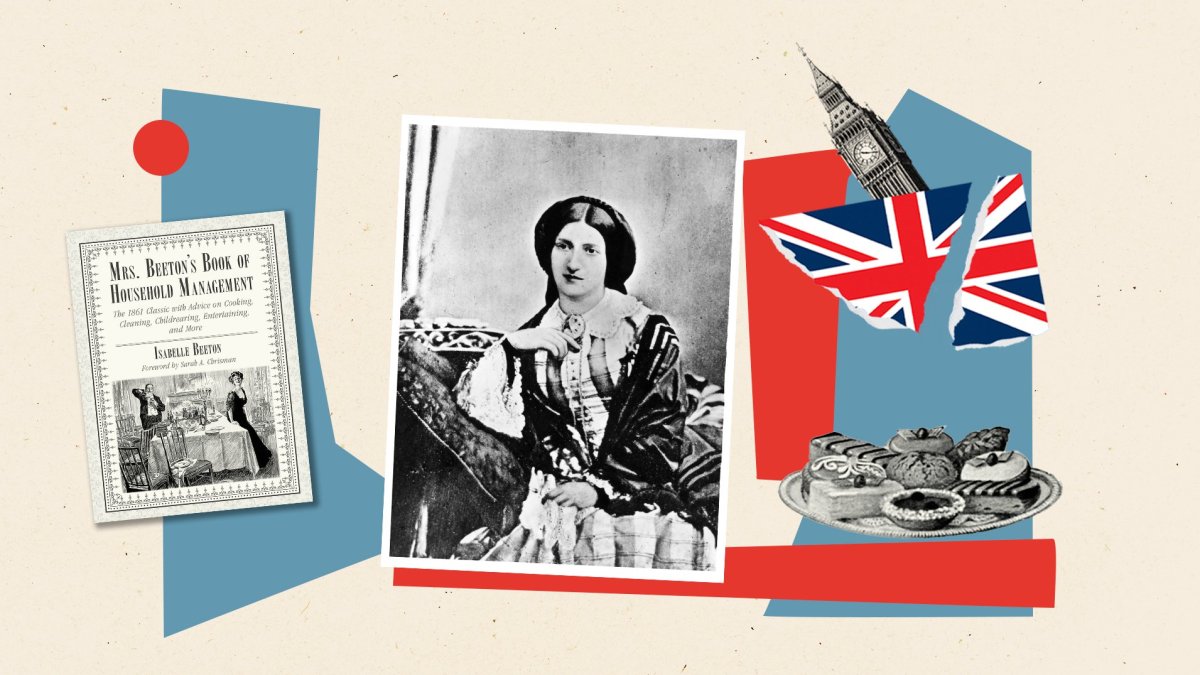
Who broke Britain? Welcome to The i Paper’s opinion series in which experts and writers debate the issues that concern them about modern Britain. • Martin Lewis: the money-saving expert… who accidentally cost Britons billions• The economist worshipped by Labour… who gave Britain its dangerous debt addiction• Jamie Oliver: The food saviour who accidentally created a culture of shame Loving preserved by a grandmother I never knew, and handed down in a box of family treasures, is a much-repaired copy of Mrs Beeton’s Cookery Book in an early 20th-century edition. Inscribed by an an unknown female soldier in the kitchen wars called Betty, the chirpy preface tells us Mrs Beeton has been “guide, philosopher and friend of countless happy homes for more than half a century.” And here we are in the 2000s: Mrs Beeton’s Book of Household Management is still on the shelves; her recipes have been recreated by food historians in Downton Abbey; and her legacy is alive in the Continental belief that English food is soggy and unpalatable. Isabella Beeton’s martial style of instruction is a signal that she treated the home front like a battlefield. And guess who are the poor bloody infantry: female servants and the “mistress”, whose duties never end. Even the Christmas feast reads like a grisly set of demands on how to deal with a turkey: “Cut off the neck, take out the gut and draw the bird with a hook solid enough for this purpose. Take great care not to break the gut joining to the gizzard for fear of the gall bladder.” Permanent war with trussed fowls, curdling custards and stoves continues throughout the pages. The problem with the Mrs Beeton view of the domestic realm is that she set up a legacy of household as a place of duty – pleasure is always deferred or promised only when perfection has been achieved and stove scrubbed. It is a recipe for misery, alleviated by satisfaction at a well-risen pudding. She worries that getting up late will cause the house to be poorly run for a whole day. In the Beeton vision of domestic life, there is the scant idea that anyone might need a break from scrubbing, broiling or trussing fowl. Often credited with launching the ideal “domestic goddess” mode, her outlook owes more to the tradition of Mars than Venus. The mistress of the household was like “the commander of an army” – and that sense of a home as the place of female duty infuses the demands for routine and warnings of the dire consequences of disorganisation. It is all based on a paradox: the woman who produced the defining British cookbook was herself only 25 when the first edition emerged from recipe columns – and very much not a domestic slave. She was a journalist working with her rakish publisher husband, and commuted to an office – not a routine that features in the recommendations of devotion to home and hearth. Personally, she sounds admirable: driven and determined. But her doctrine is stringent enough to make the domestic sphere feel like a boot camp. There is a guide to which rooms should be cleaned on which days. Shutters must be opened, the kitchen range brushed and cleaned. “The beds are made between the time that the (house) work is done and the midday mealtime. The cooking can be done.” Elevenses were not on the cards. If the intention was to help young married women learn to organise a household, the tone is so domineering that one’s heart goes out to the young Victorian women worrying whether they have lived up to her standards. One of Arthur Conan Doyle’s characters concluded that “Mr Beeton must have been the happiest and most comfortable man” – but reality told a different story. Samuel Beeton was a buccaneer who published Uncle Tom’s Cabin and built a lucrative business model from his wife’s trove of recipes. According to Mrs Beeton’s biographer Kathryn Hughes, he admitted visiting a prostitute before their marriage. Poor Isabella’s death at the age of only 28 was the result of puerperal fever after the birth of a fourth child. And that gap between the imagined perfection of the model household and the grimmer reality of many women’s existence is the painful part of rereading Household Management. These days her style would have suited a thriving You Tube channel – TradWives would love the neatness and order she promised – and doubtless judged MasterChef. There would certainty have been complaints of recipe plagiarism – she “plagiarised only the best” as a New York Times cookery historian drily put it. Carrots and parsnips were set to be boiled for over an hour – her terror of the undercooked vegetable verges on OCD Unfortunately, she is also responsible for much of the perception of Britain as the home of soggy vegetables and stodgy fare and for a sense that we must keep apologising for the state of the kitchen when we have guests round. As cookery historian Annie Gray puts it: “Beeton’s book is… enthralling and inspiring and makes you proud to be part of such a culinary heritage. I just wish the recipes worked.” In earlier editions she famously left eggs out of Victoria sponge by mistake. Few are the recipes from the classical French repertoire that she could not make worse by the addition of a very English heaviness. Fish pie has eels added, carrots and parsnips were set to be boiled for over an hour, and her terror of the undercooked vegetable verges on OCD. Someone else might like to try out “Ornamental Savoury Jelly” consisting of four pounds of veal knuckle, cow heel, and various herbs. Potatoes with cheese baked in an oven works out fine – largely because it consists of potatoes and cheese. The fact that I am stuck finishing this column against the clock, and worrying that the chicken won’t defrost in time for the Friday dinner I insisted the young come home for, shows a bit of Mrs Beeton’s doleful perfectionism persists in a lot of us. It’s that drive for the kitchen and table to be a place of high standards, and the nagging knowledge that we are running behind, out of one vital ingredient – and that is without the “one to two servants” Mrs B thinks would be about right for a household of six. (On that we can agree – but you just cannot get the staff.) It doesn’t get much more joyous when we turn to instructions for a young wife’s clothes. “Nothing more distressing than seeing a dress of deep blue, inclining to purple, with a bonnet with sky-blue ribbon”. Except perhaps all those vegetables in aspic – which for all my nostalgia about the heirloom cookbook, is frankly where the sainted Mrs Beeton and an awful lot of her her instructions belong.
The domestic goddess who gave Britain soggy vegetables and impossible standards
Full Article
Original Source
Read the full article at Inews →KhanList aggregates and links to publicly available news content. We do not host full articles from third-party sources. Always verify important information with original sources.