
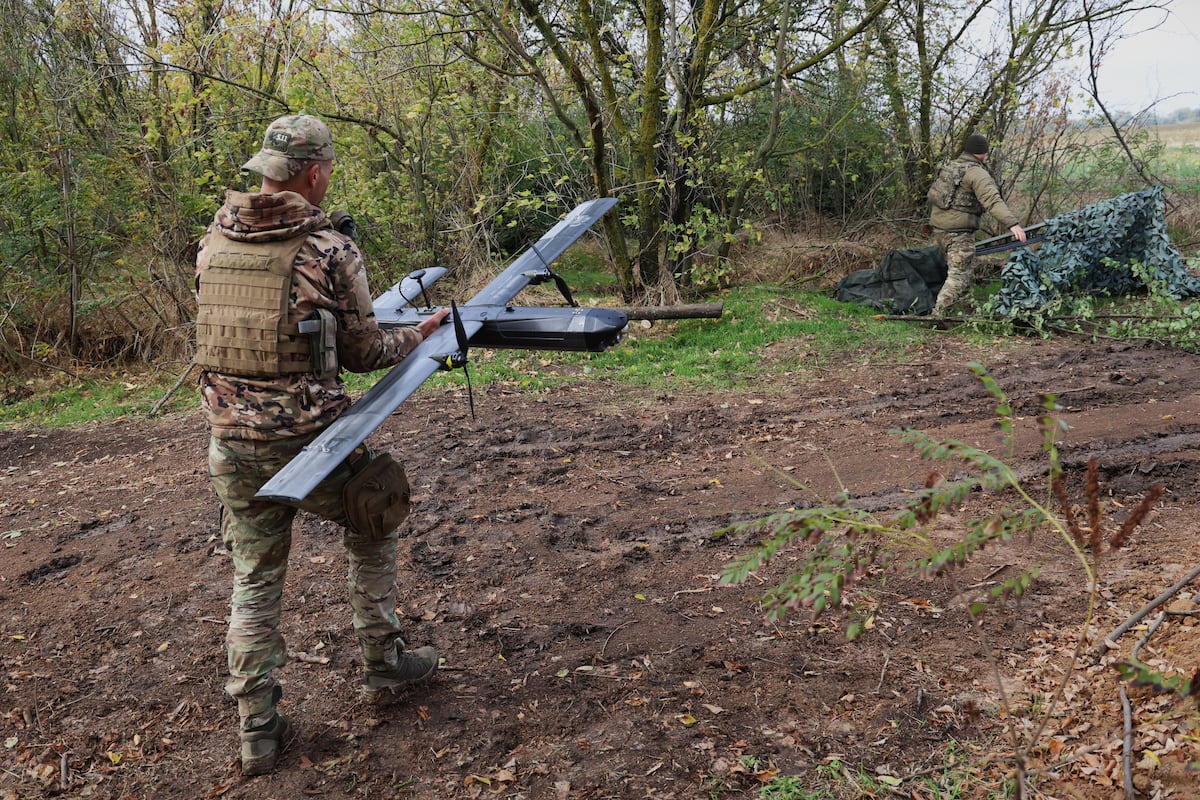
At the command of Snake, the nickname of the unit’s leader, the Baton attack drone takes off. The craft, a kind of small light aircraft that costs around $3,300 to produce, is launched from a semi-hidden catapult among a line of trees in the Kherson region in southern Ukraine. Thanks to the drone’s camera, the pilot and his assistant steer the flight in real time, protected from a position hollowed out a few meters underground. These men from the 140th Intelligence Battalion of the Ukrainian Marines are trying to contest the Russian presence on the left bank of the Dnipro River.Its riverbed, a few miles from these soldiers’ position, forms the border between the two armies in the Zaporizhzhia and Kherson regions. “It poses an obstacle for both sides. It’s just as difficult for them to cross over here as it is deadly difficult for us to cross over there,” Snake summarizes.This river, without which Ukraine cannot be understood, once served as a strategic barrier during World War II. But now the reality of warfare is changing at a much faster pace than it did then. “This is no longer an infantry-level conflict. We’re in a war of drone pilots,” Snake explains as he discusses with the reporter the footage of the Baton flying over Russian positions on its way to its target after leaving the waters of the Dnipro behind. Since 2022, “we’ve gone from a 20th-century war to a 21st-century one,” he specifies.“The bad thing,” he adds, “is that the enemy attacks regardless of the target, civilian or military, homes or buses… while we cannot attack the other side without taking into account that our compatriots are over there." Russian craft carry out a daily hunt for civilians in the streets of Kherson and its surrounding areas, which is popularly known as a “human safari.”Rivers like the Dnipro often end up as battlefields that shape the course of wars, as happened in 1943. For Snake and his men, military involvement is intertwined with family and sentiment. The unit is mostly from Skadovsk, a town on the Black Sea and one of those under occupation on the left bank.They have fought together since their battalion was formed in 2019 and, at 48, Snake is a kind of patriarch to a group of men younger than him. “Last week they bombed a position and we lost a good drone pilot. Those casualties are very painful,” he laments. Although they change locations every so often, this time they have set up camp on a plain between the Inhulets and Dnipro rivers.The unit commander and the rest of his men are very familiar with everything the drone shows them of the river. That territory is their home, the homeland they long to reclaim. Shamil (also a nom de guerre), 33, the chief pilot, still has his in-laws in Skadovsk.“Given that my home is 40 miles away, I feel, in a way, that we are doing work that could speed up the liberation of our hometown,” Shamil admits. But “we are at war and we have to fight on all fronts,” the serviceman clarifies; he started flying basic Mavic models before moving on to the most modern drones and training his comrades.Witness to historyIn the ongoing invasion of Ukraine, which began in February 2022, other smaller rivers have been the scene of clashes between local troops and the Russian invaders. None, however, have been on the same scale, or of the same significance, as the fighting taking place along the great river that divides the country. The Dnipro is both a witness to and guardian of Ukraine’s history; it flows through key regions from Kyiv to Kherson, passing through Dnipropetrovsk and Zaporizhzhia, and is home to some of the conflict’s most critical infrastructure, such as Europe’s largest nuclear power plant, the Zaporizhzhia Nuclear Power Plant. From Zaporizhzhia to its mouth in Kherson, the left bank remains occupied.In the early hours of the invasion, the Ukrainian army blew up one of the bridges over the Irpin River on the outskirts of Kyiv. That prevented columns of Russian vehicles from reaching the heart of the capital. That local forces held out for a month until expelling the invaders was key to thwarting the Kremlin’s plans, which aimed to overthrow Volodymyr Zelenskiy’s government and see the country fall.Even today, Moscow knows that the Dnipro is central to the daily life of Kyiv’s three million inhabitants. Over several days last October, the Russian offensive managed to strike up to four of the bridges that connect both sides of the capital, some repeatedly. The Oskil River in Kharkiv region or the Inhulets in the Kherson region have witnessed other battles that shaped the course of two major Ukrainian counteroffensives.Earlier, in a swift thrust, Russian soldiers jumped to the right bank of the Dnipro at Kherson in the opening maneuvers of the invasion. They remained on that side for more than eight months until the Ukrainian counteroffensive in November 2022. The invading troops managed to cross the river mainly via the Antonivka bridges, near the regional capital, and the bridge at the Nova Kajovka hydroelectric power plant dam.Petro Kobernyk, an analyst and reporter based in Kherson with the Ukrainian Investigative Journalism Center, wonders whether, as in other cases, destroying those bridges might not have been worthwhile to halt the invasion at the river. “Had they done so, they could have considerably slowed the Russian advance,” he explains.Since they were expelled, attempts by both sides to secure positions on the opposite bank have failed. The largest operation took place in October 2023, when Ukrainian special forces and marines established two bridheheads on the left bank. Snake did not take part personally, but some of his brigade comrades did. They held out there until the summer of 2024, when they were forced to withdraw after the Battle of Krynky.The battle fought in 1943 remains indelibly etched in the memory of Ukrainians. The Soviet Union’s Red Army launched an assault on the right bank to drive out the Germans in an operation that lasted four months and left around one million dead, before reaching Kyiv on November 5. Allowing the Russians today to make the same advance that the Soviet troops achieved back then would mean the “surrender” of Kyiv, Kobernyk believes. But he thinks that Moscow, even though it controls the left bank, does not have — even with additional military mobilization — sufficient resources today to launch another assault on the city of Kherson.“Control of the river and the establishment of supply lines across its channel would allow the Russians, in the long term, to continue their offensive” into other southern Ukrainian regions such as Mykolaiv and Odessa and even to bridge the conquered territory with Transnistria, the pro-Russian separatist region of neighboring Moldova, the journalist concludes.No turning backSnake reflects and concludes that an arms race has begun from which there is no turning back. “These new drone technologies make it possible to eliminate anyone we don’t like for very little money,” and “the truth is, I don’t like any of this at all,” he says. “But I’ll be there until the end,” he emphasizes.The Baton, added to the Ukrainian military arsenal a few months ago, can reach 140 kilometers per hour (87 mph) at a maximum altitude of 500 meters for 50 minutes of flight. It can strike targets located up to 90 kilometers (55 miles) from its launch position, according to data published by specialist media.In barely 10 minutes, Snake’s men unpack it from a crate in pieces and have it assembled. The last thing they do is load the explosive into the drone’s nose. The most advanced model of the two types of Baton produced by the local defense industry can follow moving vehicles thanks to U.S. Starlink technology from Elon Musk’s company.On the pilot’s screen appears a vehicle they consider to be Russian, but it is not the marked target this time and they pass it over. “They must think that because the weather is bad we won’t fly,” Snake jokes, referring to clouds that do not entirely prevent the mission, although they do not help. On favorable days, they can launch up to half a dozen of these craft.When the Baton they’ve launched has already flown several dozen miles, the unit commander draws attention to the “magnificent natural scenery” prevailing in the area invaded by Russia as he watches the screen. Heading toward the coordinates provided by their intelligence colleagues — a building housing Russian troops — the drone flies over what is known as the Oleshky Desert. It is a sea of dunes near this city, around which Moscow and Kyiv have agreed to a ceasefire so that civilians can be evacuated amid a serious humanitarian crisis.The Baton’s camera feed goes dark moments before the small explosive-laden aircraft reaches its target. Clouds prevent another reconnaissance drone, as sometimes happens on clearer days, from verifying and confirming the hit on the other side of the Dnipro. For the moment, the great river remains the major frontier in the war.Sign up for our weekly newsletter to get more English-language news coverage from EL PAÍS USA Edition
The Dnipro, the impregnable river and military frontier between Ukrainian and Russian forces: ‘We’re in a war of drone pilots’
Full Article
Original Source
Read the full article at English →KhanList aggregates and links to publicly available news content. We do not host full articles from third-party sources. Always verify important information with original sources.