
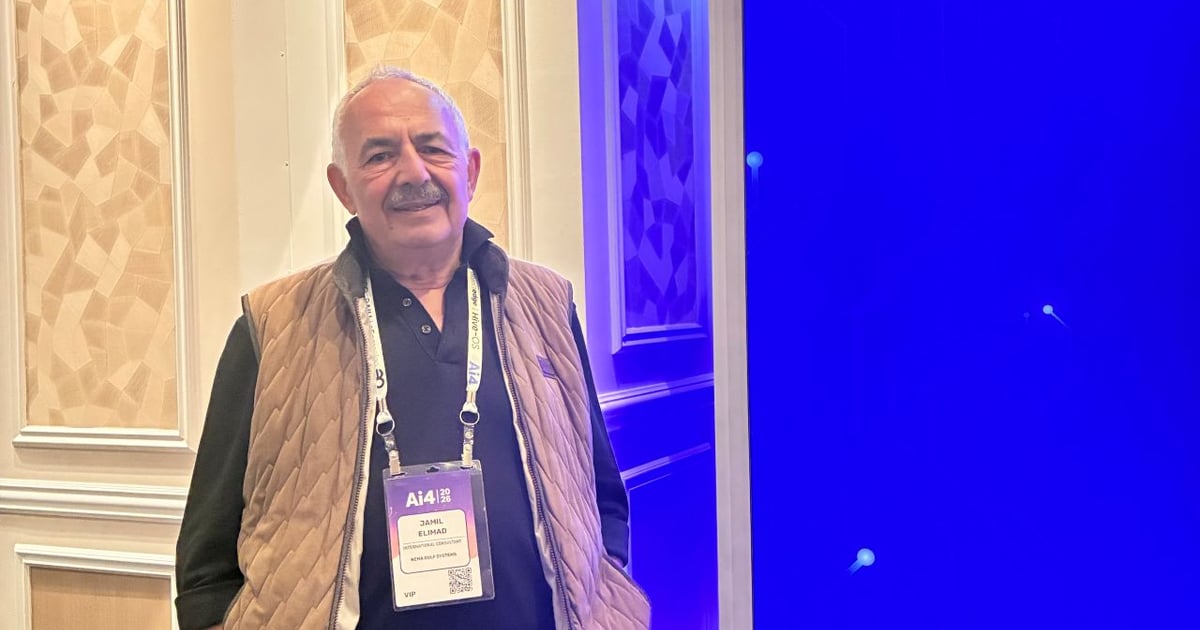
Many argue that generative AI will radically transform businesses, eliminating many roles and ultimately leading to what technology leaders such as OpenAI CEO Sam Altman and SpaceX owner Elon Musk describe as artificial general intelligence.Others see the technology more as a productivity tool that can help maximize human potential and create new opportunities. Jamil El Imad is a longtime technology expert who is an honorary senior research fellow at Imperial College London’s Department of Electrical and Electronic Engineering. His view is that while AI is powerful, it ultimately lacks the sort of intelligence humans possess.In this interview, at the AI4 conference in Las Vegas last week, he discussed what he thinks is the difference between intelligence and intellect and what type of jobs he thinks will be valued in the age of AI.Do you think artificial general intelligence is possible?Jamil El Imad: It’s fantastic what AI can do today with natural language.Related:Class Action Lawsuit Filed Over Meta AI Glasses Privacy ClaimsIntelligence is a big word. Humans have a habit of always overstating what they create; we understate nature.What we have now is not intelligence. We have intellect. It's different. Intellect is when somebody reads a lot of books and can sit in a quiz and answer from that body of knowledge. Super smart. Intelligence is when someone comes up with a crazy idea that isn't in any book.In history, the people who really made a difference, from Newton to Einstein, all these great thinkers and scientists; they didn't come up with what's in the book.Intelligence, to me, is about imagination. We are blessed as humans with your imagination. No other species has that. We can dream of something and then make it a reality. We can think outside the box.This is intelligence, which is emotions … all these attributes that make someone intelligent are not found in machines.The machines are faster; they can compute faster than we can. They can analyze faster than we can. They can store a lot more data, and they don't lose their memory. But … if I were to rename AI, I would call it artificial intellect and give the intelligence to humans.Intelligence is biological. Zeros and ones, that is not intelligence. I worked on a machine called an assembly code for 35 years, and we were doing statistical approximation, guessing what’s going to happen next. There's no intelligence, there's no awareness. This is all statistics.There is a new wave, where we may be able to use binary principles, to create cognitive AI. Cognitive AI is mimicking the brain a little bit.Related:Anthropic Defies the Pentagon. Trump Fires BackThere are 86 billion neurons in our heads. We cannot simulate [those neurons]. We cannot now build, not IBM nor Nvidia; they cannot build 86 billion neurons and simulate them.That's the only organ in our body that we cannot simulate. We can simulate a kidney, lungs and heart, but we cannot simulate that.You use the term "guided autonomous AI." What does that mean for enterprises and businesses?El Imad: There's a lot of talk about autonomous. Autonomous is a big word. A machine having full control of the situation or whatever assignment you've given it, that is still very dangerous.Even in the workplace, humans, you know, are quite intelligent compared to these machines. They still have accountability. I mean, in a corporation, when you have everybody, including the CEO, even the board, they have a schedule of authority.That's what accountability is. If we don’t have accountability on these models, we are creating digital tyranny.I worry that we could end up being run by autonomous systems with no human oversight. These machines don’t have empathy or passion.You say that this is the luckiest generation because of job opportunities created by AI. However, many still fear that the impact of job losses might outweigh the opportunities. Why do you think the reverse is true?El Imad: Given a choice, would you think it’s so meaningful to work in accounts and sit there all day plugging in spreadsheets? Is that what we’re designed for? Is that what humans can offer? It’s horrible. We have so many horrible jobs now, and we accept it because this is how it is. It's boring, repetitive.AI will take a lot of these jobs away from us. That leaves us with creativity. With each era, new jobs are created, and old jobs disappear.The same thing with AI, we will see new jobs coming. These jobs will involve humans. That's one thing AI cannot beat us in: our humanity.I've created a job in one of my articles called The Humanizer. Keeping the human itself is a job in itself. We need to keep our humanity. We need to revisit how we interact with each other in our workplace and with our customers.How does that apply in business settings, especially when some would argue that most businesses value profit more than humanity?El Imad: Businesses that are for-profit value profit. But if you want sustainable profits rather than short-term gains, you need to look after your employees. What better way to get these employees to perform than by creating a workplace culture that is compassionate, inclusive and respectful?So, humans, we are weird. Profit is not always what we care about. Good companies grow when they understand that.Companies that have programs to retrain for the age of AI and ensure that most employees have value to offer will be successful.Editor’s note: This story was edited for clarity and conciseness.About the AuthorNews Writer, AI BusinessEsther Shittu has covered AI technologies and industry trends since 2021. As co-host of the Targeting AI podcast, she talks with experts, thought leaders and practitioners exploring critical AI developments. Before AI Business, she wrote for SearchEnterpriseAI, the New York Daily News, Bklyner and the Brooklyn Daily Eagle. When she's not diving deep into the world of AI, she spends her time on passion projects and raising her three daughters.
The Difference Between Artificial Intelligence and Artificial Intellect
Full Article
Original Source
Read the full article at Aibusiness →KhanList aggregates and links to publicly available news content. We do not host full articles from third-party sources. Always verify important information with original sources.