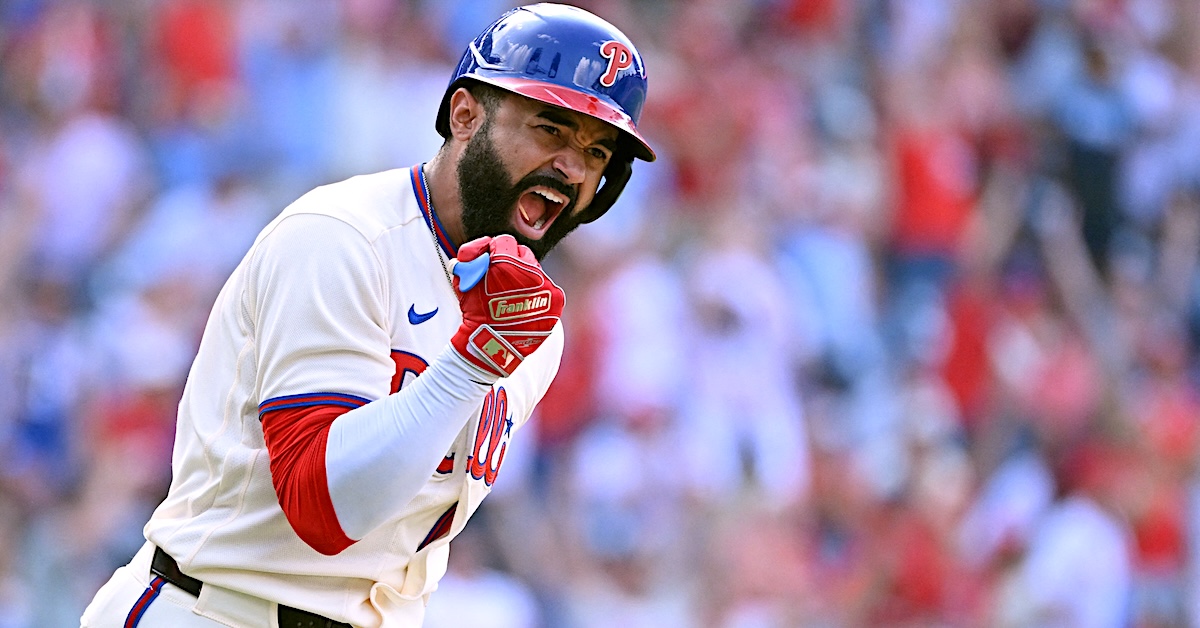
Eric Hartline-Imagn Images I say this with nothing but charity in my heart: It’s generally not a good sign when your team has a load-bearing Derek Hill. When the Phillies traded for Hill in June, he was arguably less valuable than the international bonus money they picked up in the same deal. Hill is a career fifth outfielder with a strikeout rate (31.5% in 806 career plate appearances) that would make almost any hitter unplayable, especially a hitter with a career .281 on-base percentage and a career .132 ISO. But he can run, he can play center field, and he can hit lefties a bit. Best of all — and again, I’m not trying to be unkind here — Hill could not have dreamed up a scenario in which the bar for success was lower. The Phillies traded for Hill the day after Adolis García went down with a season-ending lat tear. García, who bulls-eye’d replacement level in his 67 games in red pinstripes, was an improvement on his predecessor, Nick Castellanos. But the Phillies have been desperate for right-handed outfield help since before anyone had heard of either of those guys. For most of the 2000s, the Phillies had at least one impact right-handed bat in their outfield corners: Pat Burrell first, then Jayson Werth, then Hunter Pence. But it’s been nine years since a right-handed-hitting Phillies outfielder put up a 2-WAR season. That campaign, authored by Aaron Altherr in 2017, is the best by a player matching that description since Pence in 2011. It’s really bad. In 42 games and 91 plate appearances over two months and a week, Hill is hitting .259/.300/.459 for the Phillies. Hill has just five walks and 34 strikeouts in those 91 plate appearances, but the Phillies have two lefty-hitting starting outfielders (Justin Crawford and Brandon Marsh) who need a platoon caddy from time to time, and Hill’s been much better than the alternatives. You Aren't a FanGraphs Member It looks like you aren't yet a FanGraphs Member (or aren't logged in). We aren't mad, just disappointed. We get it. You want to read this article. But before we let you get back to it, we'd like to point out a few of the good reasons why you should become a Member. 1. Ad Free viewing! We won't bug you with this ad, or any other. 2. Unlimited articles! Non-Members only get to read 10 free articles a month. Members never get cut off. 3. Dark mode and Classic mode! 4. Custom player page dashboards! Choose the player cards you want, in the order you want them. 5. One-click data exports! Export our projections and leaderboards for your personal projects. 6. Remove the photos on the home page! (Honestly, this doesn't sound so great to us, but some people wanted it, and we like to give our Members what they want.) 7. Even more Steamer projections! We have handedness, percentile, and context neutral projections available for Members only. 8. Get FanGraphs Walk-Off, a customized year end review! Find out exactly how you used FanGraphs this year, and how that compares to other Members. Don't be a victim of FOMO. 9. A weekly mailbag column, exclusively for Members. 10. Help support FanGraphs and our entire staff! Our Members provide us with critical resources to improve the site and deliver new features! We hope you'll consider a Membership today, for yourself or as a gift! And we realize this has been an awfully long sales pitch, so we've also removed all the other ads in this article. We didn't want to overdo it. In those 91 plate appearances, Hill is already up to sixth among Phillies position players in WAR. That’s not too remarkable. Mostly it speaks to how (again: not trying to be mean here) abject García, J.T. Realmuto, and Alec Bohm have been at the plate this year. Here’s the fun stat: Hill is fourth on the team in WPA. The gap between him and third-place Bryce Harper (0.16 wins) is small enough it could conceivably be covered in a single plate appearance. How does one accomplish such a gaudy clutch stat line? Well, hitting a go-ahead grand slam when your team is down three runs in the seventh inning doesn’t hurt. Derek Hill’s Phillies Career, by Leverage Index Leverage PA BB% K% AVG OBP SLG wRC+ Low 44 6.8% 36.4% .244 .295 .415 93 Medium 33 0.0% 48.5% .219 .219 .344 47 High 14 14.3% 14.3% .417 .500 .917 275 Just Monday night, Hill entered the game as a pinch-hitter in the sixth inning. In two high-leverage plate appearances, he contributed an RBI single and a bases-loaded walk. And this from a hitter who never walks. The sample size is small enough to have zero predictive value, but looking back on Hill’s brief career as a Phillie, he turns into Superman when the leverage index gets over 1.5. He’s not the only one. We actually have a stat that measures how much a player raises his game in clutch moments — it’s called Clutch, fortuitously enough. Zero is neutral, and positive numbers are better. Out of 423 players with at least 100 major league plate appearances this year, 361 have a Clutch number between -1 and 1. Hill is 28th, at 1.03. For what it’s worth, Hill isn’t even the clutchest Phillies hitter this year: That’d be Bryson Stott, who’s sixth in the league in Clutch at 1.65. But Stott is also having the best offensive season of his career overall, and in the second half he’s second among qualified hitters in WAR and sixth in wRC+. This isn’t some bench guy who happens to have run into a couple mistakes in late-and-close situations. Still, there’s more than one way to measure clutchness. (For that matter, there’s more than one way to define high leverage.) I’ve written about this before, but in general, the hitter you want up in a clutch situation is the hitter you want up in any situation, regardless of context. This year, that’s Yordan Alvarez, who leads the league both in wRC+ and WPA. Alvarez actually raises his game in crunch time too; he’s 37th out of 423 in Clutch rating. But his base level is so high I can’t imagine anyone noticed. Of the 67 hitters who are at least one standard deviation better than the mean in wRC+, 31 are also at least a standard deviation above average in WPA. There are 13 hitters who are in the top 20 in both wRC+ and WPA; of those, only Pete Crow-Armstrong is also in the top 20 in Clutch. Top 20 in Both wRC+ and WPA Name Team PA wRC+ Rank WPA Rank Clutch Rank Yordan Alvarez HOU 543 186 1st 5.68 1st 0.83 37th Willson Contreras BOS 469 155 4th 2.14 19th -0.41 318th Pete Crow-Armstrong CHC 561 154 5th 5.57 2nd 1.67 5th Shohei Ohtani LAD 530 153 6th 2.99 8th 0.30 128th James Wood WSN 535 151 7th 3.27 4th 0.98 30th Munetaka Murakami CHW 388 150 9th 2.13 20th 0.41 103rd Nick Kurtz ATH 434 144 14th 3.32 3rd 0.61 73rd Jake Bauers MIL 448 143 15th 2.54 13th 0.76 45th Ben Rice NYY 509 143 16th 2.43 15th 0.14 171st Kyle Schwarber PHI 536 142 17th 2.82 11th 0.17 156th Pete Alonso BAL 543 141 19th 2.49 14th 0.42 100th Matt Olson ATL 545 140 20th 3.05 6th 0.28 133rd Through 8/17 The rest are mostly on the right side of the median figure in Clutch, but apart from that they’re all over the map. Speaking of the map, here’s a scatter plot of every hitter’s wRC+ and WPA this season. I’ve highlighted three outliers here: Alvarez in gold, PCA in red, Ezequiel Tovar in purple. But the other 420 hitters are not only closely clustered, they’re arrayed in such a way that the correlation between wRC+ and WPA is clear even to the naked eye. Obviously, the better a hitter is, the more he advances his team’s win probability. But WPA is a counting stat. That means the best way to accumulate lots of it (positive or negative) is to play a lot. That privileges everyday players like Alvarez and PCA, while relegating the likes of Hill to the muddy middle. He simply hasn’t logged enough at-bats to make a dent. It’s easy enough to turn WPA into a rate stat, though: Instead of tallying up win probability, you turn it into a ratio of wins per 100 plate appearances. Top 10 in WPA/100 PA Name Team PA wRC+ Rank WPA/100 Rank Luis Campusano SDP 153 157 3rd 1.08 1st Yordan Alvarez HOU 543 186 1st 1.05 2nd Nathaniel Lowe CIN/CLE 313 121 73rd 1.02 3rd Pete Crow-Armstrong CHC 561 154 5th 0.99 4th Samad Taylor SDP 102 134 30th 0.89 5th Derek Hill CHW/PHI 181 95 226th 0.88 6th Nick Kurtz ATH 434 144 14th 0.77 7th Cole Carrigg COL 222 117 86th 0.76 8th Luis García Jr. WSN/NYY 420 129 45th 0.62 9th James Wood WSN 535 151 7th 0.61 10th Through 8/17, minimum 100 PA This is more like it. For starters, I did not know that Campusano has been the third-best hitter in baseball this year with at least 100 plate appearances. That’s fun. Nevertheless, Hill is the only player in the top 10 in WPA/100 who’s outside the top 100 in wRC+. Surely there are more hitters like him. The general trend is similar — more wRC+ equals more WPA, even on a rate basis — but we’ve got a few outliers above the curve now. Here they are: Eight players, including Hill, with a below-average wRC+ but a WPA/100 at least one standard deviation above average. Good WPA/100, Bad wRC+ Name Team PA wRC+ Rank WPA Rank Clutch Rank WPA/100 Rank Derek Hill CHW/PHI 181 95 226th 1.60 33rd 1.028 28th 0.88 6th Agustín Ramírez MIA 160 95 230th 0.85 76th 1.081 23rd 0.53 19th Brandon Lockridge MIL 109 88 278th 0.54 106th 0.540 79th 0.50 21st Owen Caissie MIA 283 96 222nd 1.36 42nd 1.536 10th 0.48 22nd Luis Torrens NYM 225 95 232nd 0.85 77th 1.287 15th 0.38 41st José Caballero NYY 360 94 235th 1.27 47th 2.245 2nd 0.35 47th Nick Allen HOU 125 82 314th 0.43 120th 0.645 66th 0.35 48th Nick Castellanos SDP 122 50 405th 0.38 126th 0.739 49th 0.31 53rd Through 8/17, minimum 100 PA No player has — and I’m going to need you all to come with me here, this is a risky neologism I’m about to coin — outkicked his clutchverage as much as Hill this season. Caballero deserves a mention; he is second in Clutch and in the top 50 in both WPA and WPA/100, despite a slightly below-average wRC+ overall. Caballero was in the news earlier this year as the alternative to Anthony Volpe. As the Yankees’ incumbent starting shortstop struggled to meet the sky-high expectations around him, Caballero stole a lot of bases and posted strong high-leverage numbers that masked a less-impressive overall performance. The most popular man in town is the backup quarterback, the saying goes. That might not be literally true in New York, a city that hasn’t seen legitimately good quarterback play since… I’ll have to get back to you. But it’s been figuratively true for Caballero. I should stress that all of this analysis is descriptive, rather than predictive. I know better than to believe in an inherent clutch ability, especially when the evidence for it consists only of a couple dozen plate appearances. But seasons are made and lost when a bench player inexplicably starts feeling it in big moments. This is not only how cult heroes are made; it’s often how championships are won.
The Derek Hill All-Stars
Full Article
Original Source
Read the full article at Blogs →KhanList aggregates and links to publicly available news content. We do not host full articles from third-party sources. Always verify important information with original sources.