
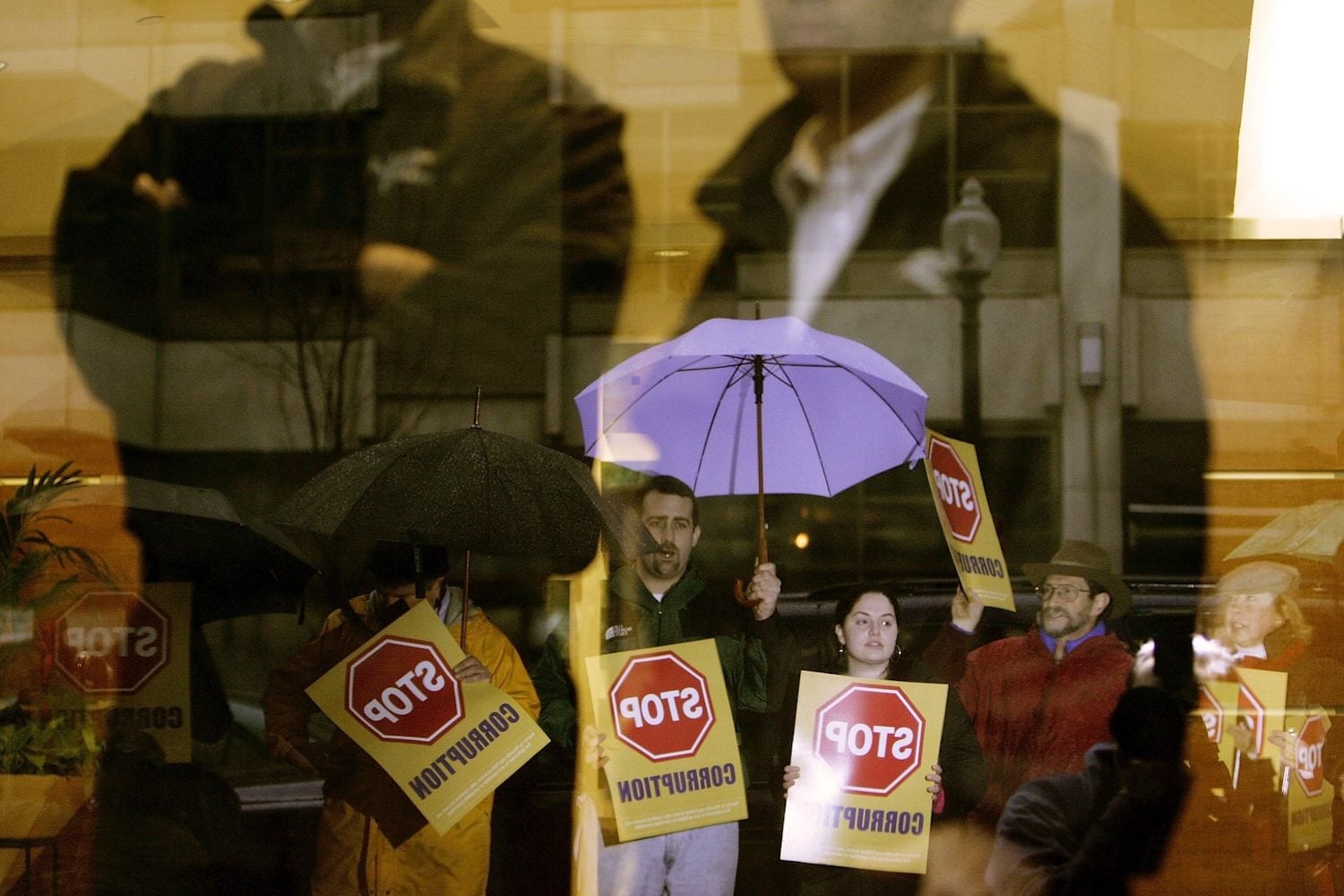
The party should start with investigations and subpoenas, then prepare for more substantial campaign finance reform. Demonstrators at a "Stop Corruption Now" rally organized by MoveOn.org Political Action in front of 1920 L Street January 18, 2006 in downtown Washington, DC. Demonstrators at a "Stop Corruption Now" rally organized by MoveOn.org Political Action in front of 1920 L Street January 18, 2006 in downtown Washington, DC. Chip Somodevilla/Getty Images November 10, 2026, 9:31 AM For the first time in living memory—and potentially for the first time in U.S. history—voters cited corruption as their leading concern in last week’s midterm elections. Given what we’ve seen over the past few years, perhaps this isn’t surprising. Time and again, U.S. President Donald Trump tossed the doors of his White House open to all comers, enriching himself and his family members and creating an open-air market for buying U.S. foreign policy. Trump’s crypto schemes brought in significant (and secretive) investments from Gulf autocracies, despite rampant national security concerns. Trump’s real estate company continued inking deal after deal around the world during his presidency, enriching regimes and the administration in the process. Trump’s children saw their wedding parties sponsored by sanctioned Russian oligarchs, and they traveled around the world monetizing their last names, while governments plied Trump with everything from luxury watches to luxury jets and beyond. For the first time in living memory—and potentially for the first time in U.S. history—voters cited corruption as their leading concern in last week’s midterm elections. Given what we’ve seen over the past few years, perhaps this isn’t surprising. Time and again, U.S. President Donald Trump tossed the doors of his White House open to all comers, enriching himself and his family members and creating an open-air market for buying U.S. foreign policy. Trump’s crypto schemes brought in significant (and secretive) investments from Gulf autocracies, despite rampant national security concerns. Trump’s real estate company continued inking deal after deal around the world during his presidency, enriching regimes and the administration in the process. Trump’s children saw their wedding parties sponsored by sanctioned Russian oligarchs, and they traveled around the world monetizing their last names, while governments plied Trump with everything from luxury watches to luxury jets and beyond. The result of all this was a spectacular midterm defeat for Republicans. Now, the Democrats riding the blue wave know that voters expect massive change going forward, especially as it pertains to cleaning up these Augean stables of corruption. There are plenty of directions that the new Congress could go in, and there are plenty of scandals and policies to choose from. But when it comes ending the kind of corruption that has effectively privatized U.S. foreign policy, here are some clear places to start. Because Democrats will control both chambers of Congress, and because there is little likelihood that Trump will sign any legislation passed into law, the logical place for Democrats to begin is with hearings. Democrats will be able to appoint committee chairs—or even form select committees—to oversee and direct investigations and wield subpoena power to force targets to comply with investigations. Trump’s family should be the first focus. Americans watched the president’s children grow spectacularly wealthy through an impressive array of international scandals. There is, for instance, the role of Donald Trump Jr. in helping oversee World Liberty Financial, a crypto firm that received a covert investment from the United Arab Emirates while the country received high-end chips that had been previously blocked. Then, there’s Jared Kushner. The president’s son-in-law has been at the center of U.S. policy on everything from failed negotiations between Russia and Ukraine to failed negotiations with Iran. The problem wasn’t just Kushner’s lack of regional or technical expertise. Rather, it was his conflicts of interest. Kushner’s private investment firm has received billions of dollars from Iran’s geopolitical adversaries, and it has profited from things like Israeli arms manufacturing and expansion in Palestine. The Russian government has meanwhile begun dangling trillion-dollar arrangements in front of Kushner and his allies. But the family can’t be the sole focus for congressional investigators. They should also target pardons, sanctions, and prosecutions. There is a long list of crooks and kleptocrats who have been openly bidding to get a presidential pardon or have legal cases against them dropped, including the former president of Honduras, who was convicted on drug-trafficking and bribery charges, and India’s wealthiest businessman, who was charged with fraud and bribery only to have his case expunged. The Trump administration has also wielded sanctions to protect corrupt governments around the world—for example, by targeting anti-corruption advocates in Brazil. Finally, one particular issue is at the core of voters’ concerns about corruption: campaign finance. Congress should highlight how the United States’ porous campaign finance laws have opened the door to corrupt forces, including foreign regimes, looking to pocket American politicians. The country’s corporate secrecy laws present the perfect ways for foreign forces to mask their financing, and their corruption, of U.S. politics. Thanks to the combination of anonymous shell companies, unlimited caps on corporate election spending, and unenforced campaign finance regulations, it is now “virtually impossible to discern the extent of foreign-influenced corporate spending in U.S. elections.” These hearings, investigations, and subpoenas will help show American voters just how badly the Trump administration’s corruption has damaged the country’s interests. And with 2028 right around the corner, Democrats should also begin preparing more dramatic steps they can take if they win back the White House and are in a position to pass meaningful legislation. There are plenty of sweeping anti-corruption reforms needed, but they fall into a handful of key buckets. The first is rebuilding. For all the damage he’s done, Trump has largely left the bones of the United States’ anti-corruption policies in place, preferring non-enforcement to outright repeal. This means that a future Democratic administration can immediately reinstate and fully fund the anti-corruption task forces and offices that Trump dissolved. It should also announce that it will start enforcing the Foreign Corrupt Practices Act again, restore the now-defunct shell company registry, and close a range of anti-money laundering loopholes that many American industries still enjoy. But you can’t simply rebuild. You have to expand. In tandem with congressional allies, a future administration should create new anti-money laundering requirements that cover everything from the crypto industry to law firms. It should also make the U.S. shell company registry public, accessible to anyone in the United States, and expand it to cover institutions like trusts. Legislation must also be passed to explicitly ban profiteering by presidents and their family members and to reform the president’s pardon powers. From there, Democrats must begin thinking broader, and they must begin building an anti-corruption architecture that can last for decades. They should create a new Anti-Corruption Bureau to coordinate legislative and executive efforts and serve as a clearinghouse for the government’s anti-corruption work. More ambitiously, Democrats should begin exploring constitutional amendments to tackle corruption. This process is one of the key tools available for overturning Supreme Court rulings that both allowed unchecked campaign financing and severely restricted definitions of bribery and corruption, leading directly to the current morass. These reforms are all eminently doable. And while there are plenty of clear domestic reasons for pursuing them, they are also crucial for rebuilding U.S. foreign policy. Voters expect nothing less. This post is part of FP’s ongoing coverage of the Trump administration. Follow along here. Corruption United States Casey Michel is a senior nonresident fellow on corruption at the Center for International Policy and author of United States of Oligarchy: How America’s Wealthiest Ally with Dictators, Weaken the U.S., and Destroy Democracy. X: @cjcmichel Read More Defense Secretary Pete Hegseth is seen looking down in a close up picture of his face. The Walls Close In on Hegseth The Pentagon chief could get pushed out soon, one way or another. OTHER SUBSCRIPTION OPTIONS Stories Readers Liked Go to slide 1 Go to slide 2 Go to slide 3 Go to slide 4 Go to slide 5 Go to slide 6 Go to slide 7 Go to slide 8 Go to slide 9 Go to slide 10 Three people rest on a sandy beach while a large, partially submerged and tilted ship sits out in the water in the background. The sky above is a hazy gray with cloud cover. A Taiwanese crowd protests while waving flags of the Republic of China. U.S. Undersecretary of Defense for Policy Elbridge Colby, left, and NATO Secretary-General Mark Rutte, right, stand during a press conference at NATO headquarters. Rutte is looking over at Colby, whose fingers are pressed together in a steeple gesture in front of him. Both men are wearing dark suits and ties, standing in front of a blue backdrop and U.S. and NATO flags. A camera rig and a red light are partially visible in the foreground, slightly obscuring the center of the frame. Xi (left) and Trump (right) are shown up close, with Xi looking at Trump. Putin and Xi are both seen in profile as Putin walks to the right and away from Xi, just a few feet of space between them. Xi, meanwhile, is also faced away from Putin, standing and looking down at his feet or the red carpet beneath them. Both men wear dark suits. A man wearing a dark suit jacket, light blue button-down shirt, and patterned red tie sits on a dark gray couch against a textured dark blue wall. He is looking off to the side with a mild smile, next to a teal pillow. The Twilight of the Francis Fukuyama Era By Jeremi Suri An illustration in red and blue tones depicting five silhouetted figures running forward through a dark corridor flanked by large, textured Russian lettering on the walls and floor. Light radiates from the far end of the tunnel behind them A statue of a seated, bearded man with a bare torso and draped cloth around his waist, holding a scroll in one hand, positioned in front of a row of large classical columns. Negotiators from the United States, Canada, and five European countries converse after finishing the draft of the North Atlantic Treaty in Washington on March 18, 1949. Trans-Atlanticism Isn’t Dead—It’s Being Renegotiated By Alexandra de Hoop Scheffer An aerial photo shows Doha in the booming petrostate of Qatar. U.S. Midterm Election Sen. Chuck Schumer is seen standing next to Rep. Hakeem Jeffries. Where Democrats Can Thwart Trump’s Foreign Policy From the Iran war to boat strikes to Ukraine, Democrats now have powerful leverage. Two people at night bend down along an outdoor ground memorial covered in small flags and flowers, flanked by rows of tall standing flags against a dark city background. People gather on a stage behind a podium labeled "Fighting for an Affordable America," with a woman clapping on the left, two men smiling toward each other in the center, including Jeffries, and two people embracing on the right in front of a blue backdrop. Supporters of Democratic U.S. Senate candidate, Texas state Rep. James Talarico, cheer as they watch midterm election returns during a party in Austin, Texas, on Nov. 3.
The Democrats Have a Mandate to Tackle Corruption. Here’s How.
Full Article
Original Source
Read the full article at Foreignpolicy →KhanList aggregates and links to publicly available news content. We do not host full articles from third-party sources. Always verify important information with original sources.