
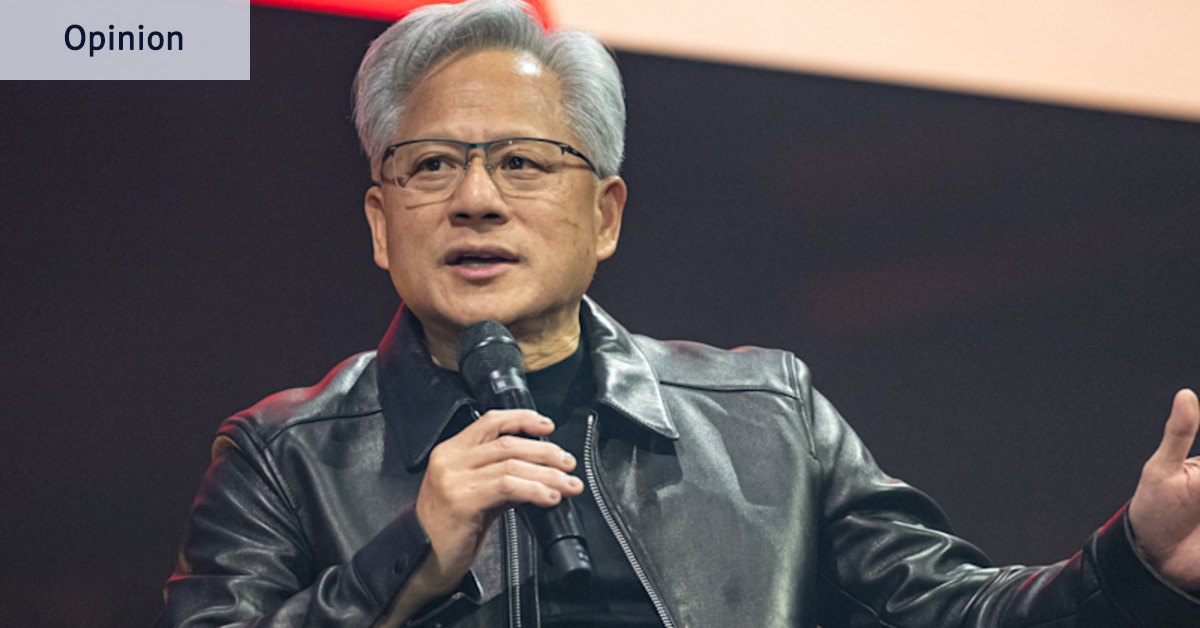
OpinionJames TitcombOctober 26, 2026 — 6:15pmSwotting up on investment bubbles has become fashionable in recent months.Satya Nadella, the Microsoft boss, is telling everybody to buy 1873, a book about the railroad boom and bust. Barack Obama recommends 1929, a recent bestseller about the interwar crash.One day, “2026” may be another ominous title on a famous person’s reading list.Nvidia boss Jensen Huang. Shares in his company are down 10 per cent from their peak this month.DPA via APIn recent days, a stratospheric AI boom has been replaced by bubble fears as financial markets are jolted by a severe loss of confidence in many of the companies propping up the industry.Shares in Nvidia and Oracle, two poster children of the boom, are down 10 per cent from their peak earlier this month, while Anthropic investors have reportedly cut expectations for its looming trillion-dollar IPO.The greatest damage, however, has been inflicted on a cluster of less well-known names.Companies such as CoreWeave, Nebius and Iren have all suffered seismic sell-offs as investors baulk at their heavy losses and inflated borrowing costs.Sceptics believe that distress at these companies, which have borrowed billions to finance a data centre building boom, could be the warning sign for a reversal of the AI trade that has been responsible for most of the stock market’s gains in recent years.Ken Griffin, the billionaire chief executive of trading firm Citadel, has become the latest investing heavyweight to warn about a bubble, and said last week that we were “almost certainly” in one.“Any radical transformation of our economy is generally intertwined with a bubble,” Griffin said at a conference in New York.Much of the early development of AI infrastructure – the data centres, chips and networking equipment that power systems such as ChatGPT and Gemini – came from “hyperscale” tech companies such as Microsoft and Amazon, which already had profitable existing businesses to fund these projects.Ken Griffin, the billionaire chief executive of trading firm Citadel, has become the latest investing heavyweight to warn about a bubble.BloombergThe newer crop of companies, called neoclouds, are less flush. Their building booms instead require gargantuan fundraising operations, selling shares and – in particular – issuing debt to pay for their own AI factories.CoreWeave, the biggest player, has raised $US32 billion in debt and equity to fund 51 data centres. However, it recorded revenue of just $US4.6 billion in the first six months of the year.Nscale, a British rival, has arranged deals to raise almost $US10 billion in debt alone, despite being just two years old.The companies are raising these sums on the promise of earning riches in the future.Both CoreWeave and Nscale have more than $US100 billion of deals in the pipeline, should they build the demanded infrastructure.So far it has worked, and investors have been happy to fund what appeared to be insatiable demand for AI computing resources. But a volley of recent setbacks has hit the companies.Rising global interest rates brought about by inflationary fears have mixed with concerns about appetite for AI infrastructure, especially as cheap, more efficient AI software becomes increasingly capable.Analysts at Barclays said that while AI companies such as OpenAI and Anthropic were once buying as much data centre capacity as they could, they had become more selective.“The industry may be shifting from capacity at any price to capacity at an acceptable return,” the analysts said. “This could pressure pricing and returns for neoclouds.”Nvidia chief executive Jensen Huang, addressed this issue on Thursday, and claimed the sector was suffering from a “scarcity of capital” rather than a lack of demand.“If you look at the fundamentals, the demand for the neoclouds is off the charts,” he told CNBC. “What is missing in the middle is the working capital to fuel that growth.”Borrowing costs, meanwhile, have soared.Interest rates on some of CoreWeave’s debt briefly hit 16 per cent last week.While the company’s own borrowing is at fixed rates, the spike does not bode well for the continued borrowing the company will need to finance new data centres.The industry was founded on the idea that demand for AI infrastructure would exceed the nerves of debt investors, creating a margin for plucky entrepreneurs. But the opposite has become true.“The industry is caught between cheap intelligence and expensive capital,” Raphaëlle D’Ornano, the head of research firm Decoding Discontinuity, wrote last week.Rising global interest rates brought about by inflationary fears have mixed with concerns about the appetite for AI infrastructure.iStockThese developments have flipped the investment story on its head.In an excoriating research note last week, which declared CoreWeave was overvalued by 50 per cent, analysts at HSBC said the company’s return on its investments was 8.9 per cent, well below borrowing costs.“The more the company invests with this return profile, the more the value destruction,” they wrote, suggesting CoreWeave would remain loss-making into 2029.Shares in CoreWeave have fallen by one-third in recent weeks, although things could be worse.‘Any radical transformation of our economy is generally intertwined with a bubble.’Citadel founder Ken GriffinAustralian data centre company Firmus has cancelled a $44 billion IPO and Singapore-based DayOne may follow.London-based Nscale, which has received enthusiastic backing from the British government, is believed to be pressing ahead with plans for its own float, but investors have pared back valuation forecasts.Joachim Klement, an analyst at Panmure Liberum, said that if neoclouds couldn’t now generate the revenues needed to service their debt, they risked entering a “death spiral”.That will depend on delivering on their promises.Shares in CoreWeave have fallen by one-third in recent weeks, although things could be worse.BloombergThe Telegraph revealed last week that Microsoft had pulled out of a deal to rent space at a facility in Essex, which has been delayed for years because of the company’s struggles to get a grid connection.Will Sommer, an analyst at Gartner, this month predicted that $US3.5 trillion in AI infrastructure spending could be written off by the end of 2030.“Our research indicates that enterprise and consumer AI revenue will be insufficient to support profitable returns on all planned AI capital expenditures during this period,” he wrote.Sommer told The Telegraph: “It is unlikely that investors would continue to prop up companies with high losses and no clear pathway to differentiation or profit.”He predicted that 80 per cent of neoclouds would cease independent operations by 2030, either by being bought or going under.If that happens, the question may then be whether the ruptures are confined to a handful of young infrastructure companies, or whether they ripple across the AI companies that have sustained the stock market and fostered a construction boom that has propped up economic growth.“In our view, the neoclouds are the weakest link in the chain,” Klement said. “Their trouble indicates that the AI boom is getting shaky.”Telegraph, LondonGet news and reviews on technology, gadgets and gaming in our Technology newsletter every Friday. Sign up here.From our partners
The ‘death spiral’ that is ominous for the neoclouds and could destroy the Wall Street boom
Full Article
Original Source
Read the full article at Smh →KhanList aggregates and links to publicly available news content. We do not host full articles from third-party sources. Always verify important information with original sources.