
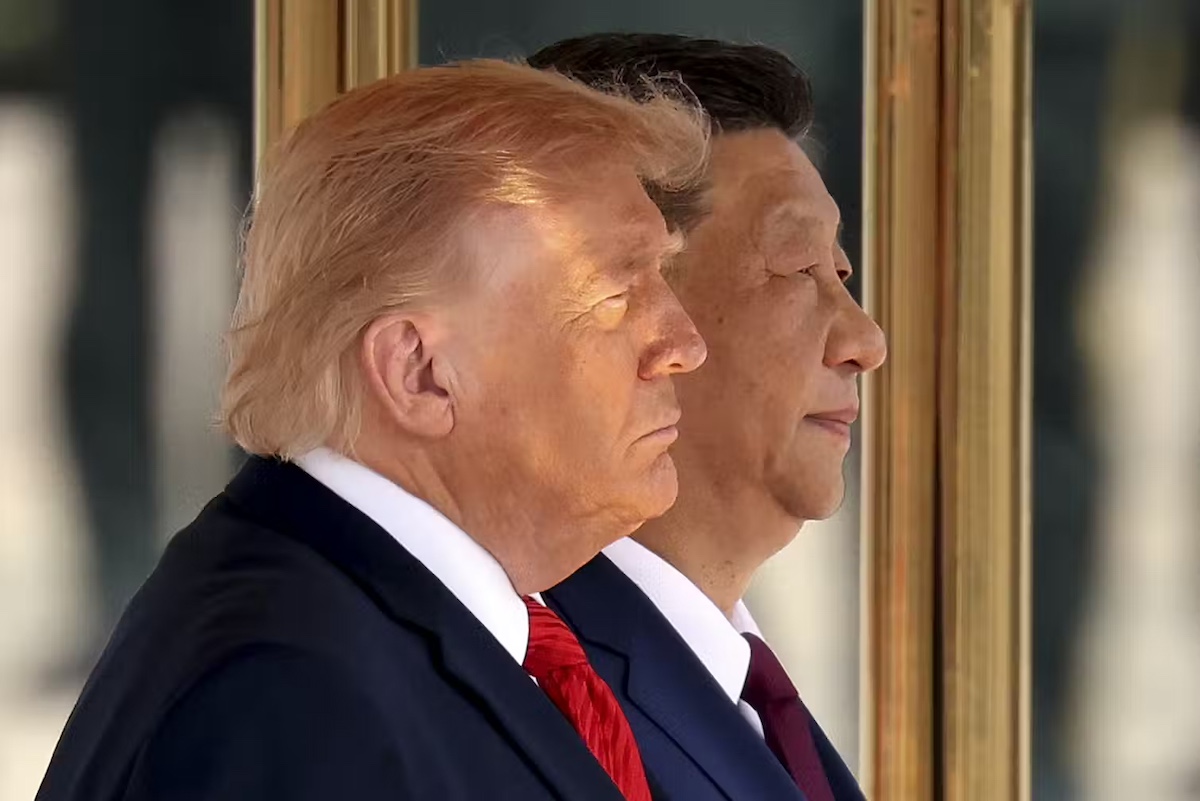
In July 1971, Henry Kissinger, then American national security adviser, had arrived in Pakistan on an official trip but suddenly developed a convenient case of “Delhi belly.” The top envoy was supposedly too ill to continue his itinerary. Instead, under cover, Kissinger slipped onto a secret aircraft and flew to Beijing. There, behind the curtain of the Cold War, he met Premier Zhou Enlai and laid the foundations for Sino-US rapprochement. The deception was audacious. The objective was even more so: to turn two ideological adversaries of the Cold War into strategic partners against a common rival, the Soviet Union. The secret mission eventually produced President Richard Nixon’s historic week-long visit to China that came to be known as the “week that changed the world.” Fifty-five years later, history has reversed its choreography but not its stakes. After their May 2026 meeting in Beijing, where they had agreed on ensuring “constructive strategic stability“, Donald Trump and Xi Jinping will meet at White House on September 24, not behind any curtains of the Cold War but beneath the full glare of world media, with no secret channels or common enemy to justify their encounter. Yet, the question hanging over their summits remains disquietingly similar to the one that had haunted Kissinger on his covert flight to Beijing: can these two rivals build a durable peace without ever pretending to like one another? Weaponized interdependence For most of the Trump era, the world has come to see US-China relations through a single, blunt vocabulary: tariffs. But that vocabulary is now dangerously inadequate. Their relationship has since mutated into a contest over mushrooming new chokepoints. But the most revealing weapon is one most Americans had barely heard of until recently: rare earths. China’s dominance over refining and supply is so complete that even a limited stock of rare earths mined in California is sent to China for processing. China’s dominance in processing can be weaponized, holding US industrial applications from aerospace and semiconductors to high-temperature coatings hostage to Beijing’s strategic calculus. China’s recent export restrictions have exposed vulnerabilities in US industrial supply chains and demonstrated how something buried deep inside a supply chain can suddenly acquire geopolitical significance. This mutual weaponization of their asymmetric economic interdependence represents the new geoeconomics of their great-power politics. Washington also possesses formidable leverage: tariffs, advanced semiconductors, investment restrictions, financial power, sanctions and access to cutting-edge technology, including cutting-edge AI chips. Beijing possesses a different arsenal: manufacturing scale, supply chains, rare earths, critical minerals, processing capacity and access to one of the world’s largest markets. Political scientists Robert Keohane and Joseph Nye once described this as “complex interdependence”, i.e., the recognition that mutual dependence generates both constraint and leverage. But what is unfolding between Beijing and Washington is the darker, harder version of that insight. US-China interdependence has become increasingly securitized. Rival philosophies Trump’s instinct is transactional and immediate — leverage converted swiftly into visible, measurable concession – the kind that can be announced, photographed, and claimed as victory before the news cycle turns. Xi’s instinct runs on an entirely different clock. His tradition favors incrementalism, sequencing and calculated ambiguity — a patient accumulation of strategic space, careful never to concede anything that might later bind one’s hands. Washington wants greater predictability in Chinese rare-earth supplies and restraint on practices considered economically or strategically damaging. Beijing wants relief from technology restrictions, tariffs and a durable framework of engagement. Their Board of Trade created last May aims to cut tariffs on non-sensitive commodity exports up to $30 billion per annum — a modest institutional scaffolding for an otherwise volatile relationship. But beneath these economic negotiations lurks a deeper security dilemma. Taiwan remains their most dangerous fault line. In their May meeting in Beijing, Xi warned Trump that mishandling Taiwan could push bilateral relations into “a very dangerous place.” AI is another layer of intensifying complexity. The two sides are racing to dominate AI, yet neither can manage it alone. Measures intended to increase security by one — export controls, technology restrictions, military deployments, supply-chain diversification — can be interpreted as preparation for containment by the other. It’s unclear whether the US-China Dialogue mechanism, agreed in advance of the Trump-Xi summit to flag rogue AI developments, will actually be established and used in the heat of the competitive moment. None of this needs to trigger war, but these escalating tensions on so many fronts make them vulnerable to other exogenous forces. This is where the Trump-Xi summit is larger than just US-China relations. The wider world is no idle spectator, and its incremental assertion should also shape the summit’s agenda and outcomes. The world out there Wars in Ukraine and Iran have revealed the hard limitations of great powers. At the same time, India, ASEAN, Europe, Japan, South Korea, Australia, the Gulf states and much of the Global South have gradually enhanced their bargaining power. They may depend on China for manufacturing, on America for technology and finance, on the Gulf for energy and on one another for markets and connectivity, yet most of them do not wish to choose between Washington and Beijing. India’s emphasis on strategic autonomy and multi-alignment fits this pattern. So is ASEAN’s seasoned resistance to making binary great power choices. European governments want resilience without rupture, i.e., economic security without severing ties to Beijing. Gulf states are quietly demonstrating how partnership with Washington need not preclude a parallel courtship of China. The most consequential question hovering over the summit is not which of the two will have greater leverage. It is whether their rivalry leaves enough oxygen — enough strategic space — for everyone else. A US-China condominium would alarm much of the world. A full-blown confrontation would be equally unacceptable. A carefully managed rivalry could permit other powers to retain agency while these two giants fine-tune their equilibrium: not friendship, not trust, not even reconciliation — just managed coexistence. What coexistence requires The summit should therefore be judged not by its optics but by whether Trump and Xi can construct some modest but durable guardrails. The first would be economic predictability. Businesses cannot reorganize global supply chains every time Washington or Beijing reaches for a new trade war weapon. The second would be strategic communication. Hotlines and military-to-military contacts are not guarantors of trust, but they are proven mechanisms for preventing accidents from becoming crises. The third would be selective cooperation. Climate, public health, financial stability and AI safety all require urgent collaboration that can happen before settling their geopolitical differences. The fourth would be bounded competition. Great powers have always competed. The problem is when competition becomes uncontrolled and results in conflict. Finally, both sides will have to accept something psychologically harder: the other is not disappearing anytime soon. America will remain a formidable technological, financial and military power. China will remain a formidable industrial, commercial and geopolitical power. That is the reality from which a sustainable relationship must begin. In 1971, Kissinger’s secret flight to Beijing helped demonstrate that yesterday’s adversary can become tomorrow’s partner. In 2026, Trump and Xi face the opposite challenge: demonstrating that an adversary need not become an enemy. Nixon and Mao sought a strategic opening because the Cold War demanded it. Trump and Xi need a strategic ceiling — a limit beyond which rivalry can slip into catastrophe. This week’s Trump-Xi summit will not determine whether the US or China dominates the 21st century. But it could yield something more consequential: whether these two can compete peacefully without making the rest of the world pay the price for their competition. Swaran Singh is a former professor of diplomacy and disarmament at the School of International Studies, Jawaharlal Nehru University, New Delhi.
The deal Trump and Xi should artfully make
Full Article
Original Source
Read the full article at Asiatimes →KhanList aggregates and links to publicly available news content. We do not host full articles from third-party sources. Always verify important information with original sources.