
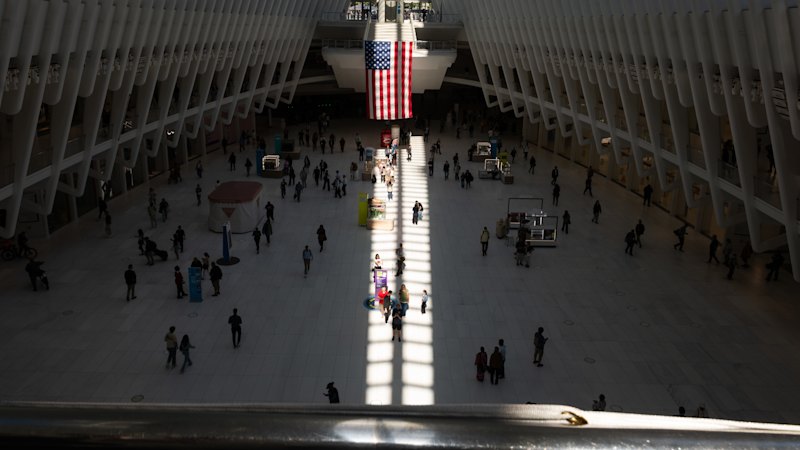
New York: When the Joint Terrorism Task Force led by the FBI gathered for an all-hands panel last week, it convened at the 9/11 Memorial and Museum in Lower Manhattan, hallowed ground that was a smouldering wreckage 25 years ago.Part of the reason for meeting there, says FBI assistant director James Barnacle, was to remind younger officers of the enduring importance and impact of what happened.Sunlight shines across the Oculus floor, along the exact axis of what would be the North Tower, in lower Manhattan.Getty Images“The age that we hire people is between the age of 25 and 30,” he said during a public event at the museum on Thursday night. “For those who were young or not yet born on September 11, it is our responsibility to ensure that the lessons of that day are not lost with time.”Twenty five years on, that risk is real. When the planes crashed into the World Trade Centre, it was a full six years before the first iPhone; it even pre-dated the iPod by a few weeks. There was no Facebook; no Twitter or Instagram. Australia was halfway through the John Howard years, still adjusting to the GST. Lleyton Hewitt had just won his first grand slam.Since then, America and the Western world have changed immensely, even if they still face some of the same enemies. But the picture is more complex now: a rising China, a newly aggressive Russia and a nuclear North Korea, cyber warfare, artificial intelligence.Nancy Gibbs, an American journalist and historian who wrote a famous essay for TIME magazine in the days after September 11, notes the context in which the attack tore apart the comfort of the post-Soviet Union 1990s.“It happened so soon after a decade of relative historic peace and prosperity, ending in a presidential election in 2000 that was almost literally a tie, where the country was just so fat and happy and complacent, even as these enormous changes were happening in technology and demographics, in economics, in culture,” she says.“To then have this cataclysmic event that then belies the whole idea of the end of history, and the notion that a peaceful integrated world was the inevitable path to the future, was such a shocking and startling development. It wrenched us in all kinds of ways.”There are so many images from that day that endure.The second plane, Flight 175 from Boston, crashing into the south tower. Desperate people jumping from the burning building. White House chief-of-staff Andrew Card whispering in George W. Bush’s ear as he read to primary school children. First responders rushing to the scene as debris and dust surged through the streets of Lower Manhattan.Smoke pouring out from the World Trade Center after it was hit by two planes on September 11, 2001.Getty ImagesPeople flee as the north tower of the World Trade Center collapses. Getty Images And people remember how, in the weeks and months after, Americans united, led by a president who pledged righteous vengeance. They also remember how that unity and purpose collapsed as their country became embroiled in another quagmire in Iraq, misled by either an intelligence failure or a lie (or both).Today, Americans can agree on very little. “The notion that that event brought the country together may have been true in the moment,” Gibbs says. “But it doesn’t feel like a lasting result.”The most visible legacy of September 11 is security, especially for airline passengers. The Transport Security Administration, now a source of great frustration and the butt of jokes for many Americans, was born in the aftermath of that day to replace a web of private security contractors hired by the airlines.Flimsy cockpit doors, which were left unlocked most of the time, were replaced by sturdier models that could not be breached. The world became more cautious, whether in the sky or on the ground.It eventually became clear that intelligence shortcomings, a lack of co-operation between agencies, a failure to act on information or heed particular warnings, had contributed to America’s inability to prevent the attack.In one case, a field officer in Phoenix, Arizona, Kenneth Williams, wrote an alert that became known as the “Phoenix memo” advising of a possible effort by Osama bin Laden to send agents to flight schools in the US.That memo, sent in July 2001, noted a significant number of people of investigative interest were taking civil aviation courses in Arizona. As it transpired, several of the September 11 hijackers trained in Arizona and Florida. “The system was blinking red,” said then CIA director George Tenet.‘The enemy within’Part of the solution was to set up new systems, including a director of national intelligence, whose job it was to oversee the intelligence community, and a National Counter-Terrorism Centre. The US government was clear: Islamist terror was the greatest threat to America and the West, and it required focus, dedication and resolve.“We went from a place where the policymaker was not so focused on [terrorism] to it capturing every single day,” said Frances Townsend, former homeland security adviser to Bush, at a September 11 anniversary event earlier this year.Circumstances have changed. America now has a president who talks about “the enemy within”, and who says the nation’s biggest threat is not foreign terror but left-wing radicals in the Democratic Party. Donald Trump filled the DNI post with Tulsi Gabbard, an ex-Democrat turncoat who expressed sympathy for the regimes in Syria and Russia.After she resigned, Trump appointed Jay Clayton, a lawyer who, at his confirmation hearing, would not say who won the 2020 election.The Trump administration has been clear on what it considers the priority: domestic left-wing terrorism. At a roundtable in Washington in July, attended by numerous countries including Australia, US Secretary of State Marco Rubio heralded America’s success in confining the Islamist threat.Islamic State had been destroyed, he said, while its leader Abu Bakr al-Baghdadi was dead. So were Al-Qaeda’s bin Laden and Ayman al-Zawahiri.Jihadist attacks and plots in the US were down by two thirds since the peak of Islamic State, Rubio said, while the number of people killed by jihadist terrorism in Europe had fallen about 97 per cent from 2015 to 2024. “In other words, to a very great extent, our counterterrorism strategy has worked.”Rubio said the danger had not disappeared, and that it would continue to exist “so long as we tolerate immigration systems that import these threats directly into our respective homelands”. But it was severely diminished, he said. What was too often overlooked was “extremist violence from the political left”.Experts, including at Australia’s spy agencies, agree the threat environment has changed dramatically, even if they don’t subscribe to Rubio’s political spin.Outdated and outmatched This week, the congressional House Intelligence Committee published a report evaluating the US’s progress in responding to the recommendations of the September 11 commission.Among other things, it noted that “rapid technology developments and the return of great power competition have significantly changed the threat landscape” since 2001. The enemy was no longer hierarchical terrorist organisations planning large-scale attacks from overseas safe havens; rather, threats came from state and non-state actors operating across multiple domains using conventional, unconventional and technological tools.“The unfortunate reality is that our nation’s counterintelligence posture is outdated and outmatched by the scope and scale of threats presented by hostile foreign powers,” the report says.Some experts fear that, while times have changed, we have taken our eyes off the prize. “I worry that, again, the pendulum has swung a little too far to the domestic terrorism side,” said Townsend.“You can do both, [but] people make choices and there have been resources pulled from foreign terrorism investigations and intelligence operations … That’s a risk that we may live to regret.”In July, H.R. McMaster, a former US army lieutenant general who became Trump’s national security adviser in his first term, told Congress he believed the US was “struggling to adapt” to the new threat reality it faced.Four factors were being overlooked, he suggested: the axis of hostile states, centred on China and Russia, that were now collaborating to an unprecedented degree; the proliferation of disruptive technologies, including AI; Beijing’s economic aggression; and political subversion and cognitive warfare aimed at eroding Americans’ common identity.McMaster was the most critical on that last point. America’s adversaries were being aided by its own leaders, from Trump down, undermining the legitimacy of the country’s democracy.“The axis of aggressors cares little about who wins our elections. What Vladimir Putin, Xi Jinping and other members of the axis want most is for large numbers of Americans to doubt the legitimacy of election results,” McMaster said.“Any time a political leader compromises confidence in our democratic processes to score partisan points, I think they’re actually aiding and abetting our adversaries.”An empire humbled Nancy Gibbs, the journalist and historian who is now a professor of press, politics and public policy at Harvard University’s Kennedy School, spent days walking around the ruins of the World Trade Centre in the aftermath of September 11, speaking with witnesses and survivors and first responders, piecing together the chronology of a tragedy.Her cover story for TIME magazine, compiled in just 48 hours, won a national magazine award. It began with a famous line: “If you want to humble an empire it makes sense to maim its cathedrals.”The attack was certainly humbling for Americans who, despite previous attempts and the targeting of US embassies overseas, were still under the impression they were protected by oceans, systems and allies.So, was the empire humbled in the end? “I could argue that right now we are living through a more profound humbling of the empire and efforts to assert its economic or military dominance globally,” Gibbs says today.Journalist and historian Nancy Gibbs, who put together an award winning chronology of the 9/11 attack, says the tragedy got the ball rolling on where the US stands today. John Palmer/Alamy Stock Photo“There have been far more circumstances since [September 11], even the pandemic, that served as really bracing reminders of the limits of power: public or private.”Gibbs says there are through lines from September 11, 2001 to the Trump era of today. She notes that before September 11, the US had witnessed 30 to 40 years of decline in public trust in institutions, trust in government to do the right thing, which reversed overnight.But then came two wars, Afghanistan and Iraq, that lost public support. Then came the bungled response to Hurricane Katrina, and the global financial crisis, “and what felt like one case after another of institutions not living up to the moment”.Barack Obama’s rise on the back of his opposition to the Iraq war, and his subsequent honeymoon period as president, interrupted that decline. “But you have a series of episodes, the rise of the Tea Party, that just speak to a deeper and deeper sense that the system was not working, that it needed radical change. And Donald Trump represented nothing if not the prospect of radical change.”When Townsend, the former Bush adviser, and Richard Haass, the long-serving former president of the Council on Foreign Relations, appeared at the 9/11 Memorial and Museum for an event earlier this year, they were asked by a member of the audience whether bin Laden might feel that his horrible objectives had been belatedly achieved.The questioner noted Americans were bitterly divided, and that they often can’t even agree on basic facts; Washington’s relationships around the world are increasingly battered, with some alliances diminished; and the US is arguably perceived as a force to be feared rather than admired.Haass disputed there was a direct connection. “All the things you mentioned may, to some extent, be true. [But] none of them can be traced back to 9/11,” he said. “These are things that we own because of what we’ve done domestically or internationally.”As for whether Americans would come together if such an atrocity occurred today, Townsend was optimistic. “When it’s a foreign enemy, the American people will link arms, and they will unite themselves and put aside political domestic differences. It happened,” she said. “But if it’s not, if it’s an internal debate or an internal division, you’re not going to have that necessary cohesion.”Trump won’t be thereThis year’s 25th anniversary commemorations have not been immune from political conflict. Trump will not attend the memorial in New York, reportedly because he was not allowed to deliver a speech (which Trump denied). Vice President JD Vance will attend, while the president will go to the Pentagon, which was also attacked on September 11.Meanwhile, some survivors, families and first responders do not want New York City mayor Zohran Mamdani, the first Muslim elected to that role, to attend the event, on the grounds he and his associates have had mixed messages on extremist ideologies and American values.An online petition against Mamdani’s attendance has attracted nearly 100,000 signatures.On Thursday night, three members of Congress who sit on the House Intelligence Committee gathered for an event at the 9/11 Memorial and Museum in Manhattan to discuss their aforementioned report on the legacy of the September 11 commission.They comprised the committee chair Rick Crawford, a Republican from Arkansas, Trump ally Elise Stefanik, a high-profile representative from New York, and a Democrat from neighbouring New Jersey, Josh Gottheimer. They all agreed on the fresh challenges facing US national security, including the imperative that America not cede the artificial intelligence race to China, or anyone else.Earlier in the week, the committee travelled to Shanksville, Pennsylvania to hold a roundtable with families of the victims of United Flight 93, which crashed to the ground there after passengers rebelled. Having heard through their seat-back phones that the nation was under attack, they voted to take on their hijackers.For the committee members, that act, the final choice those passengers ever made, came to symbolise all that was good about America. It was an attitude Crawford tried to infuse in the committee’s work.“They did not attack Democrats and Republicans on 9/11. Americans were attacked,” he said. On September 12, nobody was a member of a political party.“25 years on, are we still capable of that level of unity?” he asked the audience. “I think it’s important that we demonstrate that we are.”Get a note directly from our foreign correspondents on what’s making headlines around the world. Sign up for our weekly What in the World newsletter.
The day that changed America and shaped the world we know today
Full Article
Original Source
Read the full article at Smh →KhanList aggregates and links to publicly available news content. We do not host full articles from third-party sources. Always verify important information with original sources.