
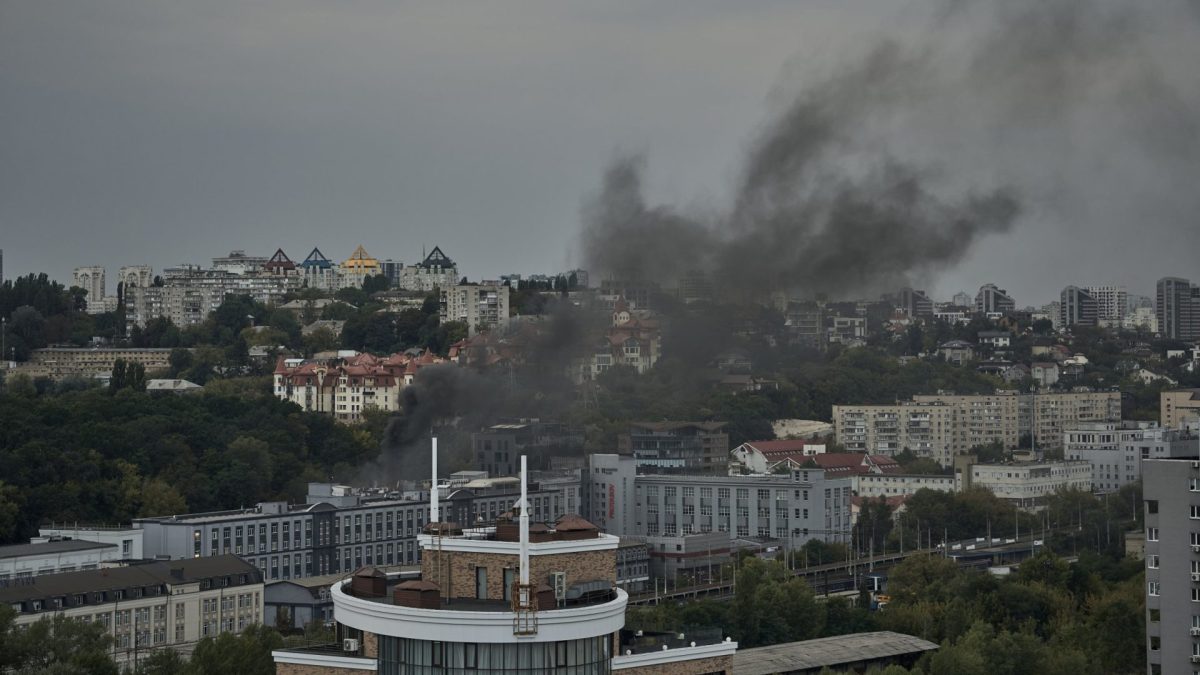
Ukraine has become adept at knocking Russian drones out of the sky. But Moscow has spent recent weeks deploying a new generation of jet-powered Geran-4 and Geran-5 drones – weapons that are quicker, more sophisticated and harder for Kyiv’s air defences to intercept. The consequences of this are already being felt. A Russian drone struck the headquarters of Ukraine’s security service in Kyiv on 4 September in what was the first direct attack on a government building in the capital. Another, reportedly jet-powered, entered Moldovan airspace last Tuesday and almost struck a plane carrying Ukrainian President Volodymyr Zelensky. What is emerging is not simply a larger drone campaign, but a significant evolution in how Vladimir Putin’s forces are using and developing unmanned weapons. Shorts Ukrainian figures suggest that attacks involving jet-powered drones rose from 350 in June to 2,800 last month – the first month in which Ukrainian Air Force data recorded attacks by jet-powered Geran drones becoming a daily occurrence. The development has put Ukraine on the back foot. The difference between these and the propeller-driven munitions Moscow has relied upon throughout much of the war is stark. John Hardie, deputy director of the Foundation for Defence of Democracies’ Russia programme, told The i Paper that “unlike propeller-powered drones, these munitions fly too fast for Ukraine’s mobile gun teams and existing interceptor drones”. “Ukraine routinely shoots down 90-plus per cent of Geran-2 and Gerbera drones, but only around 60 per cent of the Geran-4/5, and it’s had to use more expensive air defence missiles that are in shorter supply,” he added. The original Geran-1, an updated version of the Iranian-designed Shahed drone Russia began producing in 2023, can carry a warhead of up to 20kg, and has a top speed of around 115mph. The newer Geran-5 is a very different proposition. Reportedly first deployed by Russia in January, it can reach speeds of up to 370mph, carry a 90kg warhead and travel as far as 620 miles. The Geran-4 is also faster and more aerodynamic than its predecessors. The remains of an earlier version Geran-2 drone on display in Warsaw, Poland (Photo: Marek Antoni Iwanczuk/Getty) Speed matters because the weapons are beginning to outstrip the capabilities of some of Ukraine’s existing interceptors. Sam Cranny-Evans, editor of UK-based defence outlet Calibre Defence, told The i Paper that “jet-powered drones fly much faster, which makes shooting them down without guidance more difficult. This could force Ukraine to use more missiles or its self-propelled anti-aircraft guns like the Tridon Mk 2 to intercept them”. However, he added that “Tridon and similar systems are only available in limited quantities, so the jet-powered drones could force Ukraine into making uncomfortable trade-offs.” While earlier Geran models relied on relatively rudimentary guidance systems, newer versions can carry thermal cameras and AI-powered targeting systems, as well as anti-jamming antennas and Chinese mesh radio modems. The latest attacks have placed greater pressure on Ukrainian fighter aircraft, with some pilots resorting to onboard cannons to try to destroy the drones – a dangerous and resource-intensive way of dealing with weapons designed to be launched in large numbers. And Ukraine could feel the pressure as the winter months draw near. “The main danger is that Ukraine’s stock of air defence missiles is reportedly perilously low,” said Cranny-Evans. Police carry a piece of wreckage from a Russian Geran-4 jet-powered drone that struck a hypermarket in Kharkiv (Photo: Viacheslav Mavrychev/Getty) Ukrainian former Air Force officer Anatolii Khrapchynskyi said that as winter approaches, “this threat multiplies exponentially. Russia’s clear objective is to manufacture an acute shortage of interceptors ahead of sub-zero temperatures, depleting Ukraine’s air defence umbrella with cheap, high-speed drones before unleashing heavy cruise and ballistic missiles against critical energy and utility infrastructure”. Ukrainian companies have reportedly begun testing missiles designed to intercept and destroy the new Geran variants, while Zelensky has said that 67 Ukrainian companies are working on ways to bring them down. Ukraine’s new defence minister, Yevhenii Khmara, has tasked companies with producing “thousands” of these missiles as quickly as possible amid the rising threat. Hardie said that Russia is also investing in low-cost cruise missiles, as a further counter to cost-effective Ukrainian defences. The contest is becoming another chapter in the accelerating arms race between Moscow and Kyiv, and Russia has an economic incentive. While newer drones are more expensive and technically demanding than their predecessors, they remain far cheaper than the Kalibr and Kh-101 cruise missiles that Russia has used extensively since the invasion began. “A combat sortie of just six strategic bombers launching Kh-101 cruise missiles costs the Russian state approximately two million dollars in operational expenses alone, excluding the price of the missiles themselves,” said Khrapchynskyi. “Launching ground-catapulted jet-powered strike drones costing under £111,000 represents a completely different wartime economic model.” The remains of a Russian KH-101 cruise missile on display in Berlin (Photo: Ralf Hirschberger/AFP) Serhiy Beskrestnov, an adviser to Ukraine’s defence minister, said in a recent statement that almost all jet-powered drones being used against Ukraine are now being equipped with cameras. The result is a weapon that can potentially combine mass production with greater precision and resistance to Ukrainian attempts to disrupt it. Satellite imagery appears to show Moscow expanding its production facilities dedicated to drones, including a new base at Tsymbulova in Russia’s Oryol region. Longer launch rails associated with jet-powered drones are visible at the site, which is just 175km from the Ukrainian border. Meanwhile, Russia has also been using Gerans alongside Banderol cruise missiles in attacks on Ukrainian warehouses, logistics centres and Black Sea ports. The strategy reflects what military analysts have described as the gradual “cruise-ification” of Russia’s drones. One Banderol was reported to have approached the port city of Odesa at an altitude of just 20 metres above the sea earlier this month. The newer Gerans remain some way short of true cruise missiles, as they have shorter attack ranges, smaller warheads and remain vulnerable to electronic jamming. But they are an attractive asset as they offer another way of launching large numbers of weapons into Ukrainian airspace. The Kremlin’s ability to sustain production may depend on access to foreign technology, as Western countries look to target supplies coming in from countries like China. For Ukraine, however, the immediate challenge is more basic. The country has demonstrated ingenuity in developing its own drones and other battlefield technologies, but stopping an incoming drone or missile requires a different kind of industrial capacity, particularly when the attacker can launch hundreds at once. After a period where the drone war seemed to be turning things in Ukraine’s favour, the latest developments are a reminder that war can change quickly. Russia’s increasingly sophisticated drones threaten to shift the balance firmly back towards Moscow.
The dangerous threat from Putin’s new jet-powered drones
Full Article
Original Source
Read the full article at Inews →KhanList aggregates and links to publicly available news content. We do not host full articles from third-party sources. Always verify important information with original sources.