
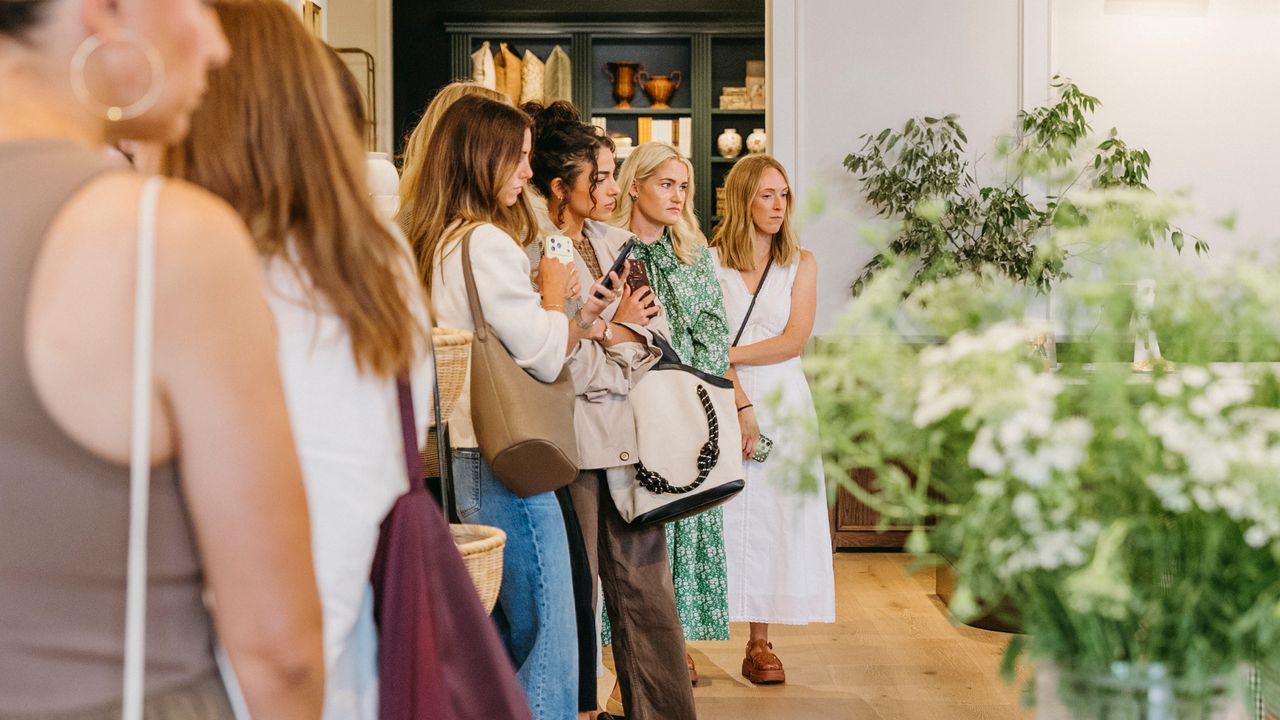
In the age of instant gratification and easy comparison shopping, relationships matter more than ever. Here’s how retail pros across the country are building them—and keeping themAt the McGee & Co. flagship in Salt Lake City, customers gather for a community event—custom embroidery and make-your-own-keychain stations included.Photography courtesy McGee & Co.Imagine you’re at home one morning—settled in, slippers on, cozy. Your kids are playing in the next room. A couple of miles away, your local Pottery Barn is hosting a bed-styling workshop: You’ll learn how to layer coverlets and quilts, mix patterns, and plan for seasonality. And maybe at the end of it, you’ll get a small discount for an in-store purchase.Do you go? Or, do you hop onto YouTube or TikTok and search for “bed-styling ideas”—slippers still on? Maybe you find what you’re looking for on Pottery Barn’s own YouTube channel. Maybe you search for some quilts like those you saw in the video, and—what’s this? A similar-looking option for less, from another brand that isn’t Pottery Barn?Well, what’s stopping you?This is the conundrum facing today’s retailers. Getting a customer’s attention is already a daunting task. Now, with inspiration, information, and comparison shopping a few swipes away—and the “unsubscribe” button ever looming—there’s got to be a lot more to get a potential buyer saying yes, and they’ve got to say it over and over again. For larger purchases like furniture, brands face the added challenge of navigating higher price points, complex fabrication and delivery logistics, and the all-important, ever-subjective metric of human comfort. (Lovesac’s recent social-media drama might be the ultimate example of furniture-buying gone haywire in 2026—a saga including viral outrage, delivery snafus, and assembly headaches.) Cultivating that kind of customer loyalty requires creating something people can’t find anywhere else: a genuine relationship.Lean Into ExperiencesGetting people out of their slippers and into the store—again and again—is one challenge that pros like Evan Hutton, McGee & Co.’s head of retail store operations and a veteran of the industry, are taking seriously. “It used to be you could just do a bed-styling class or [a class on] how to decorate a mantel, and people would come for that,” she says. No longer: Thanks to YouTube tutorials, the lure has to be much more compelling. The promise of social and experiential elements like gelato carts or floral-arranging workshops give customers a social and sensory reason to show up, she says. This strategy for cultivating customer loyalty is already making its way into the first McGee & Co. flagship in Salt Lake City, which opened in September.Retails are seeing a growing interest for hands-on events, like this keychain-making activity at McGee & Co. Courtesy McGee & Co.Shea McGee's finished keychain, complete with a monogram. Courtesy McGee & Co.“I think of in-store programming as retail theater,” says Geri Moran, vice president of marketing at ABC Carpet & Home, a longtime New York City home shopping mecca. The beauty of programming, she notes, is that it brings together “commerce, culture, and discovery.” Importantly, it doesn’t even need to produce a sale right away, either. “It can build awareness, strengthen relationships with the design community, introduce new customers to the store, and give existing customers another reason to return,” she says.During the holiday season, ABC Carpet & Home hosts carolers at its NYC flagship as a way to “give [customers] a reason to visit, connect, and come back,” says Moran. Photography courtesy ABC Carpet & HomeShe points to a caroling event held at ABC during the holiday season. Those fa-la-las aren’t frivolous: They’re how ABC makes an emotional imprint on its community, even if it may have very little to do with a specific product. “The merchandise gives people a reason to shop,” she says, “but the experience gives them a reason to visit, connect, and come back.”Inspire FOMO—Then Overdeliver on DiscoverabilityAnother way to get people coming back? Introduce elements that can only be discovered in person, whether that’s through store design, specialty goods, or locally made wares. Across the industry, brands are tackling this in a few different ways. McGee & Co., for one, is planning to include regional variations on their signature design language across its outposts as they expand across the US. Syd McGee, the company’s CEO, imagines a McGee fan encountering the store in different cities, each location informed by local culture. How does McGee do Texas versus California? There’s only one way to find out, he says.The business is also embracing the potential of merchandise that can only be purchased in-store. At the opening of their Salt Lake City flagship, McGee & Co. offered gardening gear, Cire Trudon candles, Match pewter, and vintage pieces only shoppable in person. Though customers may have initially come to the flagship to check out a new piece of furniture, they’ll discover that their local store can also be a resource for gifts and one-off finds from the McGee universe.The Lawson-Fenning showroom creates a welcoming environment for clients. Photo: Ben AndersonLawson-Fenning, a homeware brand that has built a reputation for California-inflected design, takes a similar approach to layering, blending their own collection with vintage they’ve found and work from makers they admire. “There’s always something they didn’t come in for,” says cofounder Grant Fenning, adding that “plenty of our longtime clients first walked in without a plan.” While much of their consumer base encounters the brand for the first time through a designer, shoppers will often return on their own a year or two later.A retailer’s job isn’t just to showcase hero products—it’s to build a world. Which might be why Il Buco Vita, a lifestyle brand offshoot of Il Buco’s hospitality business, does around 60 percent of its business in person, despite having a website full of products. Founder Donna Lennard notes that art, antiques, and decorative pieces frequently sell more in store, while online sales skew toward more everyday kitchen and dining products. “It all comes down to keeping the discovery process interesting,” says Lennard. “With each person that walks through the door, there is an opportunity to introduce them to something they might not have known they were looking for,” she says.The associates working the showroom floor help complete the picture, educating customers about the artisans, product pairings, and long-term care of pieces. But this year, Il Buco Vita is taking their world-building efforts one step further by opening a new retail flagship on Bond Street, just a few doors down from their original restaurant. This proximity, Lennard says, “creates a stronger connection between hospitality and home,” and provides a setting to present larger pieces, antiques, and collections in a more experiential atmosphere. “Customers can see how they live together and imagine them in their own homes.”Access the AD ArchiveEvery issue, every era. Explore 100+ years of the Architectural Digest Archive, an unparalleled digital resource for research and inspiration. Start SearchingArrowEarn Their TrustAcross the board, the brands interviewed for this story identified trust as the key ingredient in creating repeat customers. Cultivating it begins from the moment someone begins engaging with your team—and it doesn’t end when the credit card swipes. “The sale isn’t truly complete when the customer pays,” Moran says. “It’s complete when the product has arrived, the customer is happy with it, and the experience makes them want to return.”Associates’ product knowledge is the first half of the equation. Customers depend on sales staff to understand not just a product, but the whole-room experience that brands can deliver. This expertise also supports conversations on pricing. In the showroom, customers can test-drive a sofa, run their fingers across different types of upholstery, and scrutinize construction alongside an associate, who can help them unpack the differences between two similar models. “The conversation then becomes less about price and more about value, craftsmanship, longevity, and whether the product is right for the customer,” says Moran. “Our team can also help identify alternatives when something isn’t the right fit for a customer’s budget.”Hutton notes that for McGee & Co., there was a deliberate decision made to refer to in-store employees as “design associates.” “When a customer comes in, we don’t want it to be, ‘Oh, let me take you over to the design concierge,’” says Hutton. “We want all our team members to be able to start those conversations—and oftentimes finish them too.”Shea McGee, who briefed many of those first-time flagship associates herself, notes that education on the product forms a significant part of their training. The goal is for trainees to understand showroom furniture from the perspective of a designer, and to be able to translate that to the customer. By doing so, she says, associates will help buyers “make that connection between ‘designer led’ and our brand.”Studio McGee's senior-level designers host regular check-ins with McGee & Co.’s design associates to help bridge the brand's designer-led vision. Photography courtesy of McGee & Co.For trade-focused businesses, trust-building exists outside of a single transaction. Tyla Caccese, the founder of the 15-year-old trade-only rug company Tailor-Made Textiles, emphasizes a practical tack. For her new 2,000-square-foot showroom in Manhattan, “We wanted it to feel more like a workshop,” she says. The design followed: There’s a big marble kitchen island where designers can spread out drawings, plug in their laptops, or work through a project over lunch.This thinking was informed by her experiences in a shared space her brand occupied previously, where she noticed remote-working designers using the showroom as a kind of third place—not quite a home, not quite an office. “It’s been wonderful to see designers using the showroom almost as an extension of their own studios,” she says. These current and prospective customers can get to know and trust the brand through proximity and natural conversation, turning to Caccese to work through ideas and feel at home, whether or not they’re there to source a rug. “I don’t want designers to feel like they need a project or a purchase order to come through the door,” she says. Showing that you can help them solve their problems is what will earn you their business. “Ultimately, what brings designers back isn’t necessarily a particular rug. It’s knowing they can walk in with an idea, a problem, or a completely unrealistic deadline and have a real conversation about how to make something work.”Once a customer makes a purchase, overcommunicate, overcommunicate, overcommunicate, says Lawson-Fenning co-founder Glenn Lawson. He says that wait times are the biggest challenge facing their business, which makes all their furniture to order. A piece can take 10 or 12 weeks to produce—and for a designer working toward an install date, that matters. “We’d rather give a realistic date and hit it than promise something faster and miss,” says Lawson. “When people know where their piece is, the wait feels shorter.” And in a pinch, those only-in-store items can help too: Never underestimate the power of a floor sample.At the new ABC Carpet & Home store in Boca Raton, Florida, customers can explore the brand's floor coverings in a range of settings, from residential vignettes to more gallery-like arrangements. Photo: Richard SilverNurture the RelationshipUltimately, retailers need to recognize that in 2026 and beyond, you’re no longer just a merchant—you’re a builder of relationships. That kinship builds through events that cultivate brand affinity, solving customers’ problems together, and delivering compelling, can’t-find-it-elsewhere in-store discovery. But nurturing that connection is just as important as making it in the first place.“It’s not uncommon for our top buyers to receive a personal email from our sales team, letting them know about what we have coming up next and personally inviting them to check out new collections,” says Lennard. Fenning seconds the motion: “Designers hear about new work first,” he says. “We invite them in for a new collection or a maker’s show. And when a project wraps, we want to see the photos.” The transaction might end at the register—but the relationship doesn’t have to.Lila Allen's design writing has appeared in The New York Times, The Architect's Newspaper, Architectural Record, and books including Design for Children (Phaidon, 2018), Drama (Phaidon, 2021), and At a Distance: 100 Visionaries at Home in a Pandemic (Apartamento, 2021). ... Read MoreRead More87 Home Decor Stores to Shop Now and AlwaysFrom decades-old destinations in New York City to up-and-coming shops in California, discover America’s best home stores that are open for businessBy Benjamin Reynaert, Kelsey Mulvey, and Lila AllenHow to Spend Your Marketing Budget NowThe marketing landscape has changed. Here’s your roadmap to smarter spending, better client acquisition, and growth in 2027By Lila Allen, Stefanie Waldek, Jennifer Hunter, Meaghan O'Neill, and Julia MitchemReady, Style, Shoot: AD PRO’s Ultimate Guide to Styling and Photographing ProjectsThe industry’s top stylists and photographers share how to hire the right team, refine every detail, and capture images worthy of publicationBy Kyle Hoepner, Mel Studach, Jennifer Fernandez, Diana Budds, Jennifer Bradley Franklin, Kaitlin Madden, and Alyssa Giacobbe5 New Retail Design Rules, According to ExpertsHow do you design a store enticing enough to lure people off their sofas and through the door? The creatives behind some of the year's buzziest shops reveal their strategiesThe Dirty Kitchen Is Still in Demand—Here’s How to Get It RightPros with deep experience designing the popular workhorse spaces share best practicesIs the Open Floor Plan Really Dead?New demands on our homes—more multiuse than ever—have increased the desire for separation, but connected living is still very much in playDesigners Are Rethinking These 8 Home Renovation IdeasLeading architects and designers reveal their home remodel no-gos—and what they suggest insteadClients Want to Age in Place. These 8 Innovations Let Them Do So BeautifullyRenovating a home so clients can stay in the place they love is one of the most meaningful projects a designer can take on. Here, experts share eight thoughtful ways to prepare homeowners for the years aheadHow Heidi Caillier Never Designs the Same Room TwiceThe AD100 designer on keeping her work fresh, building a remote team, and the power of a “limited options program” for clientsKelly Wearstler on What It Takes to Be a Creative Entrepreneur TodayKelly Wearstler has spent her career expanding our idea of what an interior designer can be. Now, the AD100 Hall of Fame talent shares her secrets to success10 AD-Approved Millworkers to Perfect Your Next Project’s Built-InsDesign pros trust these industry favorites add finesse, function, and flexibility to any home interiorI Thought Slave Labor in Construction Was Not My Problem. I Was WrongForced labor—even slave labor—is woven into the materials supply chains feeding our profession. Here's what we can do about it
The Customer Loyalty Secret? It’s Not Just About Shopping
Full Article
Original Source
Read the full article at Architecturaldigest →KhanList aggregates and links to publicly available news content. We do not host full articles from third-party sources. Always verify important information with original sources.