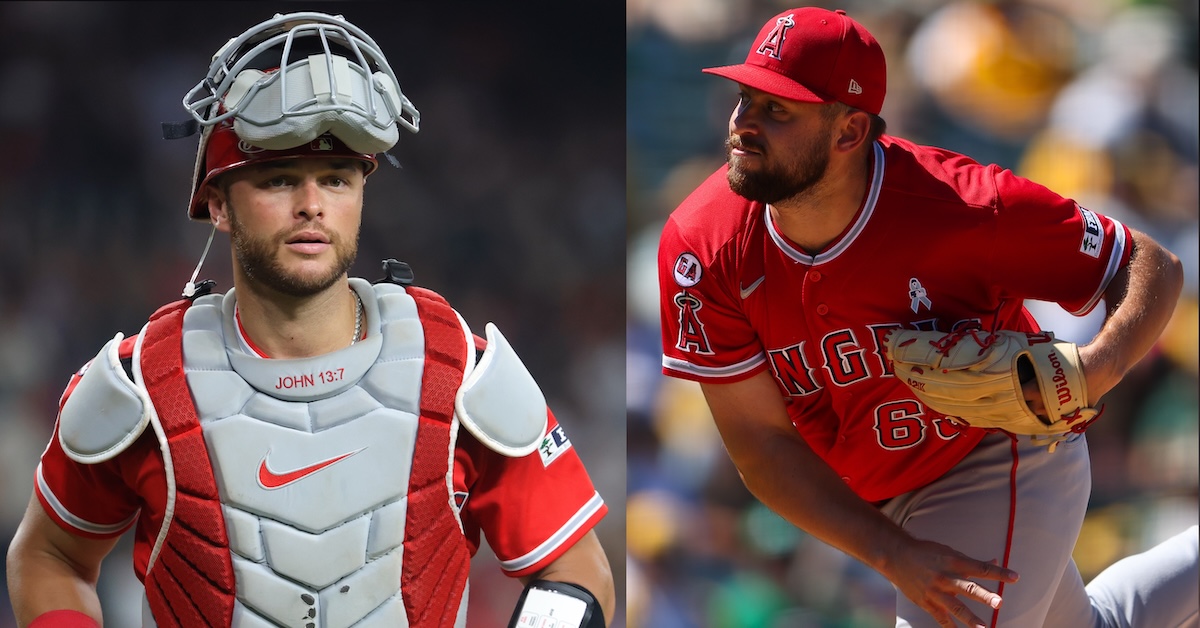
Mark J. Rebilas and Scott Marshall, Imagn Images I came into this week with a ton of trade deadline hype built up in my brain just waiting to spill onto the page the first time I had a deal to analyze. I had some clever turns of phrase, some bon mots (or “annoying puns,” if you’re not into it), and next week, you’ll surely get to hear those. But they’re staying in the proverbial writer’s quiver today, because the trade I’m analyzing is more of a mystery than a blockbuster. The trade in question: the Rangers acquired Logan O’Hoppe and Chase Silseth from the Angels in exchange for Low-A infielder Angel Arredondo, as Jeff Passan first reported. The Rangers have lurched into the AL West lead in recent weeks, turning aside the equally-scuffling A’s and Mariners while trying to hold off the surging (surging to a .500 record, to be fair) Astros. They have one of the worst catching situations in the majors – the 0.2 WAR their catchers have accrued is 27th in baseball. So surely, that’s the play here, I innocently thought as I saw this trade cross the tape. But that was a red herring, the first twist in a deal full of them. O’Hoppe was a catching prospect of some note, a late-round Philadelphia draft pick in 2018 who ascended to Top 100 prospect status and then got swapped straight up for Brandon Marsh in 2022. He hit well enough to cover up some defensive shortcomings in his first few seasons of injury-interrupted work, but then he posted a 72 wRC+ in 2025, dragging his total contributions below replacement level. He’s hitting .209/.271/.295 this year, good for a 59 wRC+, and is below replacement level again. In fact, the Angels have accrued negative WAR at catcher, so they’re hardly where the Rangers should be looking for improvement. And indeed, as I tried to puzzle through how much of an upgrade O’Hoppe would even be, the Rangers rendered my thinking moot: They optioned O’Hoppe to Triple-A. Honestly, that’s probably all you need to hear about him, but I thought I’d connect all the dots just for the sake of thoroughness. The starting catcher pairing in Texas was supposed to be Kyle Higashioka and Danny Jansen, but they’re both on the IL. Elias Díaz, a depth signing from the spring, has stepped into the starter’s role. Austin Wynns, who was actually an Angel earlier this year before getting traded to the Braves for cash considerations, caught on as a backup after Atlanta DFA’ed him. Players like them – veterans on tiny deals who bounce between teams until finding major league playing time – embody the concept of replacement level. But O’Hoppe hasn’t cleared even that bar, so now he’s yet another layer of depth, one that the Rangers probably hope they won’t have to use. My guess is that O’Hoppe was included in this deal for roster considerations and salary reasons, strange as that might sound for a guy making $2.6 million in his first year of arbitration. But realistically, the Rangers aren’t particularly likely to require his services in the major leagues this year, and they don’t seem all that likely to tender him a contract in arbitration. The minimum amount you can offer someone in arb is 80% of their previous year’s salary, and if the Rangers prefer two vets making less than that combined over O’Hoppe now, I can’t imagine them learning enough in two months to turn that around. At his best, O’Hoppe looked like he might be a jack-of-all-trades type — not a star but an everyday player. It’s hard for me to see that coming back; his plate discipline and contact quality have both backslid meaningfully over the past two years, and he was already striking out quite a bit in pursuit of extra-base power. But if he’s going to turn things around, a reset in the minors in a new organization seems like a logical enough way to get started. And given the catcher attrition rate in Texas, he has non-zero value as an emergency option; it doesn’t matter if you’re the fifth-best catcher in your organization if three guys in front of you are out due to injury. You Aren't a FanGraphs Member It looks like you aren't yet a FanGraphs Member (or aren't logged in). We aren't mad, just disappointed. We get it. You want to read this article. But before we let you get back to it, we'd like to point out a few of the good reasons why you should become a Member. 1. Ad Free viewing! We won't bug you with this ad, or any other. 2. Unlimited articles! Non-Members only get to read 10 free articles a month. Members never get cut off. 3. Dark mode and Classic mode! 4. Custom player page dashboards! Choose the player cards you want, in the order you want them. 5. One-click data exports! Export our projections and leaderboards for your personal projects. 6. Remove the photos on the home page! (Honestly, this doesn't sound so great to us, but some people wanted it, and we like to give our Members what they want.) 7. Even more Steamer projections! We have handedness, percentile, and context neutral projections available for Members only. 8. Get FanGraphs Walk-Off, a customized year end review! Find out exactly how you used FanGraphs this year, and how that compares to other Members. Don't be a victim of FOMO. 9. A weekly mailbag column, exclusively for Members. 10. Help support FanGraphs and our entire staff! Our Members provide us with critical resources to improve the site and deliver new features! We hope you'll consider a Membership today, for yourself or as a gift! And we realize this has been an awfully long sales pitch, so we've also removed all the other ads in this article. We didn't want to overdo it. In any case, O’Hoppe might be the biggest name involved in this deal, but he wasn’t the primary target. That’d be Silseth, a righty reliever currently riding a four-pitch mix to his longest sustained big league success. Silseth attacks lefties with a four-seam/splitter combination, and then pairs those two with a classic sinker/sweeper duo against righties. His stuff doesn’t jump off the page, either via pitch models (53 PitchingBot Stuff, 96 Stuff+ Stuff) or the eye test. But he mixes and matches effectively, his delivery seems to add a little deception, and he’s not afraid to work off the plate (or maybe he can’t hit his target — it’s in the eye of the beholder). He walks a ton of guys in pursuit of missing bats, but he’s striking out enough hitters to make the whole package work. Silseth will slot into the mid-leverage rungs of the Texas bullpen, in a mix that currently includes Cole Winn, Tyler Alexander, Robby Ahlstrom, Ben Peoples, and even Marco Gonzales. Silseth’s out of minor league options, but that’s surely fine with Texas; he’s a bullpen upgrade, and two of the four other middle relievers have options remaining. He’s a minor upgrade, but an upgrade nonetheless, and one that came at a fairly low cost, as in addition to taking on the rest of O’Hoppe’s salary, the Rangers sent Arredondo west to complete the deal. Arredondo is an infielder currently in A-ball, which ruined my dream title for this article, “Angel(s) on the Backfields” — if only he were still playing in a complex league. He didn’t rate among our top 38 Rangers prospects this offseason – or among Baseball America’s or MLB Pipeline’s. But Brendan Gawlowski gave me a lengthy overview of him, which I’ll reconstitute into some notes here. Arredondo has a lofted bat path that he uses to pull the ball in the air, but even though he’s hit eight homers this year, it doesn’t look sustainable; his max exit velocity through June was 105 mph, and his EV90 didn’t quite break triple digits. The homers are wall-scrapers for the most part, and in the context of the offensive environment in the minors this year, it’s hard to project those turning into big league-capable pop. Defensively, Brendan has him as a third base/second base utility guy, with decent projection at either. That’s useful, because if he makes the majors, a utility role seems like the most likely way for him to make an impact. Angels interim GM John Mozeliak gassed Arredondo up in a post-trade interview, calling him “probably in the top 10 in prospects [in the Angels system].” Brendan and I had a great discussion about that assertion yesterday. (What were you doing with your Wednesday night?) You can kind of see where Mozeliak is coming from. Arredondo walks at a double-digit clip and lifts the ball to the pull side. Tampa Bay is already drooling just from hearing me say those words. But a player’s walk rate in A-ball is often about just not swinging, and that’s the case here. Combine that with below-average raw power (Brendan put a 30 on it as an approximation), and you better believe that walk rate will plummet when he faces advanced pitching. Another way of looking at it is that Arredondo has a lot of the skills that are correlated with successful minor leaguers, but gets to those skills in a way that makes us skeptical they’ll translate up the ladder. Walking a lot and hitting for power because you swing hard and don’t get fooled is great. Walking a lot because you never swing and hitting for power because you aim for the foul pole? Not quite the same, even if the numbers look the same on the back of a baseball card (or the interface of FanGraphs dot com). I won’t begrudge a GM for saying that his own players are good (though if I were one of the other Angels prospects our team ranked this year, I might be a little miffed). Arredondo is a little bit interesting even if he’s not a can’t-miss, capital-D Dude. Some of the skills that hold prospects back are already covered here. He has a good sense for how to get the ball in the air, and whether his walk rate is because of a great batting eye or great patience, he’s unlikely to tank his career by swinging over sliders in the dirt; he’s running an 18% chase rate right now, for example. If he takes a big step forward physically – much more bat speed and raw power, basically – his approach becomes more sustainable. He’s 19! This is his first full season at A-ball. He’s still very much a mystery box, and that’s a good thing given the state of Angel farm system. But while there’s a lot of surface-level interest in this trade – O’Hoppe was a notable prospect! Arredondo’s first name is Angel! – it’s mostly shuffling deck chairs. The Rangers flipped a lottery ticket prospect for a mid-leverage reliever with no minor league options. They took on around $800,000 in salary commitments to do so, letting Arte Moreno buy a bunch of nice flower arrangements or something. It’s business as usual for small trades at the deadline – after some investigation.
The Curious Incident Of The Angels/Rangers Trade In The Night-Time
Full Article
Original Source
Read the full article at Blogs →KhanList aggregates and links to publicly available news content. We do not host full articles from third-party sources. Always verify important information with original sources.