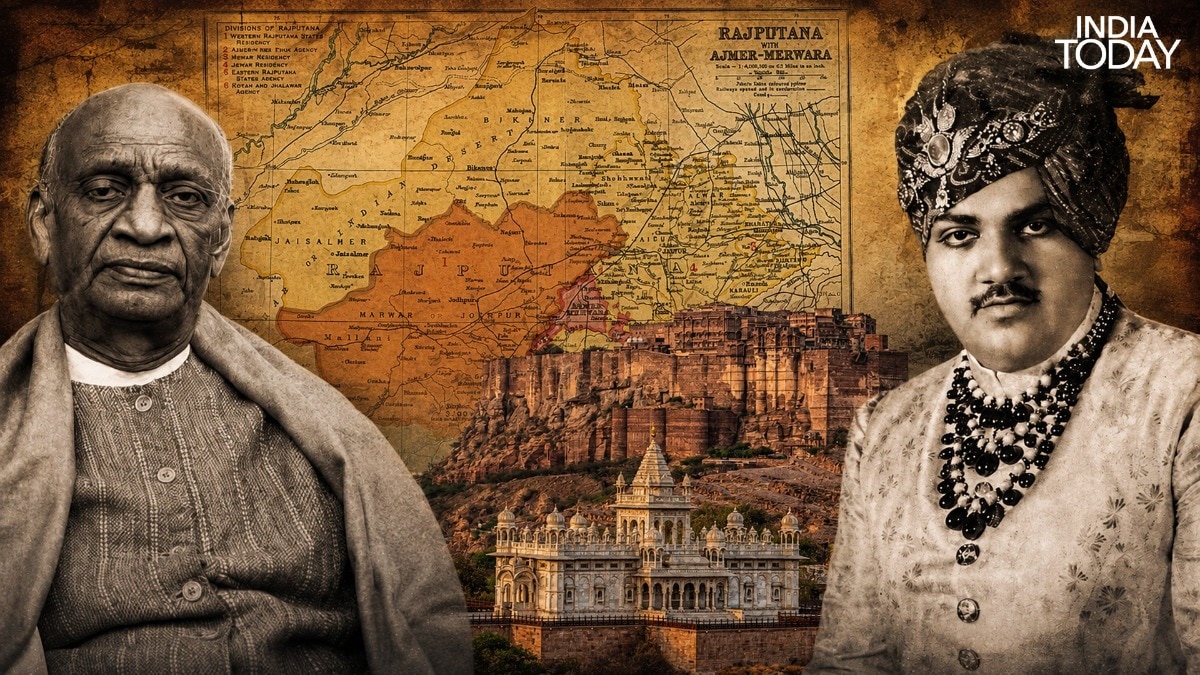
India's 80th Independence Day is near. Winning freedom was the first task; integrating 563 princely states was another. While Jammu and Kashmir and Hyderabad dominate the narrative, Jodhpur's 24-year-old king also bargained with Patel for special privileges but secured little. He later fought the Congress in democratic India, only to die in a plane crash on the day of vote counting in 1952.A 24-year-old king inherited one of the largest princely states in India at the precise moment when the British Empire was preparing to depart.Marwar, known to the outside world as Jodhpur State, was no insignificant principality. Sprawling across more than 93,000 sq km, stretching from the Thar Desert towards the borders of Sindh, it was the 3rd largest princely state in India and among the most strategically important in the west, as were Jammu and Kashmir in the North and Hyderabad in the South.Hanwant Singh came of age at the worst possible moment for a prince when the world of Indian royalty was disappearing before his eyes. The 24-year-old Maharaja of Jodhpur inherited a seven-century-old Rathore legacy just as the British prepared to leave India, forcing him to make a choice that would shape Marwar’s future.Young, ambitious and unusually modern for a prince of his time, Hanwant Singh flew planes, played polo, read widely and took an interest in technology and administration. As author Dhananjay Singh observes in 'The House of Marwar', Jodhpur’s accession was “the most tempestuous of all” the Rajputana accessions. The credit goes to Hanwant Singh, who sat on the Royal throne just 2 months before Jodhpur agreed to sign the instrument of accession.With Patel and VP Menon pushing the princely states towards India and Jinnah offering Jodhpur an alternative, Hanwant Singh found himself bargaining for the best possible future for his people, even as he watched a 7th-century-old royal world slip away. KM Panikkar later recalled in his book An Autobiography, while also serving as the Prime Minister of the Bikaner State, that when Maharaja Hanwant Singh was asked by Mountbatten, the last Viceroy of India, whether he wished to remain independent, accede to Pakistan, or join India, he expressed a preference for independence and joined the queue of kings who wished to go neither with India nor with Pakistan.So what happened between August 2 and 11, in the days before India attained independence that saw the young king meet Jinnah and Patel, place the interests of his subjects at the forefront, and finally use his pen-cum-pistol to sign the Instrument of Accession?THE FUTURE OF THE PRINCELY STATES ON INDEPENDENCE EVEWorld War II had exhausted Britain. The empire that had once seemed eternal was financially crippled and politically weakened. On June 3, 1947, the British announced their intention to transfer power to the interim government headed by Congress, and with that announcement the future of more than 560 princely states was thrown into uncertainty.The lapse of British paramountcy meant that the treaties binding the princely states began in 1818 in Rajputana to the Crown would cease to operate.Theoretically, the rulers had three options: accede to India, accede to Pakistan, or attempt to remain independent. "Jodhpur wanted to put pressure on the Indian government for privileges for his state," writes LS Rathore in 'The Untold story of freedom in Marwar.'KM Panikkar, in his later years, remarked that any account of the last days of princely rule would sound “incredible” to later generations.THE SECRET APPROACH TO JINNAHIn the first week of August 1947, while the subcontinent was on the verge of Partition, a remarkable and more politically influenced drama unfolded.As 'The House of Marwar' observes, it is unlikely that Hanwant Singh ever seriously intended to take Jodhpur into Pakistan. The negotiations were primarily a bargaining strategy designed to force New Delhi to recognise Marwar’s importance.“The tea meeting with Jinnah on 6 August should be seen as part of the strategy unfolding in the Maharaja’s mind on the eve of Independence. The rulers of Bhopal, Jodhpur, and Jaisalmer were expected to meet Jinnah," Singh adds.LS Rathore, in 'Life and Times of Maharaja Hanwant Singh', writes "that the change in the Maharaja’s attitude emerged in the shadow of the reactions of the rulers of Baroda and Bhopal, who had expressed reservations about certain provisions contained in the Instrument of Accession that was to be signed by all the princes. The growing controversy surrounding the role of the Ministry of External Affairs in the Interim Government made Hanwant Singh increasingly sceptical about whether the proposed arrangement would adequately protect the interests of his state and its subjects.”Dhananjay Singh records that the meeting took place shortly after the Maharaja’s first encounter with Jinnah and that it was arranged through Bhopal’s mediation.The scene has become one of the most famous episodes in the history of princely India. Map of Jodhpur princely state in orange, on the eve of Independence. Jinnah, eager to attract the wealthy and strategically placed state of Jodhpur, reportedly offered extraordinarily generous terms.According to accounts preserved in The House of Marwar and corroborated by later historians including Harrison Akins in Conquering the Maharajas, the Maharaja was invited to write his own conditions on a blank sheet of paper bearing Jinnah’s signature.Hanwant Singh’s demands were practical rather than ideological:Assured supplies of grain for famine-stricken Marwar,Free use of the port of KarachiPermission to import arms and ammunitionFavourable railway arrangements linking Jodhpur with Sindh.MOUNTBATTEN, MENON, AND PATELNews of the Jinnah negotiations soon reached the Indian leadership. Around August 8-10, Hanwant Singh was hurried to Delhi for meetings with Lord Mountbatten, Sardar Patel, and VP Menon. Mountbatten appealed personally to the memory of Umaid Singh, reminding the young Maharaja of his father’s long friendship with the British Crown and suggesting that he would have wished Marwar to join India.The Maharaja remained unconvinced.“But what more,” he demanded, producing Jinnah’s proposed concessions, “can India offer me?” notes Singh.Menon responded immediately. India would guarantee grain supplies, facilitate arms imports, and support improved communications with a port in Kutch. In effect, New Delhi matched or exceeded the practical concessions that Pakistan had offered.What happened next entered Rajputana legend.After Mountbatten left the room, Hanwant Singh, still deeply troubled by the implications of accession, turned to Menon holding what appeared to be a fountain pen. To Menon’s astonishment, it concealed a .22 calibre pistol. The Maharaja pointed it towards him and exclaimed: “I will kill you if you betray my people.”The incident, recorded by Dhananjay Singh, captured both the theatricality and the genuine anguish of the young Rathore ruler. Sardar Patel after inaugurating Rajasthan. (Wikimedia Commons) THE SIGNATURE THAT CHANGED MARWAROn August 11, 1947, Maharaja Hanwant Singh signed the Instrument of Accession to the Dominion of India.The agreement limited Indian authority to defence, external affairs, and communications, while Marwar retained internal autonomy for the time being, as was the case with other states.The Maharaja also secured a privy purse of Rs. 17,50,000 annually and 4 fortresses, including Mehrangarh, along with the major forts of Nagaur and Jalore and the fortresses of Siwana and Desuri, which are considered to be the best as of today.Jodhpur’s decision was a major diplomatic victory for Patel and Menon. Had Marwar chosen a different course, the map of western India might have looked very different. Yet accession did not end the Maharaja’s troubles. It merely began a new and, in many ways, more painful struggle.Hanwant Singh believed that Marwar was economically viable, geographically coherent, and culturally distinct enough to remain a separate unit within the Indian Union.When pressure mounted in 1948 for the formation of a united Rajasthan, the Maharaja went on to oppose the plan vigorously. He feared that distant Jaipur and Delhi would dominate, which had turned true as Jaipur became the capital of newly formed Rajasthan in 1949, the new state while the desert districts of Marwar would be neglected.At one stage, New Delhi appears to have taken its resistance seriously enough for military contingencies to be discussed. General JN Chaudhari, who led Operation polo, reportedly asked a Jodhpur lancers officer what he would do if Indian forces were ordered into Marwar.The reply came without hesitation: “I would go back to my regiment to face you.”Ultimately, resistance proved futile. On March 13, 1949, Marwar merged with the other Rajputana states to form the Greater Rajasthan Union, and in May the Matsya Union joined it to create the modern state of Rajasthan. Rathore sovereignty, which had begun with Rao Siha’s migration into Marwar in the 13th century, effectively came to an end after more than 7 centuries. For the first time, the Rathore word had not been the law in Maru.As Dhananjay Singh writes, the Congress claims that the princes had surrendered only their “woes” was certainly not true in Marwar. The word of the Rathore was no longer law; the power that had defined the clan for centuries had vanished almost overnight.Deeply unhappy, Hanwant Singh refused to retreat into ceremonial irrelevance.AGAINST THE CONGRESSIn the summer of 1950, a group of dissatisfied former rulers, stripped of common citizens who they ruled for centuries, gathered in the forests of Nagod in Madhya Pradesh, ostensibly for a tiger shoot. Among them were the Gaekwad of Baroda, the rulers of several former princely states, and the youthful Maharaja of Jodhpur.Hanwant Singh now entered democratic politics with the same energy he had once brought to princely statecraft. He organised an anti-Congress coalition in Marwar, drawing support from Rajput nobles, landed interests, and sections of the rural population who remained deeply attached to the Rathore house.His campaign electrified western Rajasthan. His election symbol was the camel, and his rallying cry, “Main thansu door nahin” (“I am not far from you”), created a personal bond with the people of Marwar that few former princes achieved.The results of the first general elections of 1952 suggested that the Rathore connection with the masses remained remarkably strong.Candidates associated with Hanwant Singh won an overwhelming number of seats in the former Marwar region, while several prominent Congress leaders suffered humiliating defeats.But the Maharaja himself would never see the full consequences of the movement he had inspired.THE TRAGIC ENDOn January 26, 1952, as election counting was underway, Maharaja Hanwant Singh’s aircraft crashed near Godwar. The 29-year-old Rathore died instantly. That night, even as his body was being brought back to Jodhpur, the election results confirmed the scale of his triumph.The anti-Congress forces he had led had swept much of Marwar.Crowds gathered in grief and anger, and for a moment the humiliation of the merger seemed to dissolve in a renewed sense of Rathore solidarity.Hanwant Singh's negotiations with Jinnah demonstrated political audacity; his bargaining with Patel showed strategic intelligence; his opposition to the merger reflected a genuine concern for Marwar’s distinct identity; and his later participation in electoral politics revealed an unusual willingness to seek legitimacy from the people rather than from imperial treaties.In the end, Jodhpur did join India, and history has judged that decision wise. Yet the manner of that accession mattered enormously. It was achieved not through passive acquiescence but through one of the most dramatic negotiations of 1947.As 'The House of Marwar' concludes, Hanwant Singh’s accession may have involved submission to historical necessity, “but it was not an ordinary one, not humiliating.”It revealed a ruler who fought, bargained, threatened, compromised, and finally accepted the birth of a united India without abandoning his duty to Marwar.- EndsPublished By: Rishab ChauhanPublished On: Aug 12, 2026 13:06 IST
The curious case of Jodhpur: When India almost lost a Princely state to Jinnah
Full Article
Original Source
Read the full article at Indiatoday →KhanList aggregates and links to publicly available news content. We do not host full articles from third-party sources. Always verify important information with original sources.