
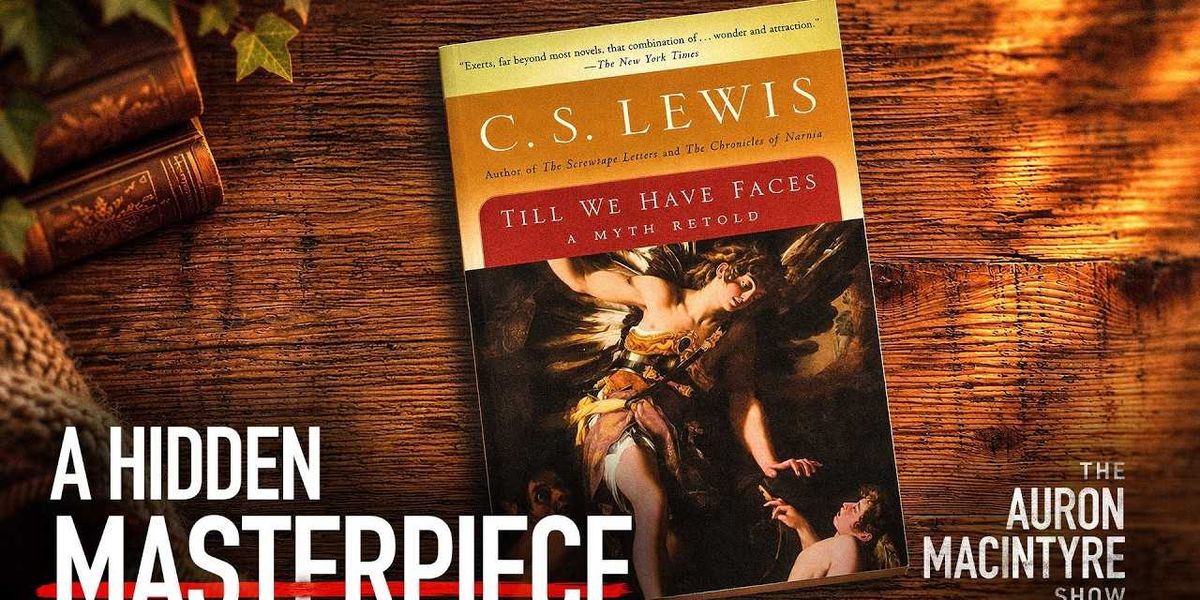
With the exception of his children’s series “The Chronicles of Narnia,” C.S. Lewis is best remembered for his nonfiction works of Christian thought, especially “Mere Christianity,” “The Screwtape Letters,” and “The Problem of Pain.” But BlazeTV host Auron MacIntyre believes the world-renowned apologist was also a master of the novel.On this episode of “The Auron MacIntyre Show,” he is joined by British commentator and C.S. Lewis enthusiast Nick Dixon to dive into what they believe is Lewis’ “most underrated masterpiece”: “Till We Have Faces.” The novel, which is a retelling of the Greek myth of Cupid and Psyche, has sometimes been called Lewis’ “most pagan book,” but MacIntyre and Dixon contend the opposite, arguing the story mirrors Lewis’ own conversion.“Lewis, you know, thought about writing this book originally as an atheist and siding with kind of the screed against the gods — you know, the logic, the reason how you're a victim,” MacIntyre explains.He argues that by the time Lewis finally wrote it, late in life and long after his own conversion, he had come to see himself as “the author of [his] own woes” — and the novel reflects that.In the novel, Orual and her beloved younger half-sister, Psyche, are raised by the Fox, a Greek tutor who scoffs at the gods and champions pure reason. When Psyche is offered as a sacrifice to a mountain god and claims to be living happily in his invisible palace, Orual, unable to see it, refuses to believe her and destroys her sister’s happiness.Orual evolves from a woman raging at the gods over her own “victimhood” to recognizing that she was actually “the victimizer” all along, MacIntyre says.“I think this is one of his most Christian books, because even though he's telling this pagan myth ... this kind of repentance, this touch of the divine is something that is so analogous to his own kind of experience in life when encountering and converting to Christianity,” he adds.“It redeems the character [Orual] in a way that I don't think you'd see in a Greek myth, right?” he continues. “Like I don't think you'd see this kind of repentance and understanding and coming to reconciliation with the gods.”Dixon agrees. Even though in the book “Christ isn't named as such … it's clear that it is a Christian conversion story,” he says.Calling himself “obsessed with these biographical readings” of “Till We Have Faces,” Dixon retells the story of Sept. 19, 1931 — the night J.R.R. Tolkien convinced Lewis that “Christianity is the one true myth,” a turning point that soon ended his years-long journey from atheism to Christianity.“I think that's kind of mirrored by the end of this book — the way that they've been messing around with paganism until there's this synthesis at the end, and the Fox realizes he was wrong, and Orual realizes she's been wrong, and Psyche, I suppose, has been vindicated really as the kind of Christlike figure,” he says.To hear the full conversation, watch the episode above.Want more from Auron MacIntyre?To enjoy more of this YouTuber and recovering journalist's commentary on culture and politics, subscribe to BlazeTV — the largest multi-platform network of voices who love America, defend the Constitution, and live the American dream.
The CS Lewis masterpiece almost nobody reads — and why it’s his most Christian novel
Full Article
Original Source
Read the full article at Theblaze →KhanList aggregates and links to publicly available news content. We do not host full articles from third-party sources. Always verify important information with original sources.