
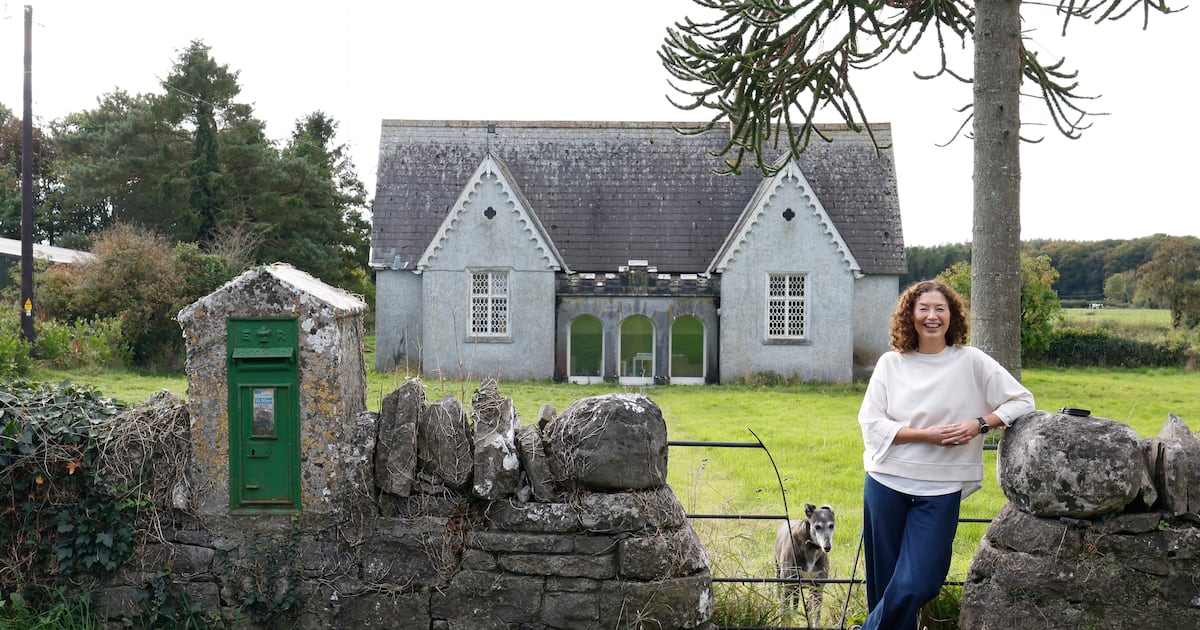
It was the lilac tree that did it. Although the massive monkey puzzle at the front of the house is the showstopper, the lilac was in full bloom that June, heavy blossoms fragrant with almond and vanilla, as we pushed open the creaking wooden gate to reach the back door. It was 2024, and after 20 years of living in an apartment overlooking the river in Chapelizod, Dublin 20, we had decided to move out of the city. My husband is a documentary maker and, after decades as a lawyer, I now write full time, so we could pretty much live anywhere. Although we’d decided an hour and a half outside Dublin was our limit, we added 15 minutes on to that once we saw the Old Schoolhouse at Sopwell, Co Tipperary. It was immediately familiar to me. I grew up in a Victorian schoolhouse in Ballyfin, Co Laois, that my parents bought in the 1970s after three years teaching in Zambia. Unfortunately, the familiarity was in the “before” pictures that I’d seen: the missing floorboards, the crumbling masonry, the rotten timbers in the eaves glimpsed through holes in the ceiling. Ballyfin was derelict too, when my parents happened upon it. But then there were the windows. Those beautiful cast-iron frames with the tiny panes, so similar to the house in which I grew up (although before even setting eyes on Sopwell, my father, a historian, guessed they would be diamond-shaped instead of rectangular, because of the date it was built).READ MORELight shines through the cast iron windows. Photograph: Nick Bradshaw/The Irish Times Sopwell Schoolhouse is a protected structure. Built in 1826 by the Earl of Charleville and Francis Trench of Sopwell Hall – metal flags flying above the front gables are punched with the letter T – we imagine it must be one of the oldest in the country. It served as a national school and teacher’s residence until the early 1960s. Our neighbours have told us that it was last inhabited by Flora Browne, a retired dairymaid from the nearby all, who lived until she was 99. We’re told that she rarely went into the classroom, although at one point, kept bales of hay in there. The house had been unoccupied for decades. But as I walked through it alone, into every room, crossing the huge classroom (built to accommodate 100 pupils) and climbing the steep, narrow, staircase, I felt calm. Despite the peeling paint, it felt like a peaceful place and I remembered my parents describing how my grandmother had said something similar about Ballyfin. Carter stands by the post box in front of her home. Photograph: Nick Bradshaw/The Irish Times The day the lilac was in bloom, we’d brought our architect and friend, Peter Carroll of A2 Architects to see it. He was enthusiastic. The dramatic limestone pillared porch with the triple arches, in particular, caught his eye. At the time, the two parts of the house, the school and residence, weren’t connected, so we imagined the schoolmaster emerging from his front door in the morning, facing into the elements as he crossed the tiled cloister to go to work in the school on the other side. And then the conundrum. We could afford to buy the house, but could we afford to restore it? As freelancers, our income is precarious. Two things made it possible: the generosity of both families, in providing us with somewhere to live during the time it took to do the work, and the Vacant Property Refurbishment Grant (with derelict top up, which brings the total grant up to €70,000) from Tipperary County Council, without which we wouldn’t have been able to raise the finance to pay for it. Once we had planning permission, Peter introduced us to Tom McCarthy of Roman Construction Ltd and work began in late summer 2025. The previous owners had obtained permission for an extensive renovation. Our plans were simpler. We wanted to work within the footprint of the house, to convert what was already there into a home for two people and a dog. But as always happens with a project like this, there are unforeseen costs, the money goes into what you cannot see, and cuts need to be made.The first thing we did was remove a poor extension at the back. Plumbing, heating, electrical installation and a new septic tank came next. But the septic tank required expensive rock breaking equipment. No sooner had the scaffolding been erected to repair the roof than the heavens opened, and it didn’t stop raining for 10 weeks, causing work to cease and water to leak into the classroom. The glazed-in cloister area. Photograph: Nick Bradshaw/The Irish Times Kitchen and dining area. Photograph: Nick Bradshaw/The Irish Times Sixty-thousand bees in the eaves required the summoning of a beekeeper, who gently persuaded them to move house. The floorboards that we’d minded carefully for six months, so they could go back into the schoolroom, turned out to be riddled with woodworm. But there were joys too. Peter’s idea to glaze the cloister, connecting the two parts of the house, while allowing it to look unchanged from the front has created a stunning new space. We’ve kept the two heavy front doors. The floorboards upstairs were saved. We’ve left the old electrical fittings on the walls, along with a wooden board with the numbers one to 10 and the rusty steel grips and flue from the teacher’s stove. The stone plinth on which it sat has been moved to accommodate our stove – when we can afford one! The numbered board. Photograph: Nick Bradshaw/The Irish Times The past exists alongside the present here; that layering of lives you only get in an old house. Copies of the Irish Independent from June 1938 were used to line the ceilings (118 years after the house was built) and they show portentous headlines about the leaking of secrets and the British secretary for war. Then, in August 2026, we moved in – exactly 200 years after the house was built.As a writer, the first thing I needed was a place to work. I have a new book to write. So, I commandeered the old cloakroom, lines of coat hooks still on the walls. I scraped, filled, sanded, primed and painted, then put in some bookshelves and a desk. It’s where I’m typing this. Carter's writing space in the property. Photograph: Nick Bradshaw/The Irish Times It hits me sometimes that the room in which we spend most of our time – the classroom – was abandoned for 65 years, while it now serves as our kitchen, dining and livingroom. My parents chose a different route for their “big room”. It was the party room, with a drinks cabinet, a record player and fires lit at either end. But then they restored Ballyfin in their 20s, while we’re in our 50s, so maybe that explains that! My parents came to visit Sopwell when we moved in. It was emotional. By that time, my dad’s Parkinson’s had become severe and I was afraid he wouldn’t get to see it. But, with my brother’s help they came, reminiscing about Dad carrying concrete blocks in the boot of his mini and laughing while my brother and I did a Harry Enfield/Paul Whitehouse style measuring of our classroom to see which one was bigger (ours is wider, theirs is longer and our ceiling is higher).We still have so much to do. We’d planned to restore the beautiful stone sheds at the rear, but they will have to wait, along with some work on the chimney and the roof. The original tiles are yet to go back into the cloister. Much of the painting is still to be done. And the bees are back!Living area. Photograph: Nick Bradshaw/The Irish Times Bedroom with en suite. Photograph: Nick Bradshaw/The Irish Times But our experience has been hugely positive, thanks to our architects Peter Carroll and David Cooney, and our contractor Tom McCarthy, all highly experienced in conservation work.Differences of opinion were good humoured. We’re still at odds over a duct protruding from one of the sheds, which Peter has christened Nellie the Elephant. We’ve grown quite fond of Nellie, although Peter is insistent on her eviction. The goodwill we’ve experienced from neighbours has been immense. People have called to the door to welcome us, or simply because they’re curious to see what we’ve done with the house. One of the property's bedrooms. Photograph: Nick Bradshaw/The Irish Times We’ve had gifts of tomatoes, biscuits, a cake, chilli peppers. Books. Guttering. Subsoil. Loans of a strimmer and lawnmower. Even the estate agent gave us a bottle of wine.One neighbour said it gave him a lift to see lights on in the house for the first time in decades. I hope we’ve done a good thing in bringing a much-loved local landmark back to life. For us, it’s a privilege to be allowed to live in it. I was cleaning the windows the other day, scrubbing at the tiny panes, when I had a sudden flashback to my childhood. As kids we were given pocket money to clean the windows in Ballyfin. I texted my siblings a picture, and my brother responded with, “Pay yourself 50p”.Andrea Carter is author of the Inishowen mystery books. Her latest novel is There Came A-Tapping.
The crime writer renovating a derelict Tipperary schoolhouse: Rotting timbers, crumbling masonry but I felt calm
Full Article
Original Source
Read the full article at Irishtimes →KhanList aggregates and links to publicly available news content. We do not host full articles from third-party sources. Always verify important information with original sources.